Magnetoresistive random access memory
a random access memory and magnetism technology, applied in the field of magnetism random access memory, can solve the problems of increasing the possibility of occurrence of a write error (read disturbance) in a memory cell, reducing the read speed, and reducing the ability of spin-transfer-torque-write mram to replace a dram, so as to achieve the effect of suppressing a write error
- Summary
- Abstract
- Description
- Claims
- Application Information
AI Technical Summary
Benefits of technology
Problems solved by technology
Method used
Image

Examples
first embodiment
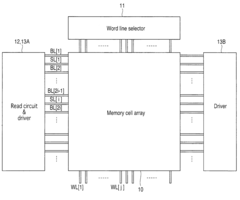
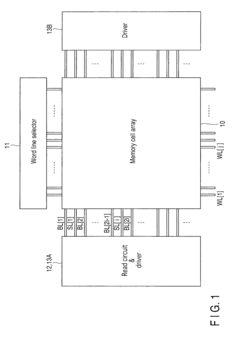
[0021]Embodiments of the present invention will be explained below with reference to the accompanying drawing. FIG. 1 shows the main parts of a spin-transfer-torque-write magnetoresistive random access memory (MRAM) according to the first embodiment of the present invention.
[0022]A memory cell array 10 is formed by arranging electrically programmable nonvolatile memory cells in a matrix. A plurality of word lines WL running in the first direction are connected to a word line selector 11. A plurality of bit lines BL running in the second direction are connected to a read circuit 12 and drivers 13A and 13B. A plurality of source lines SL are also connected to the drivers 13A and 13B. The read circuit 12 is placed at one end of each of the plurality of bit lines BL running in the second direction. The drivers 13A and 13B are arranged at the two ends of each of the plurality of bit lines BL and the plurality of source lines SL running in the second direction.
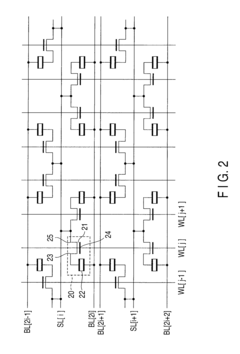
[0023]FIGS. 2 to 5 illustrat...
second embodiment
[0032]FIGS. 7 and 8 illustrate the arrangement and read method of a tunnel magnetoresistive element 22 of a spin-transfer-torque-write MRAM according to the second embodiment of the present invention. The arrangements of the main components of the second embodiment are the same as those of the first embodiment shown in FIGS. 1 to 4.
[0033]As shown in FIG. 7, the difference from the first embodiment is that a magnetization direction 58 in a fixed layer 50 of the tunnel magnetoresistive element 22 is fixed not in the direction from a drain diffusion layer 42 to a bit line BL[2i], but in the opposite direction, i.e., the direction from the bit line BL[2i] to the drain diffusion layer 42. Accordingly, the direction of SST 53 is also opposite to that in the first embodiment, i.e., the SST 53 is generated in the direction from a free layer 51 to the fixed layer 50. Therefore, a magnetic field HBL 54 is generated in the tunnel magnetoresistive element 22 in a direction to suppress the STT 5...
third embodiment
[0036]FIGS. 6 and 9 illustrate the arrangement and read method of a tunnel magnetoresistive element 22 of a spin-transfer-torque-write MRAM according to the third embodiment of the present invention. The arrangements of the major parts of the third embodiment are the same as those of the first embodiment shown in FIGS. 1 to 3.
[0037]As shown in FIG. 9, the difference from the first embodiment is that in the tunnel magnetoresistive element 22, a fixed layer 60, insulating layer 62, and free layer 61 are arranged between a drain diffusion layer 42 and bit line BL[2i] in the order named from the side of the bit line BL[2i]. This arrangement order is opposite to that of the first embodiment. In addition, a magnetization direction 68 in the fixed layer 60 is fixed in the direction from the bit line BL[2i] to the drain diffusion layer 42. During a read operation, STT 63 is generated in the same direction as that of the first embodiment, i.e., in the direction from the free layer 61 to the ...
PUM
 Login to View More
 Abstract
Description
Claims
Application Information
 Login to View More
 - R&D
- Intellectual Property
- Life Sciences
- Materials
- Tech Scout
- Unparalleled Data Quality
- Higher Quality Content
- 60% Fewer Hallucinations
Browse by: Latest US Patents, China's latest patents, Technical Efficacy Thesaurus, Application Domain, Technology Topic, Popular Technical Reports.
© 2025 PatSnap. All rights reserved.Legal|Privacy policy|Modern Slavery Act Transparency Statement|Sitemap|About US| Contact US: help@patsnap.com