Check patentability & draft patents in minutes with Patsnap Eureka AI!

Method for manufacturing pneumatic tire

a manufacturing method and tire technology, applied in the field of pneumatic tire manufacturing, can solve the problems of noise generation, vibration of the tread portion of the tire, and interference of the operation of the sound-absorbing member with the mounting of the tire on the rim, and achieve the effect of convenient operation of mounting the sound-absorbing member, favorable sound-absorbing effect, and easy and firmly fixing the sound-absorbing member

Inactive Publication Date: 2009-12-17
YOKOHAMA RUBBER CO LTD
View PDF21 Cites 19 Cited by
  • Summary
  • Abstract
  • Description
  • Claims
  • Application Information

AI Technical Summary

Benefits of technology

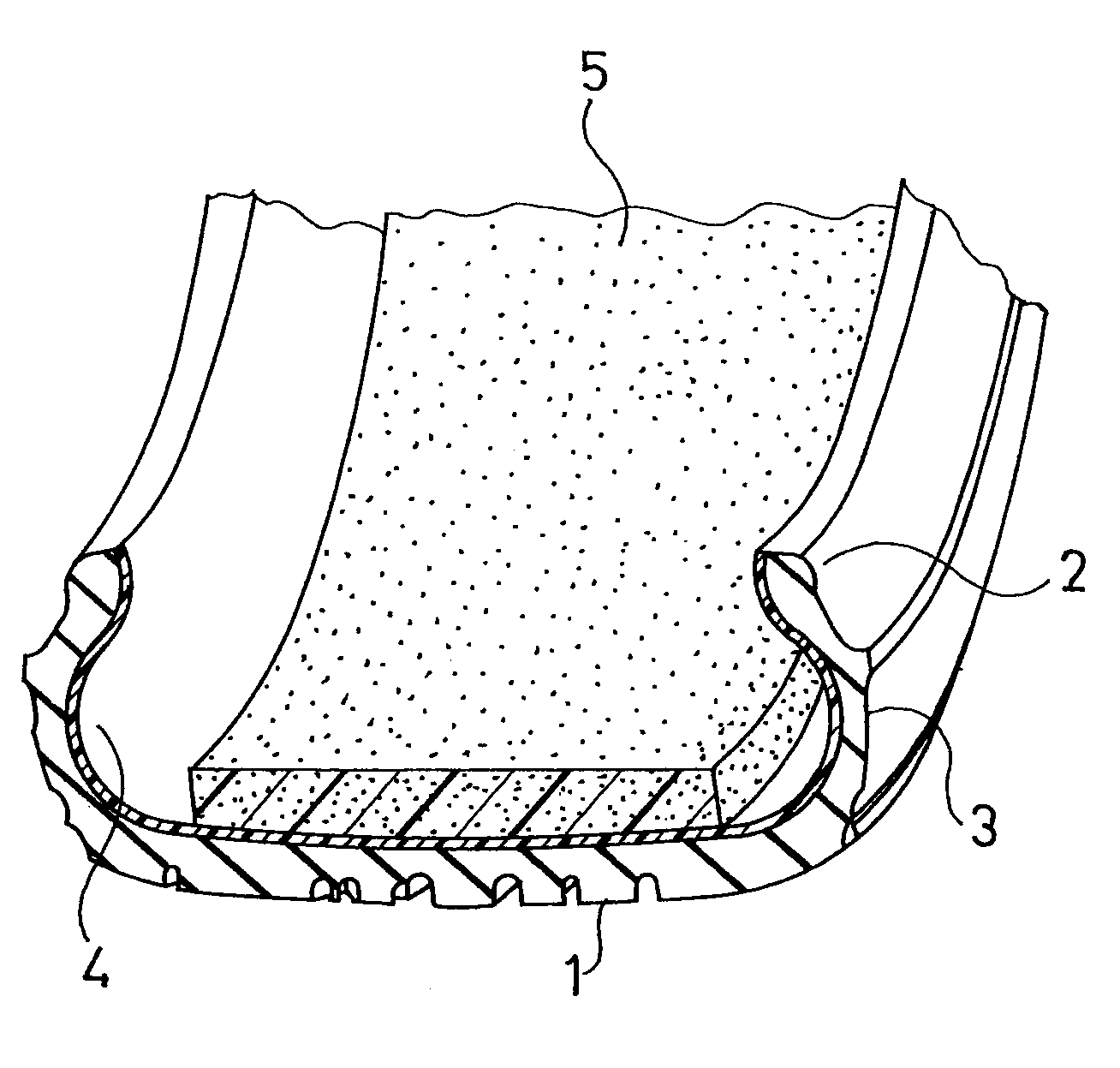
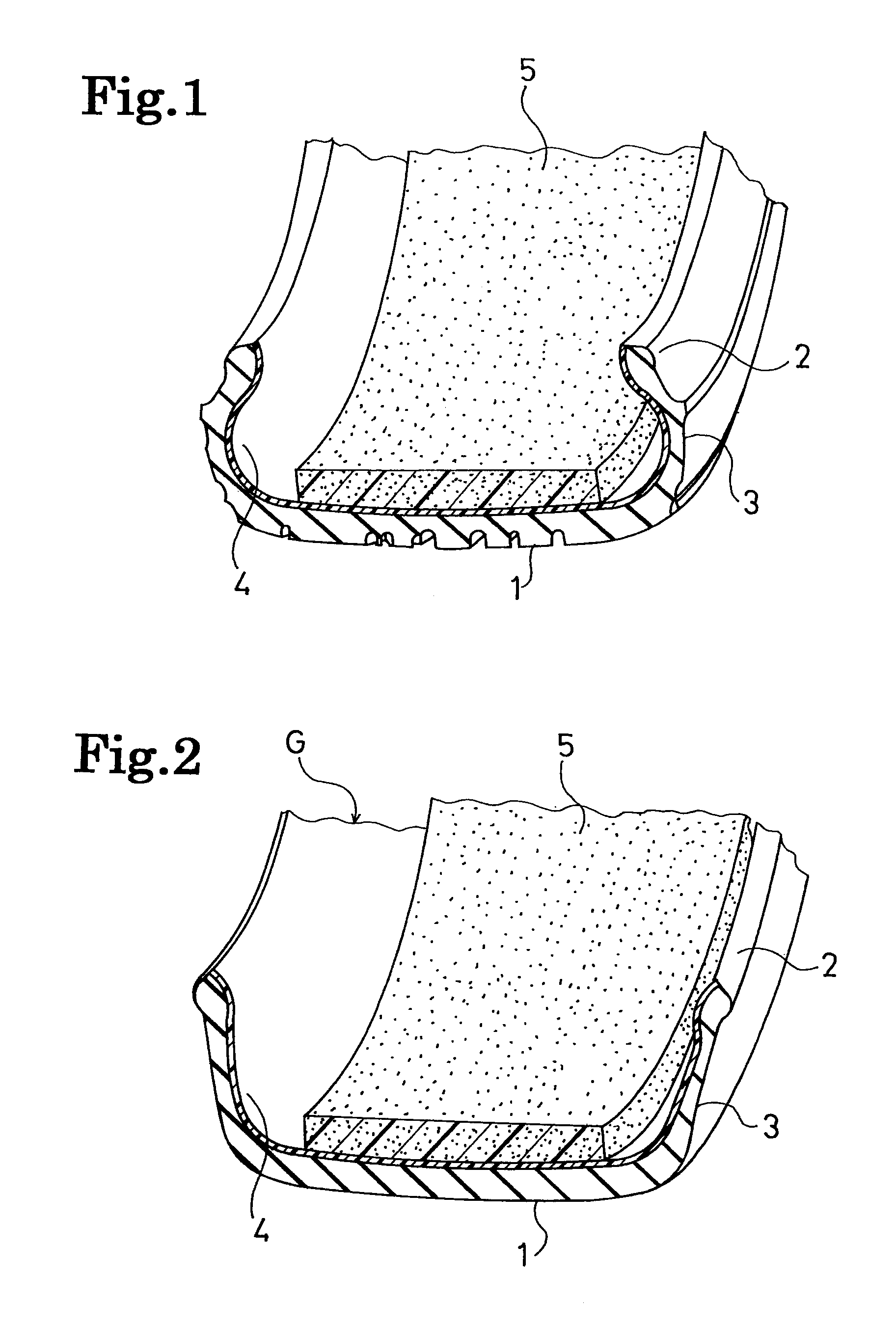
[0004]An object of the present invention is to provide a method for manufacturing a pneumatic tire, the method enabling a sound-absorbing member to be easily mounted on the tire with an improved fixation of the sound-absorbing member onto an inner surface of the tire.
[0006]According to the present invention, the sound-absorbing member made of a porous material is fixed onto the inner liner layer containing a thermoplastic resin as the matrix in the formation of the green tire, and thereafter, the green tire is cured. Accordingly, it is possible to firmly fix the inner liner layer and the sound-absorbing member to each other with no presence of a release agent therebetween. Moreover, since there is no need to remove a release agent from the inner surface of the tire unlike the case where a sound-absorbing member is attached to an inner surface of a tire after a curing process, the operation of mounting the sound-absorbing member is facilitated.
[0007]In the present invention, the green tire is preferably cured by a bladderless curing system. Employing the bladderless curing system makes it possible to prevent the sound-absorbing member disposed on the inner surface of the green tire from collapsing in the curing process.
[0008]As the porous material of the sound-absorbing member, it is preferable to use a urethane foam having open cells therein. In particular, a ratio of a tear strength (N / cm2) to an apparent density (kg / m3) of the urethane foam is preferably 0.15 or more. The urethane foam having such properties is effective as the sound-absorbing member disposed on the inner surface of the tire. In addition, the sound-absorbing member is preferably disposed on the inner surface of the tire in a region corresponding to a tread portion in such a manner as to extend over an entire circumference of the tire. This makes it possible to achieve a favorable sound-absorbing effect.
[0009]The sound-absorbing member is preferably fixed onto the inner liner layer by a flame lamination process. According to the flame lamination process, it is possible to easily and firmly fix the sound-absorbing member onto the inner liner layer, and thus to improve the durability of the sound-absorbing member. Alternatively, the sound-absorbing member may be fixed onto the inner liner layer with an adhesive agent.
[0010]It is preferable that, in the step of forming the green tire, the inner liner layer is first formed by winding an inner liner member on an outer peripheral side of a making drum, the inner liner member having the sound-absorbing member previously fixed thereto; a carcass layer is then formed by winding a carcass member on an outer peripheral side of the inner liner layer; and thereafter, a cylindrical intermediate formed body including the inner liner layer and the carcass layer is inflated, so that the green tire is formed. Specifically, using the inner liner member having the sound-absorbing member previously fixed thereto significantly facilitates the operation of mounting the sound-absorbing member. In this case, however, the sound-absorbing member is required to have an elongation property larger than a lift rate of the carcass layer.

Problems solved by technology

In pneumatic tires, one of the causes of noise generated is a cavity resonance sound, which is caused by vibration of air filled inside the tire.
When a tire is rotating on a road surface, a tread portion of the tire vibrates due to unevenness of the road surface.
In this approach, if the sound-absorbing member is attached to an outer peripheral surface of the rim of the wheel, the sound-absorbing member interferes with the operation of mounting the tire on the rim.
By contrast, if the sound-absorbing member is attached onto an inner surface of the tire (see, for example, Japanese patent application Kokai publication Nos. 2003-63208 and 2003-48407), a problem is the durability.
Specifically, when a sound-absorbing member made of a porous material such as a urethane foam is fixed onto an inner surface of a tire by using a rubber-based adhesive agent or an adhesive tape, the sound-absorbing member is sometimes detached from the inner surface of the tire because of lack of adhesion.
In particular, since a release agent at a curing process remains on the inner surface of the tire, the presence of the release agent possibly causes deterioration of fixation of the sound-absorbing member.
Meanwhile, if the sound-absorbing member is fixed after the release agent remaining on the inner surface of the tire is removed, the operation of mounting the sound-absorbing member becomes very complicated though the fixation of the sound-absorbing member is improved.

Method used

the structure of the environmentally friendly knitted fabric provided by the present invention; figure 2 Flow chart of the yarn wrapping machine for environmentally friendly knitted fabrics and storage devices; image 3 Is the parameter map of the yarn covering machine
View more

Image

Smart Image Click on the blue labels to locate them in the text.
Viewing Examples
Smart Image
  • Method for manufacturing pneumatic tire
  • Method for manufacturing pneumatic tire

Examples

Experimental program
Comparison scheme
Effect test

examples

[0034]Pneumatic tires were manufactured by various different manufacturing methods (Examples 1 and 2 as well as Comparative Examples 1 to 3). Each of the pneumatic tires had a tire size of 215 / 60R16 95H, and included a sound-absorbing member made of a urethane foam and fixed to an inner liner layer in an inner surface of the tire. Note that, although the lift rate of the carcass layer in the process of manufacturing the above-described pneumatic tires was 140%, the urethane foam used was one having an elongation of 160%.

[0035]The pneumatic tire of Example 1 was manufactured as follows. An inner liner layer made of a thermoplastic elastomer composition obtained by dispersing an elastomer (brominated isobutylene isoprene rubber) in a thermoplastic resin (nylon 6, 66) was employed. A green tire was formed in which a sound-absorbing member made of a flexible urethane foam was fixed onto the inner liner layer by a flame lamination process. Thereafter, the green tire was cured.

[0036]The p...

the structure of the environmentally friendly knitted fabric provided by the present invention; figure 2 Flow chart of the yarn wrapping machine for environmentally friendly knitted fabrics and storage devices; image 3 Is the parameter map of the yarn covering machine
Login to View More

PUM

No PUM Login to View More

Abstract

The present invention provides a method for manufacturing a pneumatic tire, the method enabling a sound-absorbing member to be easily mounted on the tire with an improved fixation of the sound-absorbing member onto an inner surface of the tire. The method for manufacturing a pneumatic tire of the present invention includes the steps of: forming a green tire including an inner liner layer and a sound-absorbing member, the inner liner layer disposed in an inner surface of the tire and made of any one of a thermoplastic resin and a thermoplastic elastomer composition obtained by dispersing an elastomer in a thermoplastic resin, the sound-absorbing member fixed onto the inner liner layer and made of a porous material; and thereafter curing the green tire.

Description

BACKGROUND OF THE INVENTION[0001]The present invention relates to a method for manufacturing a pneumatic tire including a sound-absorbing member made of a porous material on an inner surface of the tire. More specifically, the present invention relates to a method for manufacturing a pneumatic tire, the method enabling a sound-absorbing member to be easily mounted on the tire with an improved fixation of the sound-absorbing member onto an inner surface of the tire.[0002]In pneumatic tires, one of the causes of noise generated is a cavity resonance sound, which is caused by vibration of air filled inside the tire. When a tire is rotating on a road surface, a tread portion of the tire vibrates due to unevenness of the road surface. The vibration of the tread portion then vibrates air inside the tire, so that the cavity resonance sound is generated.[0003]One of the approaches proposed for reducing noise due to such a cavity resonance phenomenon is to dispose a sound-absorbing member in...

Claims

the structure of the environmentally friendly knitted fabric provided by the present invention; figure 2 Flow chart of the yarn wrapping machine for environmentally friendly knitted fabrics and storage devices; image 3 Is the parameter map of the yarn covering machine
Login to View More

Application Information

Patent Timeline
no application Login to View More
IPC IPC(8): B29D30/24
CPCB29D30/00B29D30/16B60C19/002B29D2030/0682B29D30/30
Inventor KURAMORI, AKIRA
Owner YOKOHAMA RUBBER CO LTD
Features
  • R&D
  • Intellectual Property
  • Life Sciences
  • Materials
  • Tech Scout
Why Patsnap Eureka
  • Unparalleled Data Quality
  • Higher Quality Content
  • 60% Fewer Hallucinations
Social media
Patsnap Eureka Blog
Learn More