
Two-paste type dental self-adhesive resin cement
- Summary
- Abstract
- Description
- Claims
- Application Information
AI Technical Summary
Benefits of technology
Problems solved by technology
Method used
Image

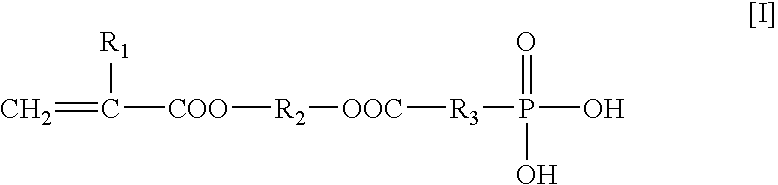
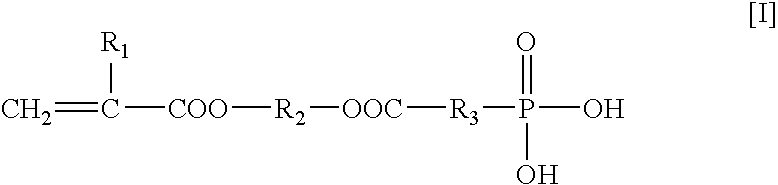
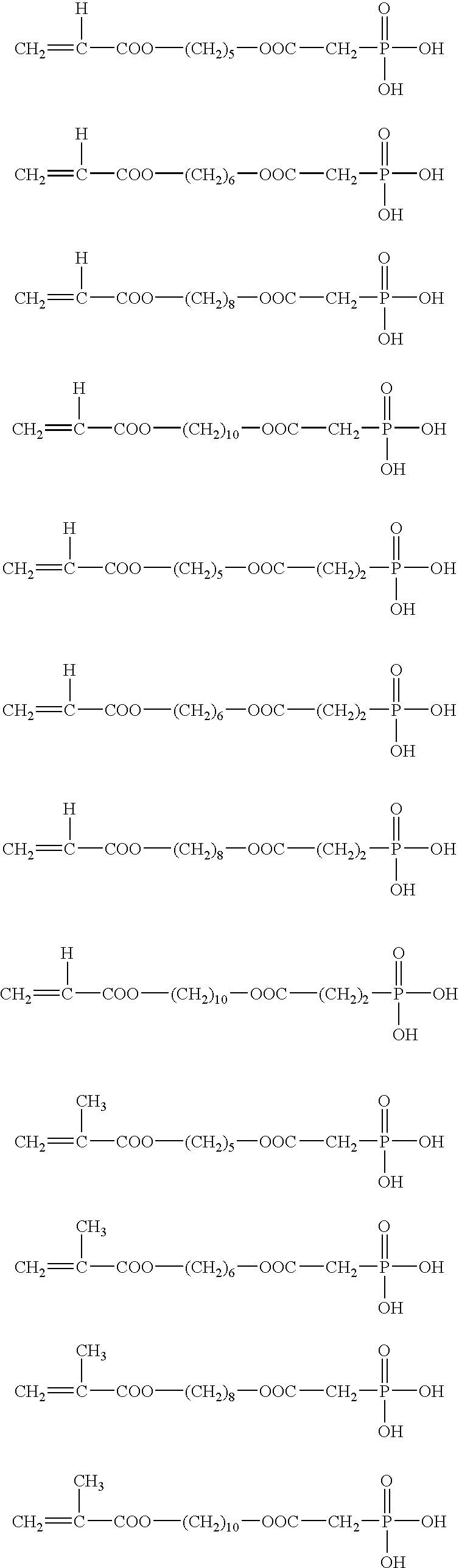
Examples
preparation example 1
Preparation of sodium 5-n-butylbarbiturate
[0135]Into a 100 mL Erlenmeyer flask, was added 25 g of distilled water, and 3.11 g of anhydrous sodium carbonate (29.34 mmol) was added with stirring. It was dissolved in a water bath at 30° C. to obtain an aqueous Na2CO3 solution.
[0136]Separately, 20 g of distilled water was weighted into a 200 mL beaker, and 10.82 g (58.74 mmol) of 5-n-butylbarbituric acid (BBA) was added to disperse homogeneously to obtain a BBA suspension.
[0137]The aqueous Na2CO3 solution was added slowly to the BBA suspension, and the mixture was allowed to react for 1 hour in a water bath at 30° C. with stirring. Thereafter, the mixture was concentrated to about 40 g in a water bath at 40-50° C. by an evaporator at 70 cm Hg. About 200 mL of acetone was added to the residue to crystallize it, and solid-liquid separation was conducted by suction filtration. The white crystal obtained was adequately washed with acetone to remove un-reacted BBA, and a remaining crystal wa...
preparation example 2
Preparation of sodium 1-benzyl-5-phenylbarbiturate
[0139]Into a 100 mL Erlenmeyer flask, was added 25 g of distilled water, and 3.11 g of anhydrous sodium carbonate (29.34 mmol) was added with stirring. It was dissolved in a water bath at 30° C. to obtain an aqueous Na2CO3 solution.
[0140]Separately, 40 g of distilled water and 6 g of acetone were added to a 200 mL beaker, and 17.29 g of 1-benzyl-5-phenylbarbituric acid (BPBA)(58.74 mmol) was added thereto and the mixture was dispersed homogeneously to obtain an aqueous BPBA / acetone solution.
[0141]The aqueous Na2CO3 solution was added slowly to the aqueous BPBA / acetone solution, and the mixture was allowed to react for 1 hour in a water bath at about 30° C. with stirring. Thereafter, the mixture was concentrated to about 40 g in a water bath at 40-50° C. by an evaporator at 70 cmHg. About 200 mL of acetone was added to the residue to crystallize it, and solid-liquid separation was conducted by suction filtration. The white crystal obt...
example 1
Influences of Composition of Resin Cements on Properties Thereof (1)
[0144](1) Preparation of Resin Cements
[0145]Two-paste type resin cements 1-5 consisting of first and second pastes were prepared on a basis of a composition of Table 2. In this Example, a total amount of components in each of the first and second pastes other than the component (f), a shelf life stabilizer, was made to be 50 parts by weight based on a total amount of the resin cement composition, and a proper amount of the component (f) was added to each of the pastes.
TABLE 2Composition of resin cements (parts by weight)PasteComponent12345First(a)UDMA10.210.210.210.210.2paste3G4.64.64.64.64.6(d)FASG33.833.833.833.833.8fillerR-7111.11.11.11.11.1(e)-(1)BBA•Na0.20.20.20.20.2DEPT0.10.10.10.10.1(f)BHT0.010.010.010.010.01Second(a)Bis-GMA8.88.88.88.88.8paste3G3.73.73.73.73.72-HEMA2.42.42.42.42.4(b)2-MEP—2.41.2—1.2(c)4-AET2.4—1.2——4-MET———2.41.2(d)FASG31.031.031.031.031.0fillerR-7111.51.51.51.51.5(e)-(2)BPO0.10.10.10.10.1CQ...
PUM
| Property | Measurement | Unit |
|---|---|---|
| Percent by mass | aaaaa | aaaaa |
| Percent by mass | aaaaa | aaaaa |
| Percent by mass | aaaaa | aaaaa |
Abstract
Description
Claims
Application Information
 Login to View More