
Beta-peptide lyotropic liquid crystals and methods of manufacture and use thereof
a technology of lyotropic liquid crystals and beta-peptides, applied in the field of liquid crystal technology, can solve the problems of difficult systematic evaluation of factors that modulate lc behavior, difficult to rationally and incrementally modify the structure of mesogen, and limited design of new lyotropic liquid crystals. , to achieve the effect of increasing birefringen
- Summary
- Abstract
- Description
- Claims
- Application Information
AI Technical Summary
Benefits of technology
Problems solved by technology
Method used
Image

Examples
example 1
Globally Amphiphilic Beta-peptide Lyotropic Liquid Crystals
[0055]The inventors prepared homologous series 1-4, shown below, to evaluate their design strategy. Peptide 5 is a sequence isomer of 3. 14-Helical β-peptide sequences 1-5 are shown as are helical wheel diagrams of 3 and 5. The abbreviation “ACHC” indicates trans-2-aminocyclohexane carboxylic acid. The “+” symbol denotes β3-hLys.
[0056]Extensive structural analysis of closely related beta-peptides allowed the inventors to determine that 1-4 will adopt the 14-helical conformation, a secondary structure that is defined by 14-membered ring C═O(i)—H—N(i-2) H-bonds between backbone amide groups and that has approximately three β-amino acid residues per turn of helix. In 1-4 the number of ACHC-ACHC-β3-hLys triads increases from one to four. This sequence design generated folded conformations displaying a global segregation of hydrophobic ACHC residues on one face of the 14-helix and hydrophilic β3-hLys residues on the other face (l...
example 2
Non-Globally Amphiphilic Beta-Peptide Lyotrophic Liquid Crystals I
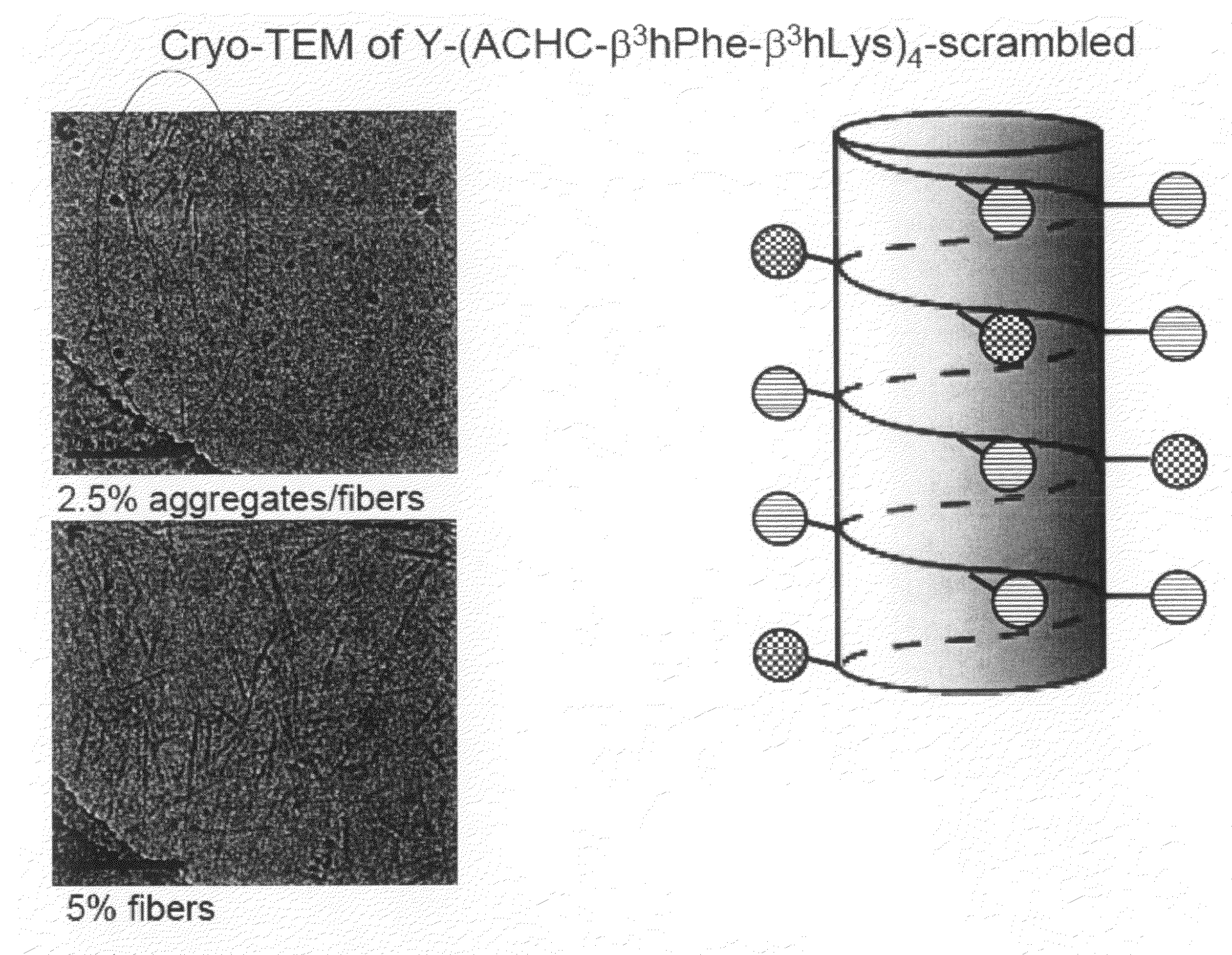
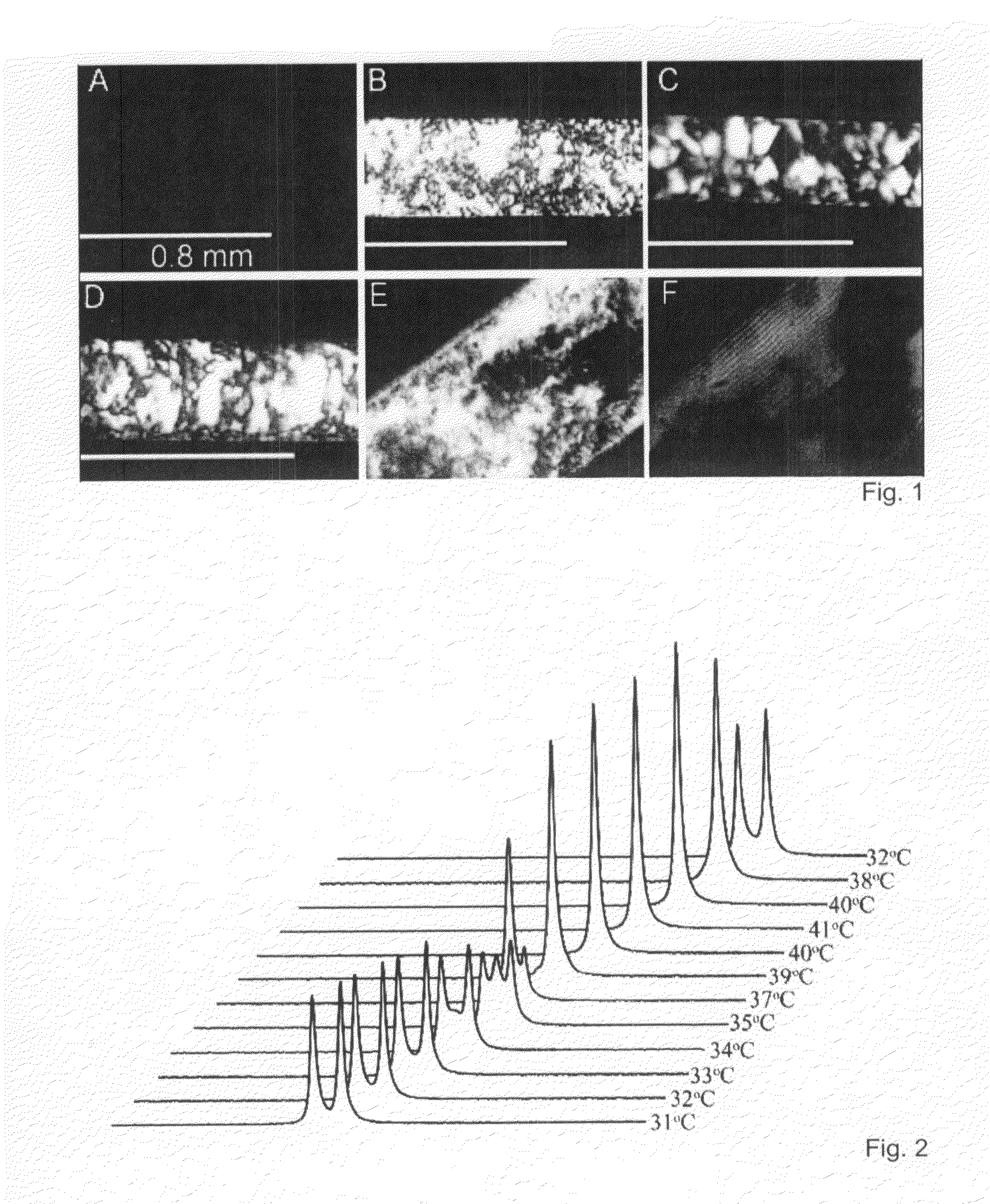
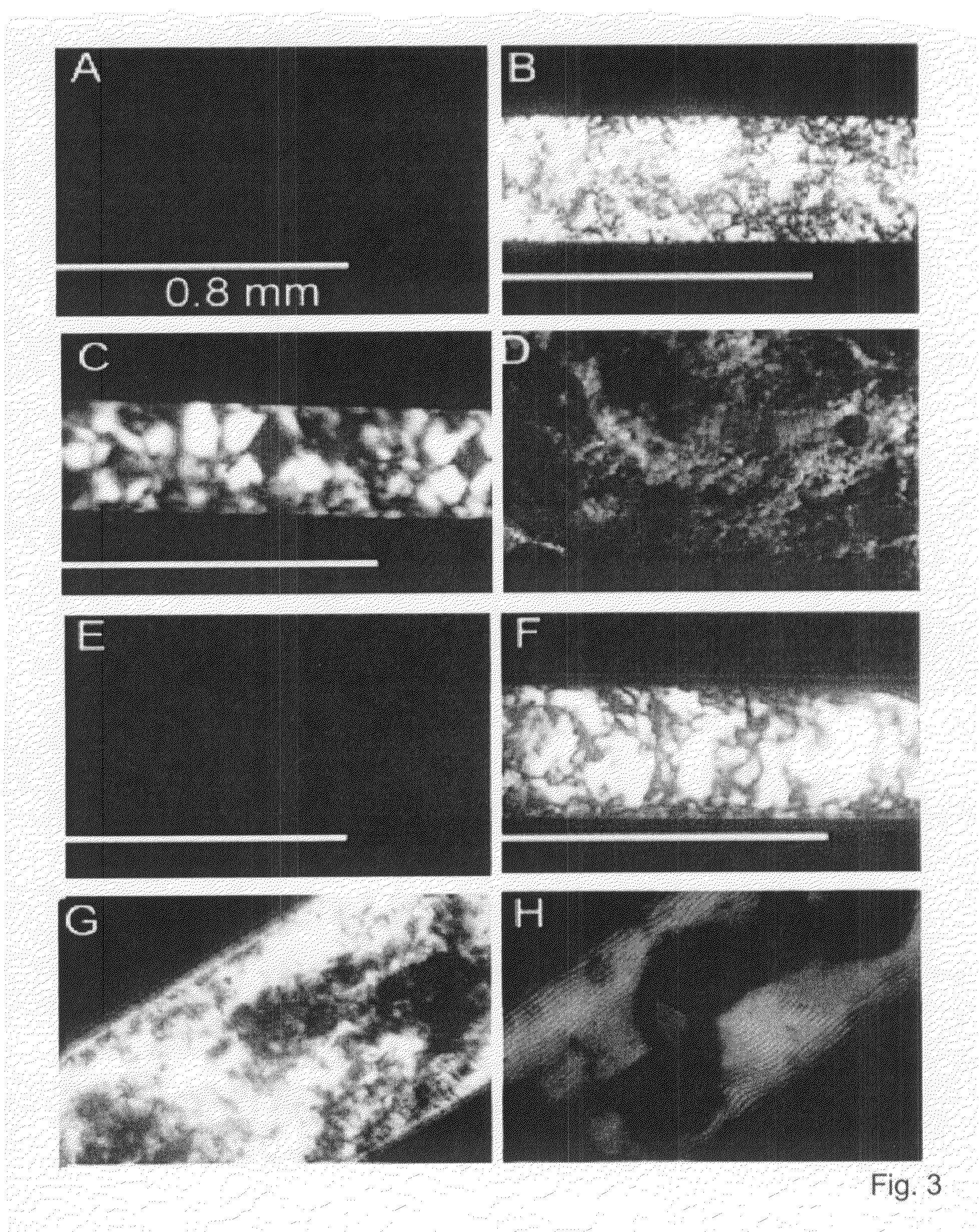
[0078]Referring now to FIG. 10, various beta-peptides in which the components ACHC, β3-hPhe, and β3-hLys have been scrambled are illustrated. Helical wheel diagrams for the four analogs are provided to aid in visualizing the partitioning of charge and hydrophobicity around the helices. FIG. 11 depicts optical micrographs of aqueous solutions of the beta-peptides shown in FIG. 10 between crossed polarizing filters. Analogs β3-hTyr-(ACHC-β3-hPhe-β3-hLys)4 scrambled 1 (“scram1”), β3-hTyr-(ACHC-β3-hPhe-β3-hLys)4 scrambled 2 (“scram2”), and β3-hTyr-(ACHC-β3-hPhe-β3-hLys)3 scrambled (“scram”) display strong birefringence.
[0079]Referring now to FIG. 12, various analog beta-peptides based on β3-hTyr-(ACHC-β3-hPhe-β3-hLys)3 are illustrated. Hydrophilic substitutions of β3-hGlu and β3-hGln residues were made at β3-hLys position 2, 6 of 10 of β3-hTyr-(ACHC-β3-hPhe-β3-hLys)3. FIG. 13 illustrates a plot for these hydrophilic analo...
example 3
Non-Globally Amphiphilic Beta-Peptide Lyotrophic Liquid Crystals II
[0080]The inventors have identified that properly designed β-peptides, such as the one shown in FIG. 14, could form LC phases in aqueous solution. This β-peptide was intended to be globally amphiphilic in the preferred 14-helical conformation (this helix is defined by 14-membered ring N—Hi→O═Ci+2 hydrogen bonds between backbone amide groups). The 14-helix has approximately three residues per turn; therefore, sequences such as 1, containing a lipophilic-lipophilic-hydrophilic triad repeat adopt helical conformations in which lipophilic side chains are globally segregated on one side of the helix and hydrophilic side chains are globally segregated the other side (FIG. 14). Isomeric sequences lacking the triad repeat pattern cannot achieve this global segregation of lipophilic and hydrophilic side chains. The inventors' design hypothesis was that extended lipophilic surfaces displayed by folded β-peptides would give ris...
PUM
| Property | Measurement | Unit |
|---|---|---|
| pH | aaaaa | aaaaa |
| flow rate | aaaaa | aaaaa |
| flow rate | aaaaa | aaaaa |
Abstract
Description
Claims
Application Information
 Login to View More