Although using the in-home
coaxial cable as the principal communication medium substantially simplifies the implementation of the MoCA network, there are certain disadvantages to doing so.
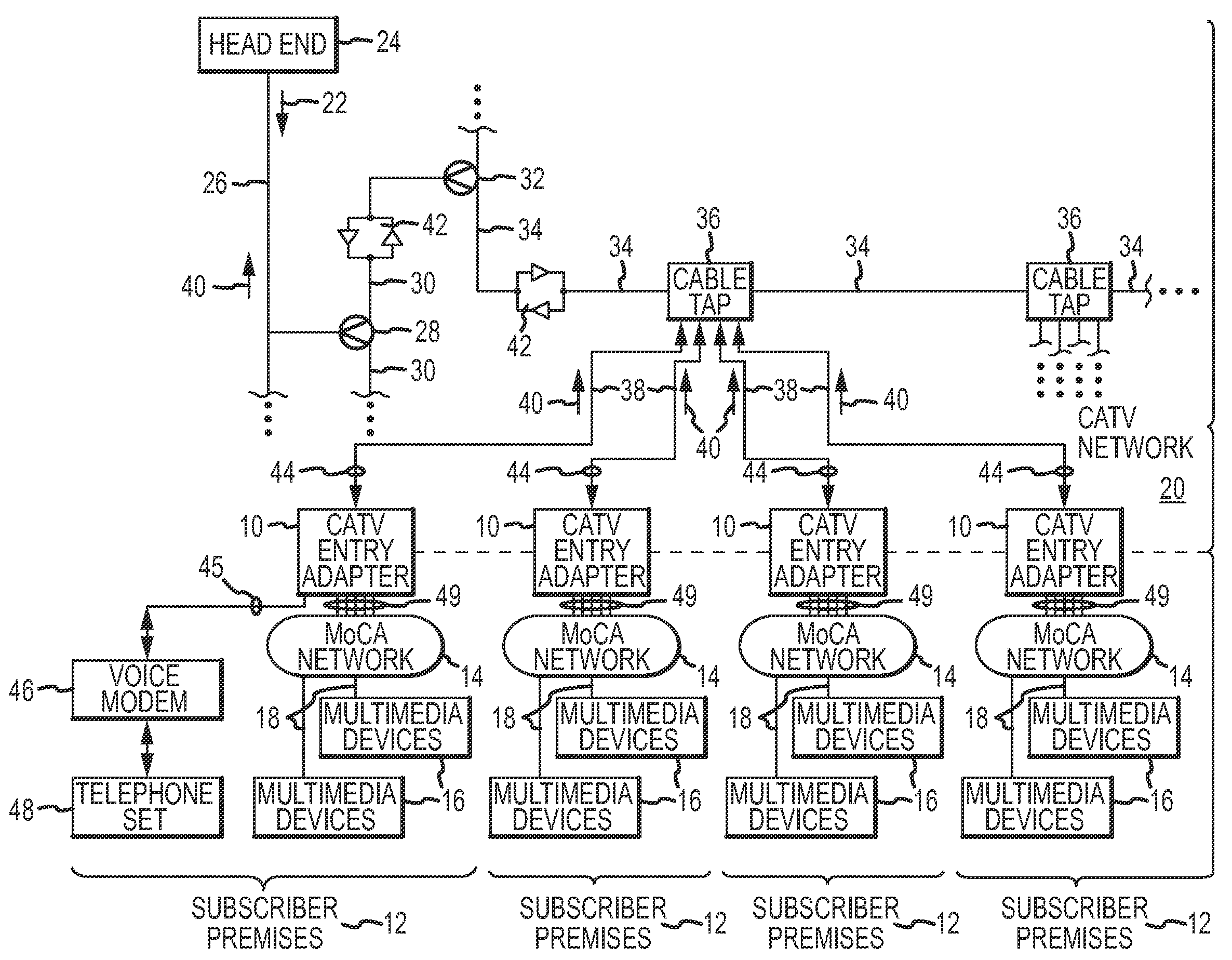
The presence of the MoCA signals at an adjoining subscriber's premises compromises the privacy and security of the information originally intended to be confined only within the original subscriber premises.
The MoCA signals from the original subscriber premises which enter through the CATV network to adjoining subscriber premises also have the potential to adversely affect the performance of a MoCA network in the adjoining subscriber premises.
The conflict of the signals from the original and adjoining subscriber premises may cause the MoCA interface devices to malfunction or not operate properly on a consistent basis.
CATV networks are subject to adverse influences from so-called ingress
noise which enters the CATV network from external sources, many of which are located at the subscriber premises.
The D bands in the MoCA frequency range are considerably outside the range of the normal ingress
noise, and ingress
noise suppression devices are ineffectual in inhibiting MoCA signals.
MoCA signals, being outside of the CATV
signal frequency, may also constitute another source of noise for the CATV network.
However, the use of such devices is subject to unauthorized removal, tampering, forgetfulness in original installation, and physical
exposure which could lead to
premature failure or malfunction.
Problems also arise because the CATV network and the in-home cable infrastructure were originally intended for the distribution of CATV signals to the cable outlets.
When the MoCA signals jump the output ports of a splitter, the degree of
signal rejection or isolation greatly diminishes the strength of the signals which effectively jump the output ports.
However, the substantial differences in the in-home cable infrastructure may nevertheless negatively
impact the strength of the MoCA signals conducted.
One example of significant negative
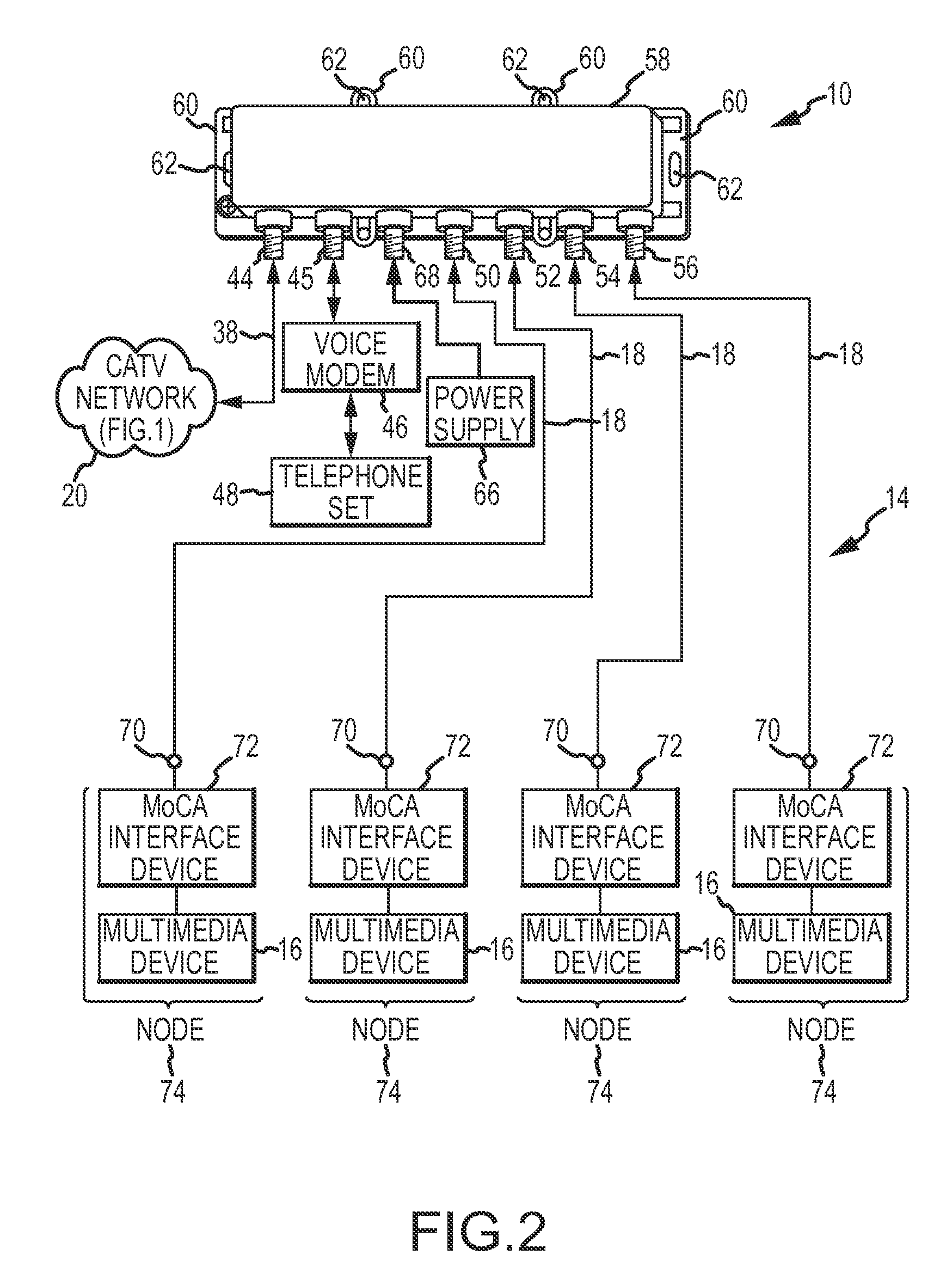
impact on MoCA signals arises from passive-active CATV entry adapters.
Because life-line telephone services are intended to remain useful in emergency conditions, the functionality of the telephone set can not depend on the proper functionality of an
amplifier or other active
signal conditioner in the signal path.
Any attempt to connect the passive port as part of a MoCA network will not be successful, however, because the MoCA signals are severely diminished in
signal strength when they pass from the active ports in a reverse direction through the forward path
amplifier.
Thus, it is essentially impossible to use a passive port on a CATV entry adapter for connection in a MoCA network, because of inadequate MoCA
signal strength.



 Login to View More
  Login to View More