

Secondary collimator and method of assembling the same
a collimator and secondary technology, applied in nuclear engineering, manufacturing tools, diaphragm/collimeter handling, etc., can solve the problems of difficult manufacturing of known secondary collimators, inability to increase the number of detector elements, and high cost of manufactur
- Summary
- Abstract
- Description
- Claims
- Application Information
AI Technical Summary
Benefits of technology
Problems solved by technology
Method used
Image

Examples
Embodiment Construction
[0014]While described in terms of detecting contraband including, without limitation, weapons, explosives, and / or narcotics, within baggage, the embodiments described herein can be used for any suitable XDI application. Furthermore, the term “parallel” as used herein refers to planes, lines, curves, and / or layers that are equidistantly spaced apart and never intersect each other.
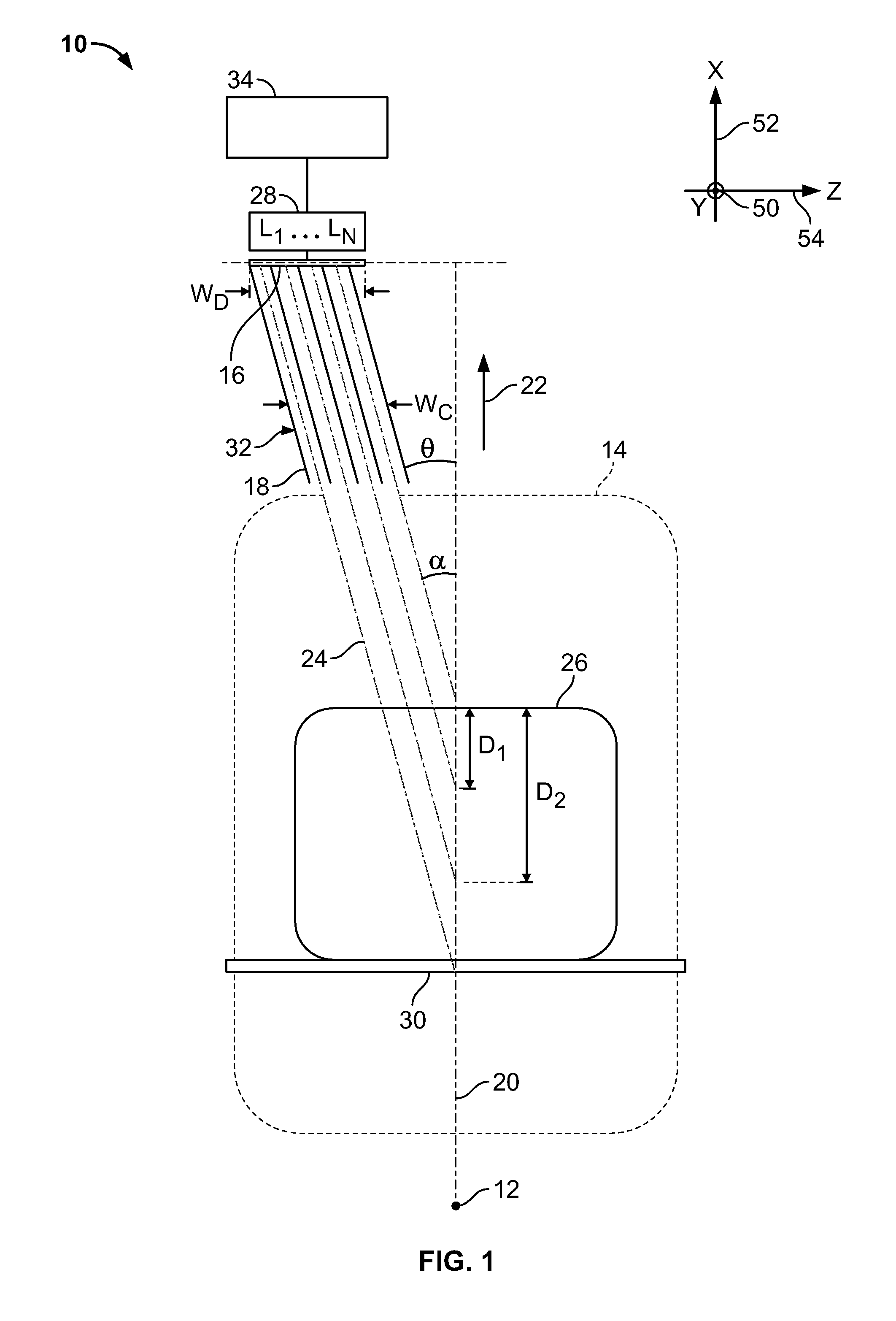
[0015]FIG. 1 is a schematic cross-sectional view, in an X-Z plane, of an exemplary embodiment of an X-ray diffraction imaging (XDI) system 10. In the exemplary embodiment, XDI system 10 includes an X-ray source 12, an examination area 14 shown by phantom lines in FIG. 1, a detector array 16, and a secondary collimator 18. X-ray source 12, in the exemplary embodiment, is a multi-focus X-ray source (MFXS) that is movable along a Y-axis 50 and emits an X-ray beam 20 along an X-axis 52 such that a direction 22 of X-ray beam 20 is substantially parallel to the X-axis 52. As such, X-ray source 12 moves in a direct...
PUM
| Property | Measurement | Unit |
|---|---|---|
| width WD | aaaaa | aaaaa |
| heights HP1 | aaaaa | aaaaa |
| heights HP1 | aaaaa | aaaaa |
Abstract
Description
Claims
Application Information
 Login to View More