[0004]The pre-installation assembly according to the invention for a contact arrangement of a sensor assembly having the characteristics of independent claim 1 has the
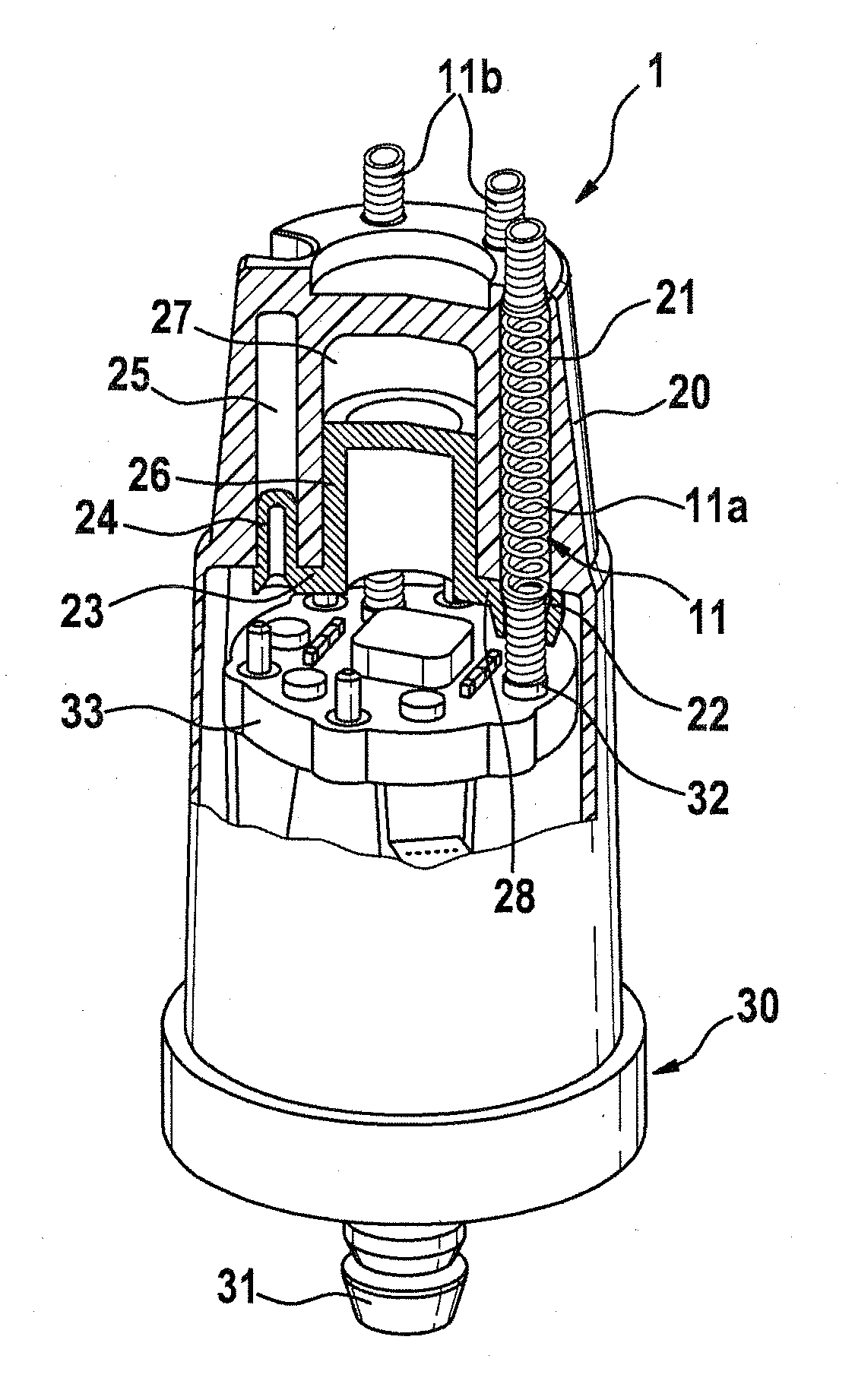
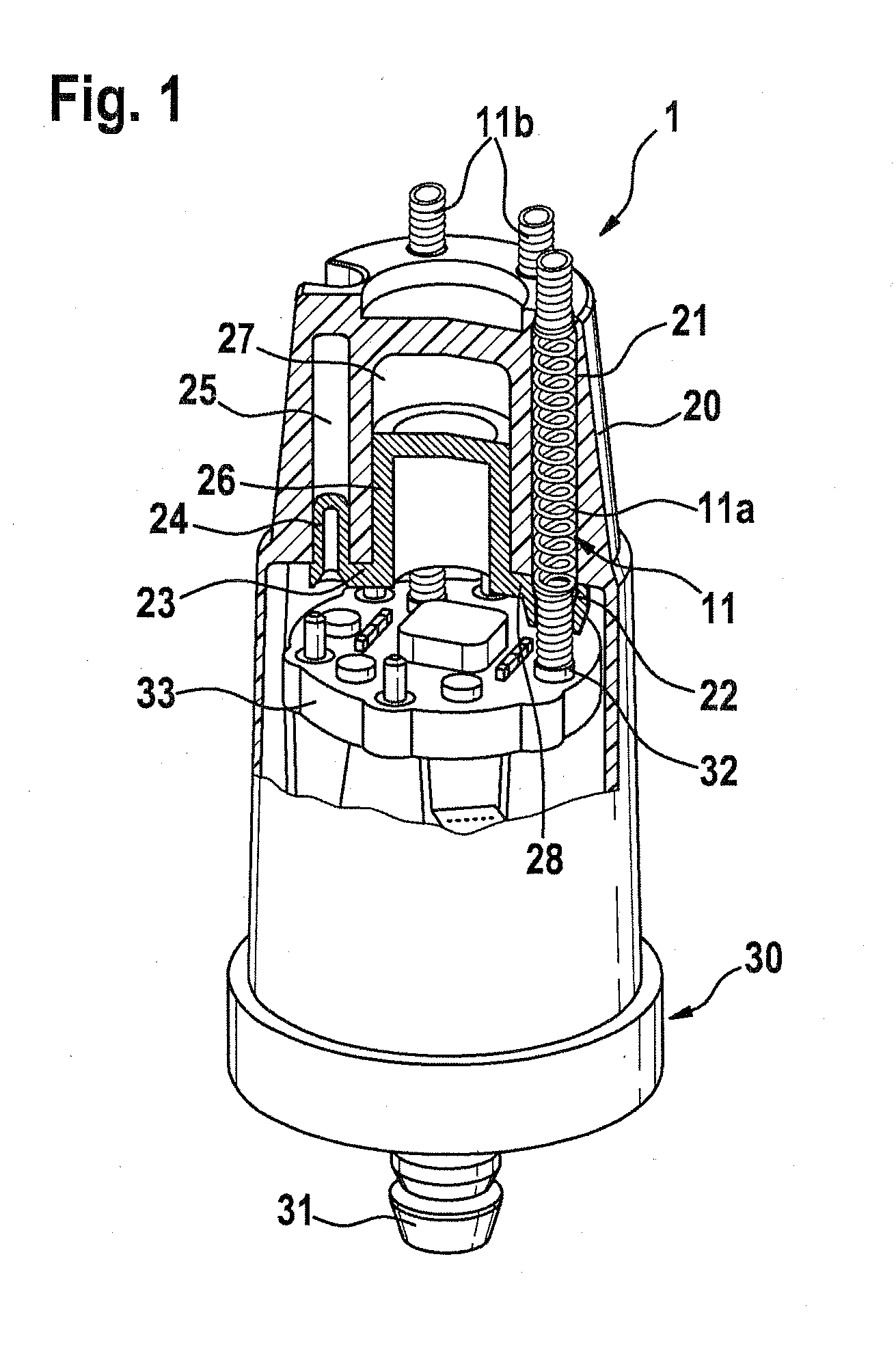
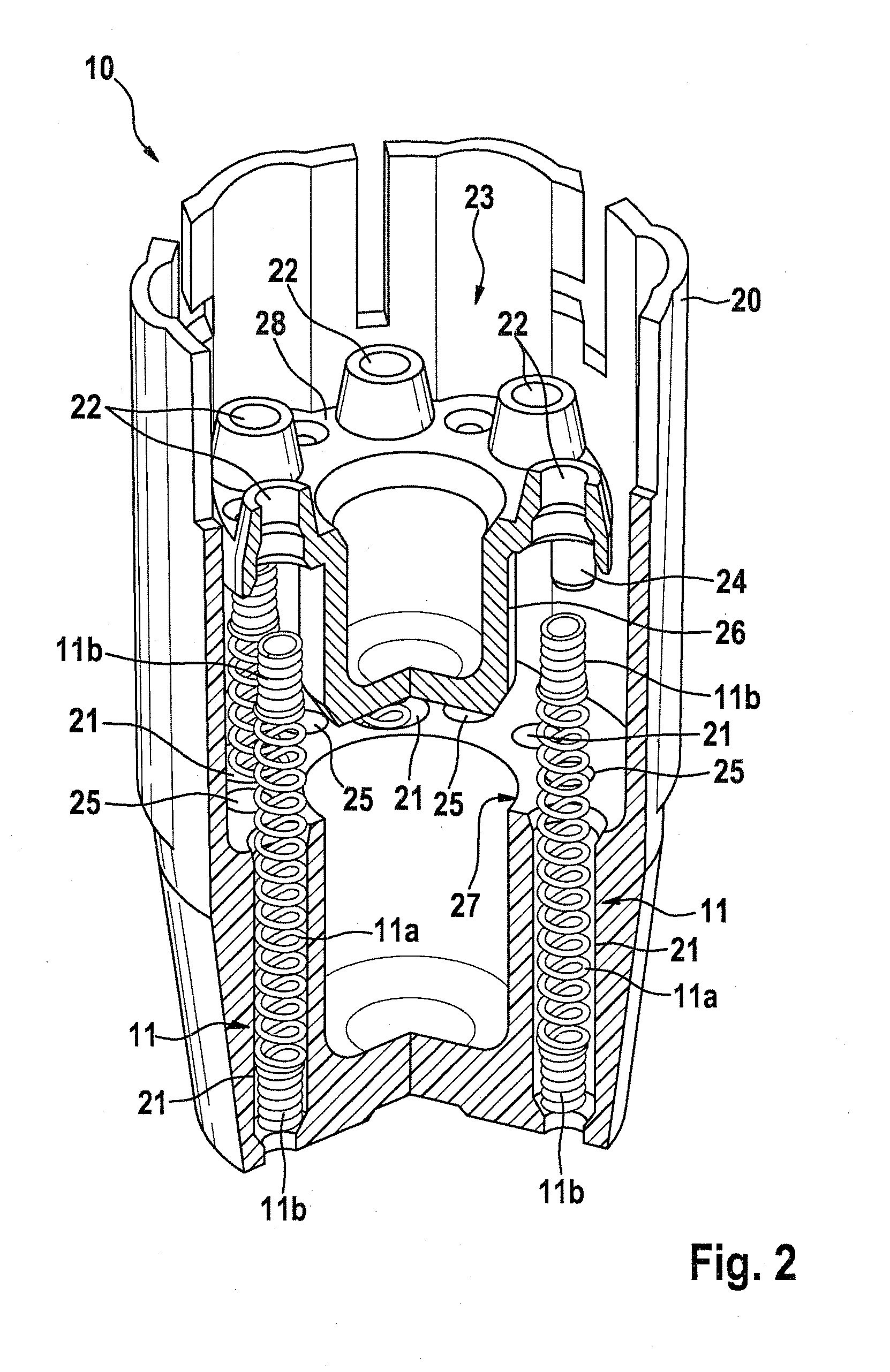
advantage over the prior art that a support component and a clamping component can be connected to one another in a simple way, via connection means, so that at least one spring contact pin is positioned and held in a simple way, via aligned guides, penetrated by the pin, in the support component and the clamping component. For forming the pre-installation assembly of the invention, the at least one spring contact pin is held in the guide of the support component, and a first end section of the at least one spring contact pin is axially braced in the associated guide of the support component. A second end section of the at least one spring contact pin is axially braced in the associated guide of the clamping component, and in the aligned position of the corresponding guides, the clamping component and the support component are connected to one another via the connection means. After the clamping component has been connected to the support component, the at least one spring contact pin is automatically compressed to the desired length and is kept in this position, captive, in the aligned guides of the clamping component and of the support component. As a result, advantageously, an easily manipulated pre-installation assembly for a contact arrangement of a sensor assembly is created.
[0006]It is especially advantageous that the aligned guides of the support component and of the clamping component, in order to be connected to one another, can easily be put into their construction position via positioning means of the corresponding support component and clamping component. As the connection means and / or positioning means between the clamping component and the support component, at least one press-fit peg, for instance, can be provided, which in the installed state is press-fitted into an associated press-fit bore. The press-fit peg and the associated press-fit bore can be structurally adapted to one another, for instance by means of a suitable predetermined shape, in such a way that in the installed state, a positionally correct connection between the clamping component and the support component is attainable. Alternatively, as the connection means and / or positioning means between the clamping component and the support component, a plurality of press-fit pegs and / or positioning pegs can be provided, which in the installed state are press-fitted into associated press-fit bores with a suitable pattern of holes. To facilitate the press-fitting operation in view of the relatively small dimensions of the individual components, a central press-fit peg can advantageously be provided as the connection means between the clamping component and support component; in the installed state, this peg is press-fitted into an associated press-fit bore, and as a the positioning means, a plurality of positioning pegs can be provided, which during the press-fitting operation are introduced into associated positioning bores with a suitable pattern of holes. The positioning pegs, which are smaller than the press-fit pegs, therefore serve the purpose of location positioning and therefore also serve as a protection against relative rotation.
[0010]To bring about simple axial bracing and simultaneously simple centering of the winding sections, forming the end regions, in the guide penetrated by them, the transition region of the spring contact pin can be wound conically, from its middle winding section to the winding section on the end regions that forms the tapered end region, with
adaptation to a conical seat in the associated guide of the support component and clamping component, respectively. By means of a mirror-symmetrical design of the spring contact pin with respect to its central
transverse axis, it can then be ensured that the spring contact pin can cooperate in both end regions with a conical seat, and as a result, the installation of the spring contact pin can be done more simply and in a way that is more secure against mistakes.
[0011]An especially simple design of the spring contact pin can be attained if the spring windings in the end regions of the spring contact pin of the invention are wound as a block for axial stiffening of these end regions. As a result, the spring contact pin can be a winding
package wound in one piece of spring wire and can thus be produced economically as a
mass-produced part in an optionally automated
work cycle. Moreover, the radial bracing of the conical transition regions in the conical guide means can be improved by providing that the spring windings in the conical transition regions of the spring contact pin are at least predominantly, or entirely, also wound as a block. In contact-making for a sensor assembly or the like, the cost
advantage is especially advantageous if the sensor assembly has a plurality of spring contact pins that are all designed structurally identically.


 Login to View More
  Login to View More