
Identification and use of compounds that affect the fidelity of eukaryotic translation initiation codon selection
a technology of eukaryotic translation and initiation codon selection, which is applied in the direction of instruments, extracellular fluid disorder, metabolic disorder, etc., can solve the problems of high accuracy, mechanistic details of this process remain a mystery, and no chemical modulator of start codon selection exists to help elucidate the mechanism of this complicated process
- Summary
- Abstract
- Description
- Claims
- Application Information
AI Technical Summary
Benefits of technology
Problems solved by technology
Method used
Image

Examples
example 1
Screening Protocols
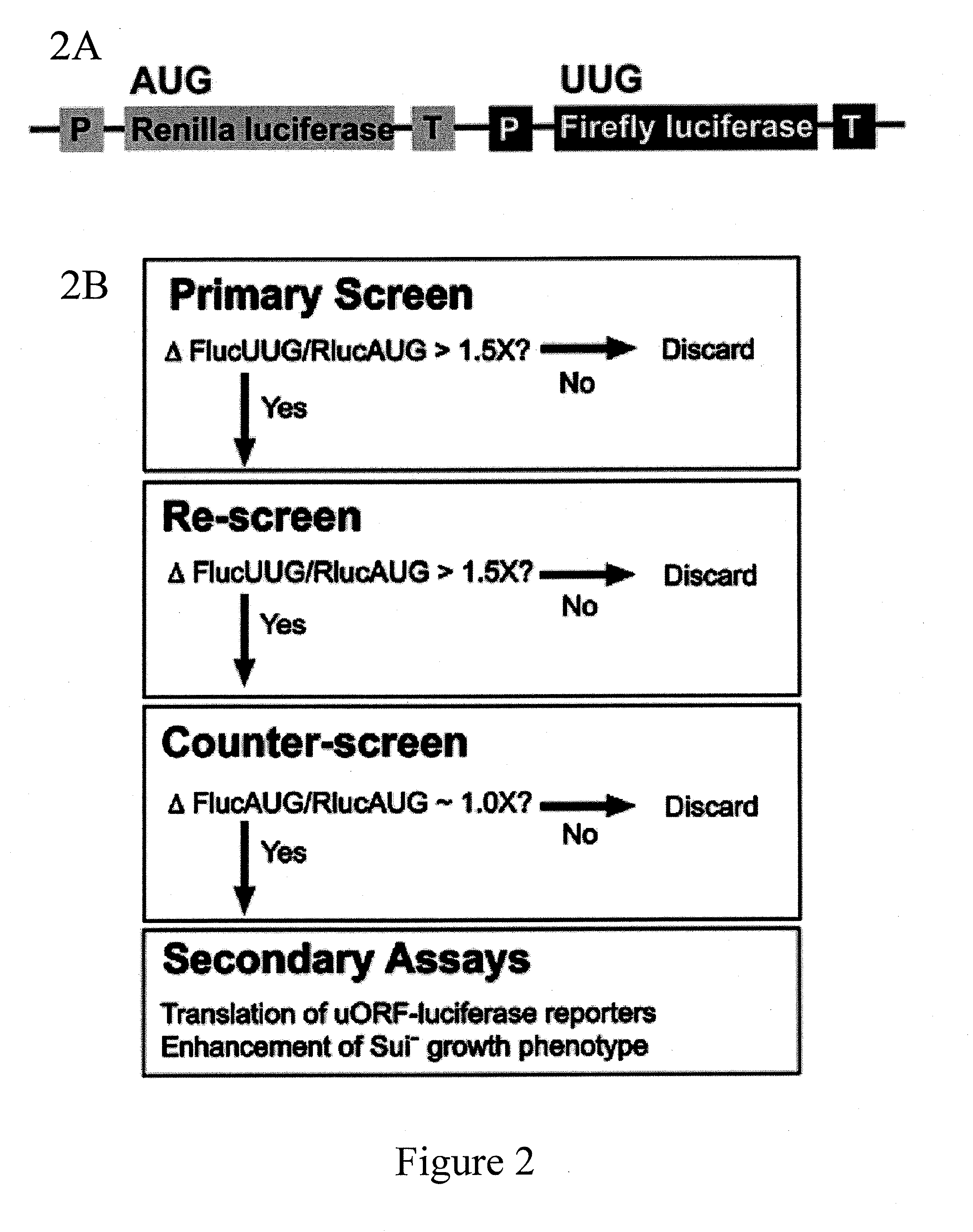
[0156]In this study, a high throughput screen in S. cerevisiae was set up using a dual luciferase reporter to find compounds that alter the fidelity of start codon selection in vivo. Approximately 55,000 compounds were screened, and structurally related molecules were identified that increase the use of non-AUG codons as initiation sites, thus chemically inducing Sui− phenotypes. Data indicate that these compounds act within the cell and that they increase initiation at a natural uORF with a near-cognate start codon as well as on the luciferase reporter mRNA. The compounds can also increase growth on medium lacking histidine of a Sui− strain of yeast (sui1-1) in which the AUG start codon of the HIS4 gene has been changed to a near-cognate codon such that initiation must occur at a non-AUG (his4-303). This effect demonstrates the feasibility of chemically ameliorating a genetic defect caused by mutation of an initiation codon.
[0157]A dual luciferase assay was previ...
example 2
Active Compounds
[0173]Approximately 55,000 compounds from four libraries were screened. The main source of compounds was the National Cancer Institute (NCI) Developmental Therapeutics Program (DTP) library. Of the >200,000 compounds in this library, 49,840 were screened. Three smaller libraries were also screened: 1) ˜2500 compounds that have passed phase I clinical trials (gift of Dr. Jun Liu, Johns Hopkins University School of Medicine); 2) ˜2500 natural products (Dr. Jerry Pelletier); 3) ˜500 microbial growth media extracts (gift of Dr. Scott Strobel, Yale University). With the liberal cut-off of a ≧1.5-fold change in the FlucUUG / RlucAUG ratio, approximately 2% of the compounds screened passed the primary screen, but 2 compounds, both from the NCI DTP library, passed the counter-screen. The structures of these two compounds, isoquinoline-1-carboxylic acid (NSC218351) and 7-amino-5-iodo-8-quinolinol hydrochloride (NSC92218), are shown below. NSC218351 is commercially available thr...
example 3
Additional Compounds
[0197]Additional compounds identified by the described screening method are shown below.
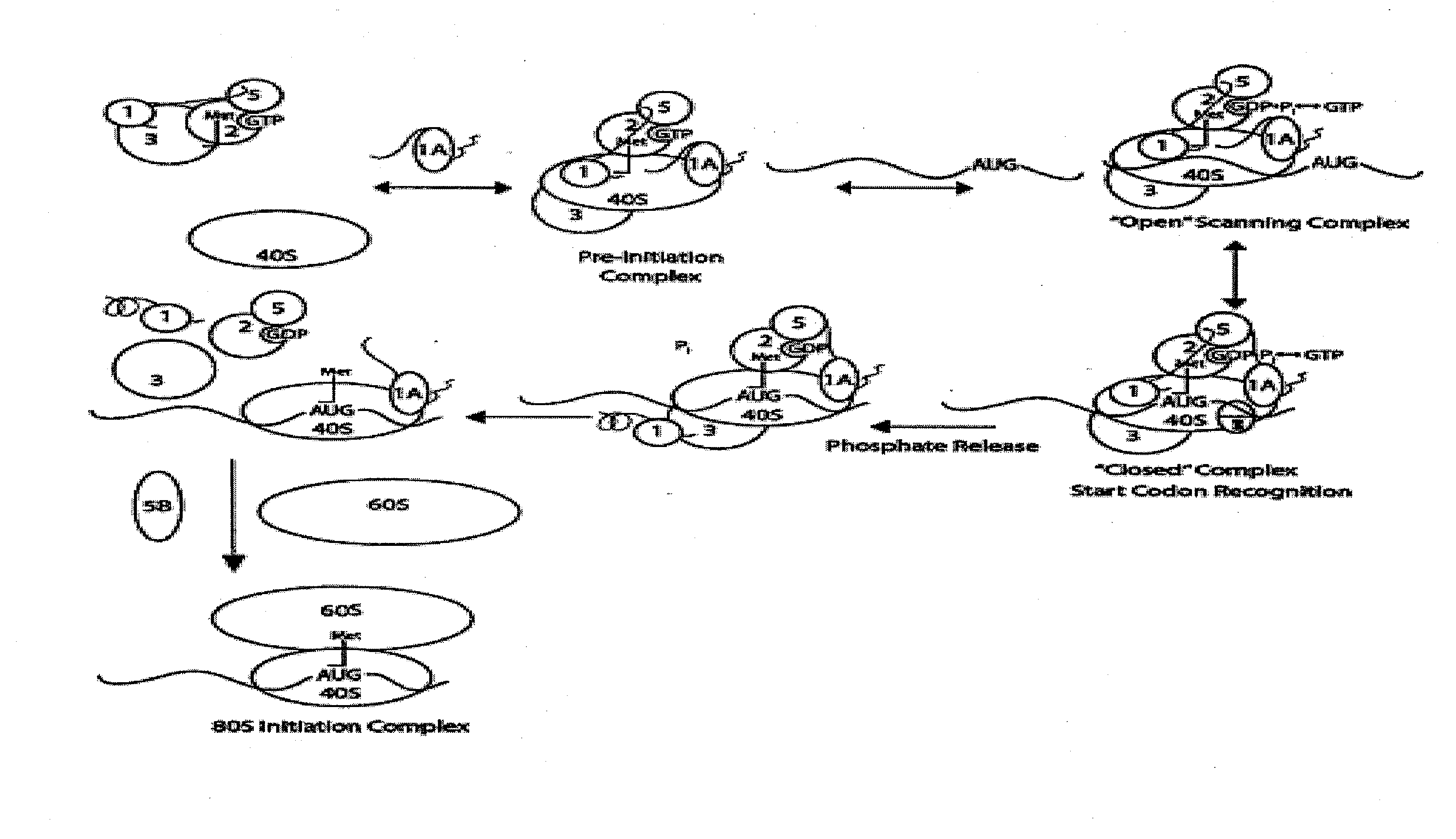
[0198]According to the invention a dual luciferase assay has been adapted into a high-throughput screen to identify compounds that alter the fidelity of start codon recognition in yeast. These structurally related compounds passing the primary screen and the counterscreen increase translation from near-cognate start codons ˜2-fold in the dual luciferase assay (at 60 μM NSC218351 and 15 μM NSC92218) and in the uORF-Fluc assay, and enhance the Sui− phenotypes conferred by the sui1-1 D83G eIF1 mutation and by haploinsufficiency of WT eIF1. Thus the compounds decrease the fidelity of start codon selection in three separate in vivo assays. Additionally, the increased use of UUG as a site of initiation caused by NSC218351 and NSC92218 is suppressed, completely and partially, respectively, by over-expression of eIF1, providing strong evidence that the compounds act in a mechanistical...
PUM
| Property | Measurement | Unit |
|---|---|---|
| Volume | aaaaa | aaaaa |
| Volume | aaaaa | aaaaa |
| Volume | aaaaa | aaaaa |
Abstract
Description
Claims
Application Information
 Login to View More