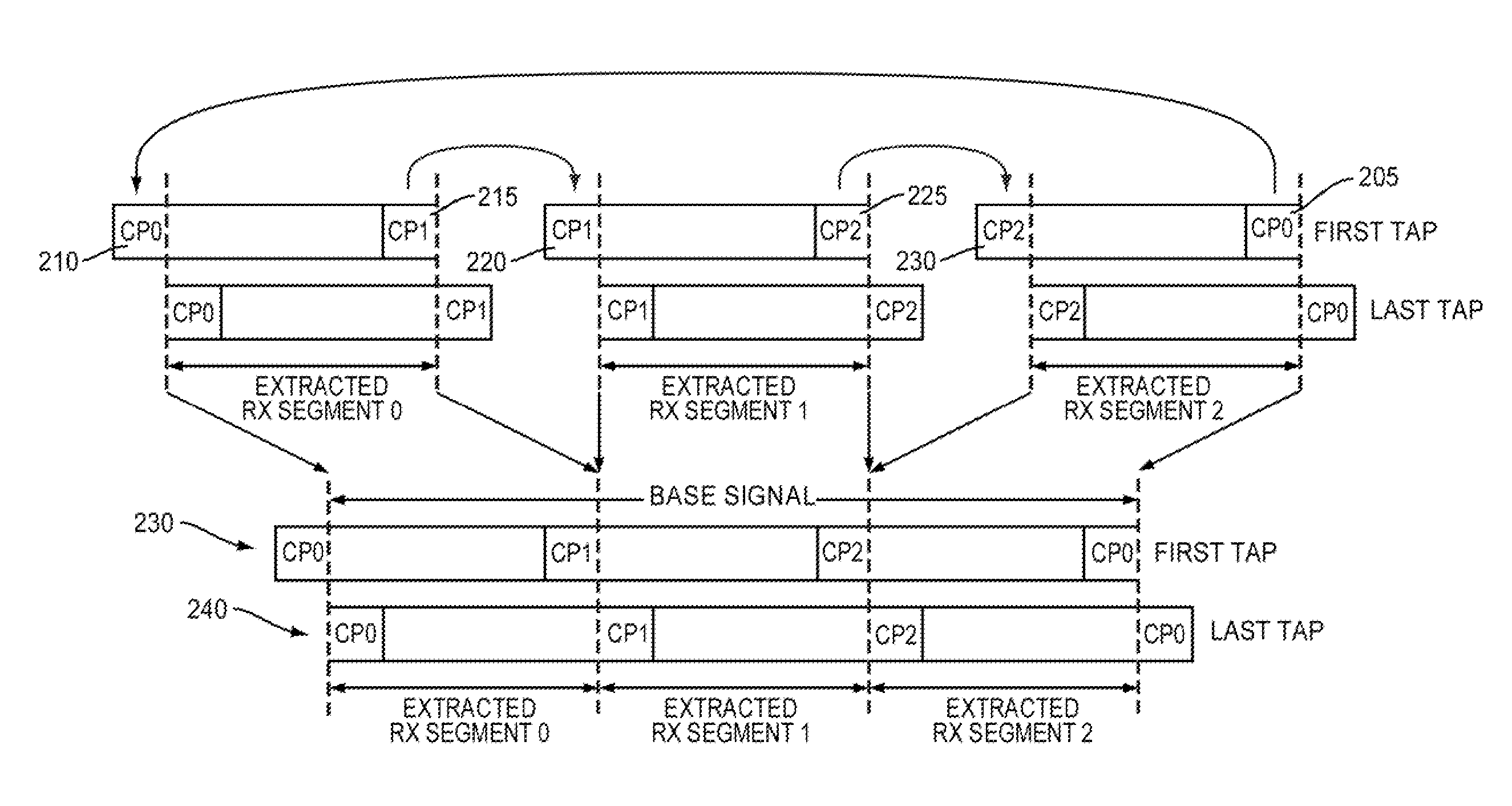
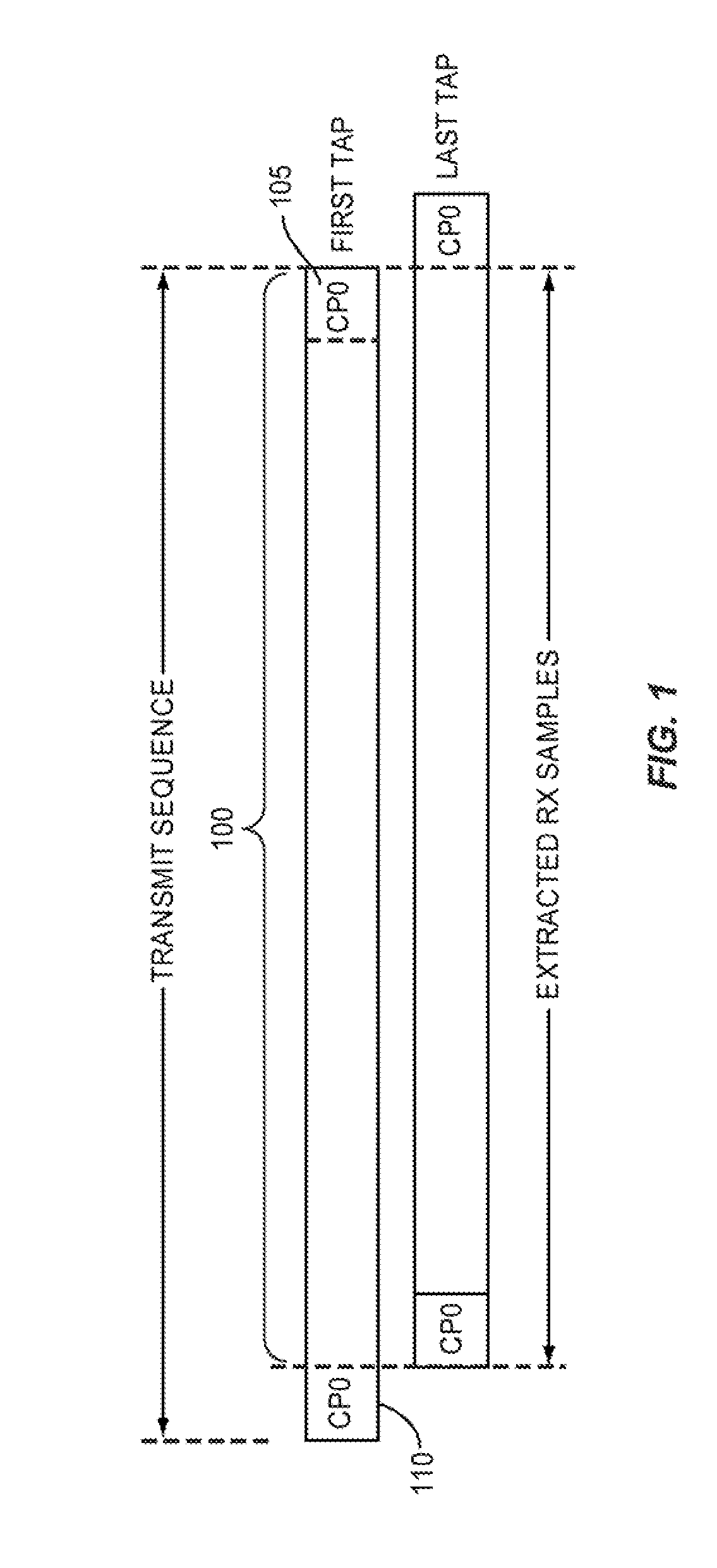
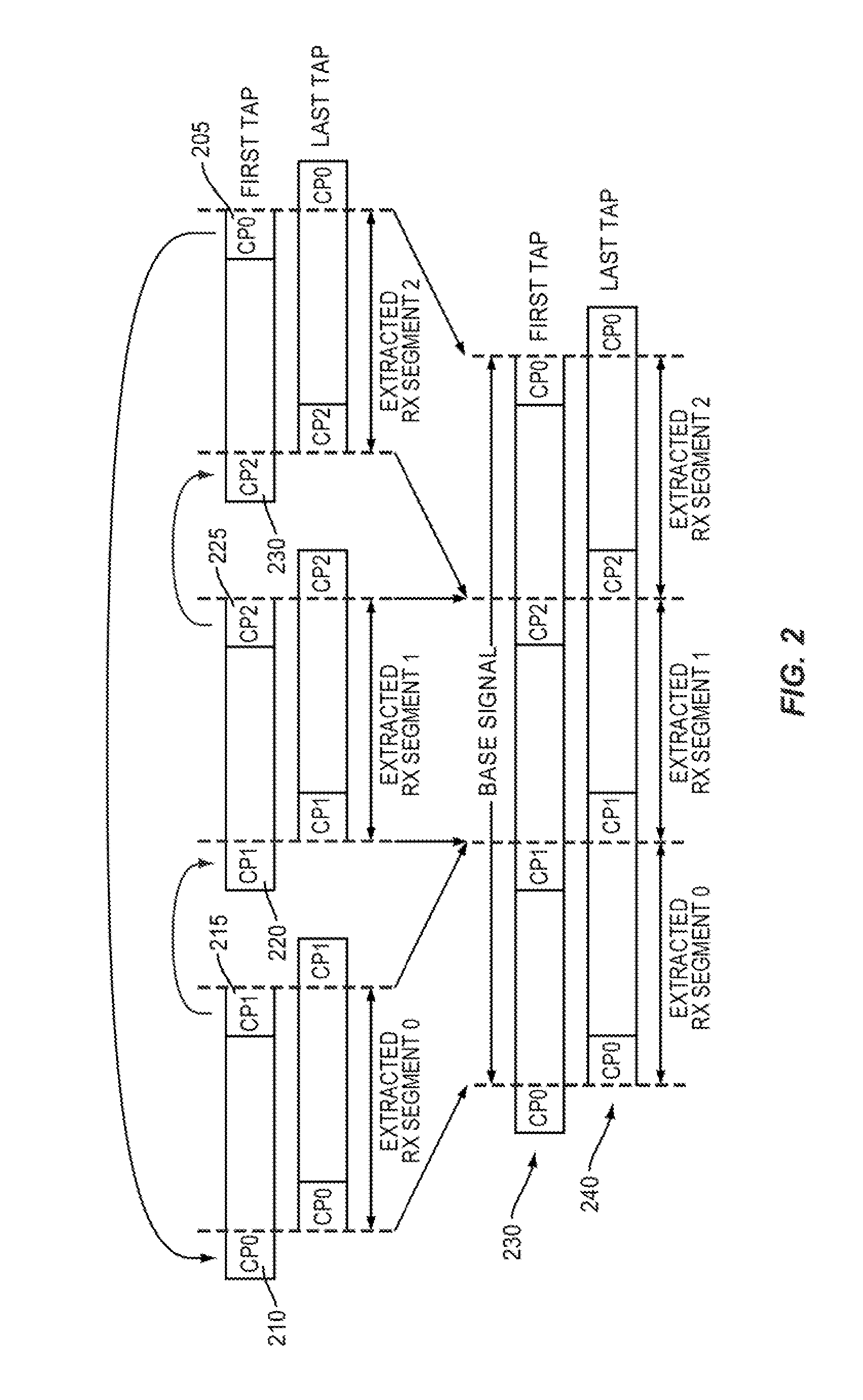
In various embodiments of the present invention, signals are modified to facilitate the emulation of circular convolution in non-contiguous transmission environments. In some embodiments, these modified signals may be derived from signature sequences that are currently used in applications where the sequence is transmitted contiguously. As described more fully in the detailed description below, cyclic prefixes are used to facilitate this emulation of circular convolution for a signal transmitted through a dispersive channel in several non-contiguous transmission intervals.
In some embodiments of the present invention, a method of transmitting a signal in a plurality of non-contiguous transmit-time intervals such that each of the non-contiguous transmit-time intervals carries a distinct one of a corresponding plurality of segments of the signal comprises the prefixing, to an initial segment of the signal, a tail portion of a final segment of the signal, to form a first transmit segment. This method further comprises prefixing, to each of the one or more segments of the signal other than the initial segment, a tail portion of the immediately preceding segment of the signal, to form corresponding one or more additional transmit segments, and transmitting each of the first transmit segment and the one or more additional transmit segments in respective ones of the plurality of non-contiguous transmit-time intervals. In some embodiments, the signal comprises one of a pre-determined set of signature sequences; in some of these and in some other embodiments the transmit segments are transmitted in the same order as the corresponding segments of the signal appear in the signal itself.
In some embodiments, all of the prefixed tail portions are of a single, pre-determined length. In some of these embodiments, the pre-determined length is selected based on an estimated or expected propagation delay spread corresponding to the transmission of the first transmit segment and the one or more additional transmit segments. In some embodiments, the signal comprises one or more orthogonal-frequency-division-multiplexed (OFDM) symbols.
Also described in detail below are methods for receiving a signal transmitted in a plurality of non-contiguous transmit-time intervals, wherein each of the non-contiguous transmit-time intervals carries a transmitted segment comprising a distinct one of a corresponding plurality of segments of the signal, each distinct one prefixed by a tail portion of a different one of the plurality of segments of the signal. An exemplary method comprises receiving the transmitted segments from the non-contiguous transmit-time intervals and, for each of the received transmitted segments, extracting a fractional portion having a length equal to the corresponding distinct one of the segments of the signal. The fractional portions are then combined in a pre-determined order, to form a received version of the signal. In some, but not all embodiments, the pre-determined order is the order in which the transmitted segments are received. In several embodiments, the method further comprises performing a discrete Fourier transform (DFT) on the received version of the signal, to form a demodulated signal. In some of these, as well as in some other embodiments, the method comprises comparing the received version of the signal to one or more pre-determined signature sequences to determine a transmitter identity corresponding to the transmitted sequences. In others, the method further comprises correlating the received version of the signal with one or more pre-determined sequences to estimate a time-of-arrival corresponding to the transmitted sequences.
Transmitter and receiver apparatuses configured to carry out one or more of the methods summarized above are also disclosed. Of course, the present invention may be carried out in other ways than those specifically set forth herein without departing from essential characteristics of the invention as set forth in the appended claims. Upon reading the following description and viewing the attached drawings, the skilled practitioner will recognize that the described embodiments are illustrative and not restrictive, and that all changes coming within the scope of the appended claims are intended to be embraced therein.


 Login to View More
  Login to View More