[0009]By way of the inventive utilization of a display unit that can be switched between a transparency mode and a display mode, the operator is provided with the option to observe the regions located behind the display surface, for instance a stage with the lighting devices arranged thereon, through the display surface upon activation of the transparency mode. By switching the display unit into the display mode, the operator in turn is provided with the option to cause graphical elements for operating the lighting control console to be displayed on the display surface. Hence, in other words, due to the aspect that the operator is provided with the option to switch the display unit into a transparency mode, the operator is no longer required to get up or else to change his / her seating position in order to be able to look past the display unit to observe the field of vision
lying behind the same.
[0014]As an alternative to utilizing an electro-chromatic glass, the projection surface may equally be made of a transparent glass carrier having a transparent film disposed thereon, wherein this film in turn includes a plurality of holographic optical elements (HOE). The holographic optical elements disposed on the transparent film cause a deflection of light, so that the
light beam emitted from the
projector, which is incident on the
holographic optical element, is deflected at a certain angle towards the observer. Light, such as in particular ambient light, that is incident on the holographic optical elements at a different angle is not deflected towards the observer and thusly cannot be spotted on the part of the observer. Thus, by utilizing the holographic optical elements, it is possible to create transmitted-light projection screens suitable for use in
daylight.
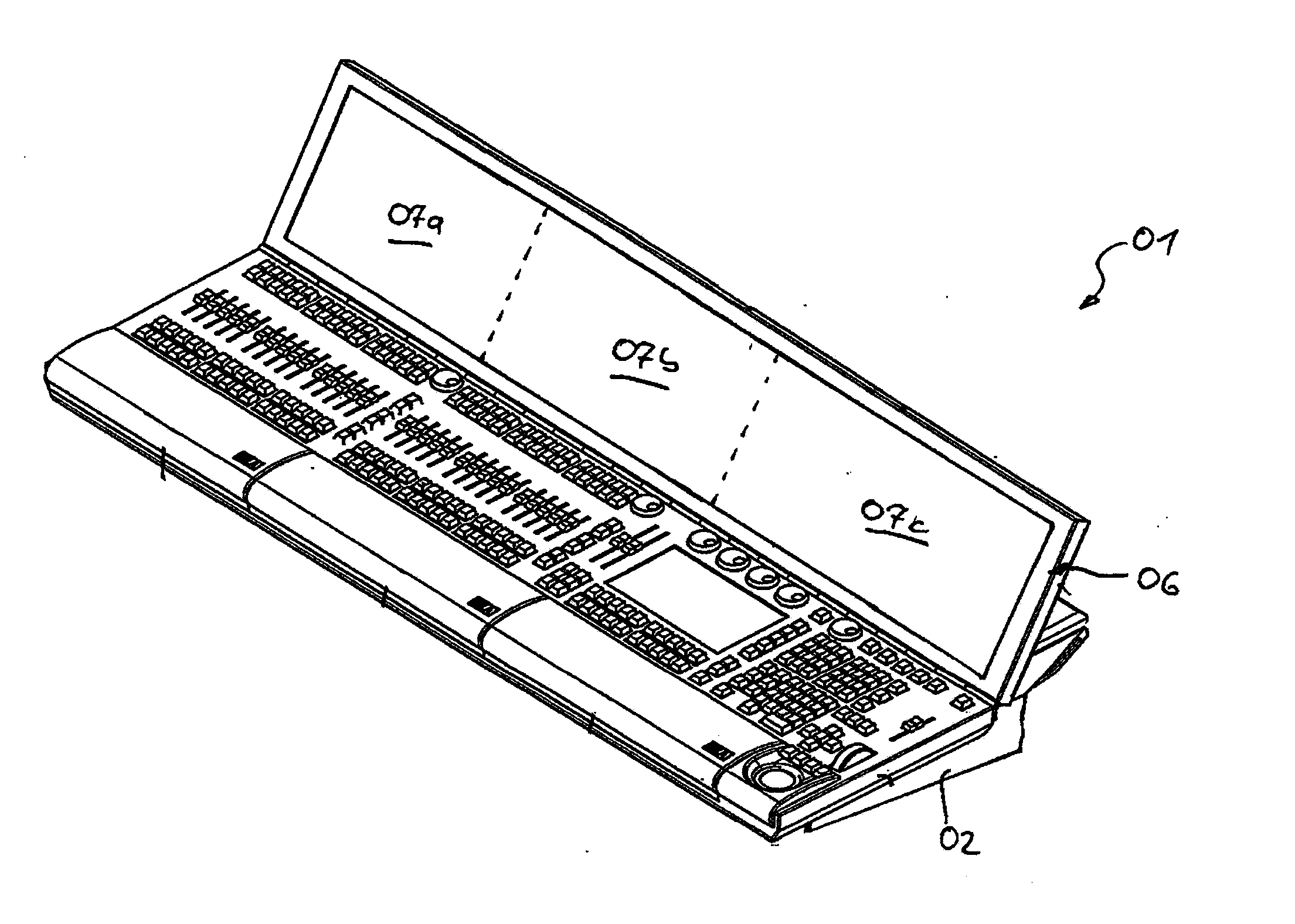
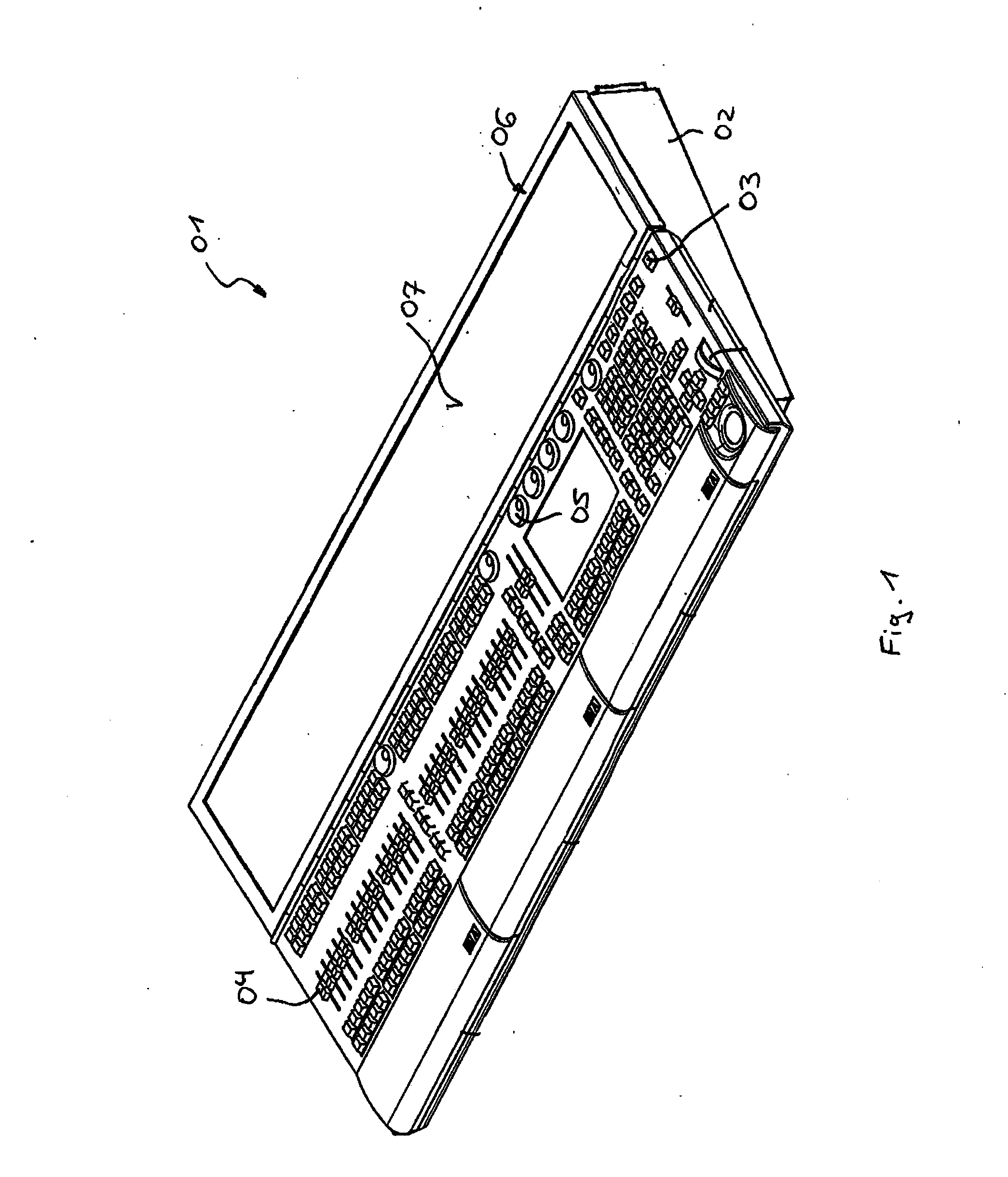
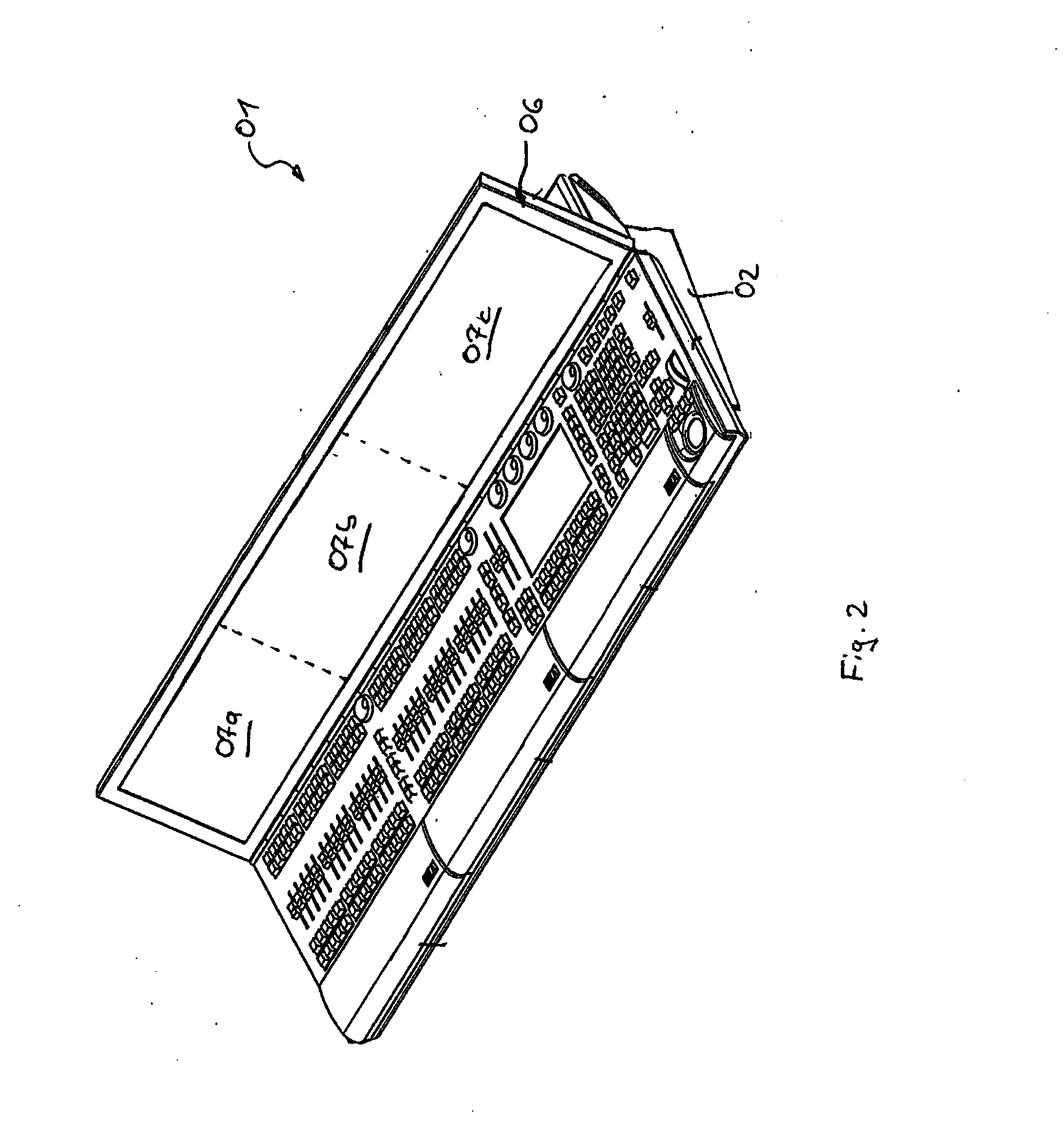
[0015]In order to provide the operator with the option of adjusting the display unit to his / her individual needs, it is especially advantageous if the display unit is mounted at the housing so as to be pivotable about a swivel axis and can be pivoted between a swiveled-back
rest position and a swiveled-up operating position, in particular in a continuous fashion. By means of arranging the display unit in the
rest position, it is in particular possible to enhance the transportability of the lighting control console. In the
rest position, the display unit may fit into the surface of the top of the housing, for instance in a manner complementary in shape. By means of swiveling the display unit upwards into the operating state, conversely, a particularly convenient
angle of view on the part of the operator is then enabled for the display unit, since the display unit extends to the top of the housing, for instance at a steep angle. For the purpose of the constructional configuration of the pivotable mounting of the display unit, the display unit may be fastened for instance at a pivotably-mounted carrier element of the housing.
[0016]In the simplest embodiment of the pivotable mounting of the display unit, the swiveling motion is manually transferred to the display unit by the operator. For the purpose of further enhancing the operating convenience, however, provision may equally be made for a drive unit that is engaged between housing and display unit and that enables motor-driven displacement of the display unit between rest position and operating position.
[0018]In the light of the aspect that the utilization of a transmitted-light projection for displaying the graphical elements presupposes a specific angle to be maintained between
projector and projection surface, it is especially advantageous if the
projector for projecting the graphical representation is disposed at a portion of the drive unit, in particular at the gear rim, for motor-driven displacement of the display unit. In this way, it is possible to equally displace the projector synchronously thereto upon actuation of the display unit, so that the angle between projector and display surface in each case remains the same.
[0020]Moreover, it is especially advantageous if the operating elements can be displayed on the display surface in a three-dimensional representation, in order to enable a more intuitive operation of the operating elements.


 Login to View More
  Login to View More