[0012]This configuration of the device provides a seal with respect to the
pipe and thus ensures the tightness with respect to the vacuum and calibration tank. Changes in
diameter of the
pipe are easily detected over a large area. The facility of stretching the resilient material to a greater or lesser extent rules out the formation of folds in the annular cross section and thus also rules out unsightly marks on the surfaces of the pipes.
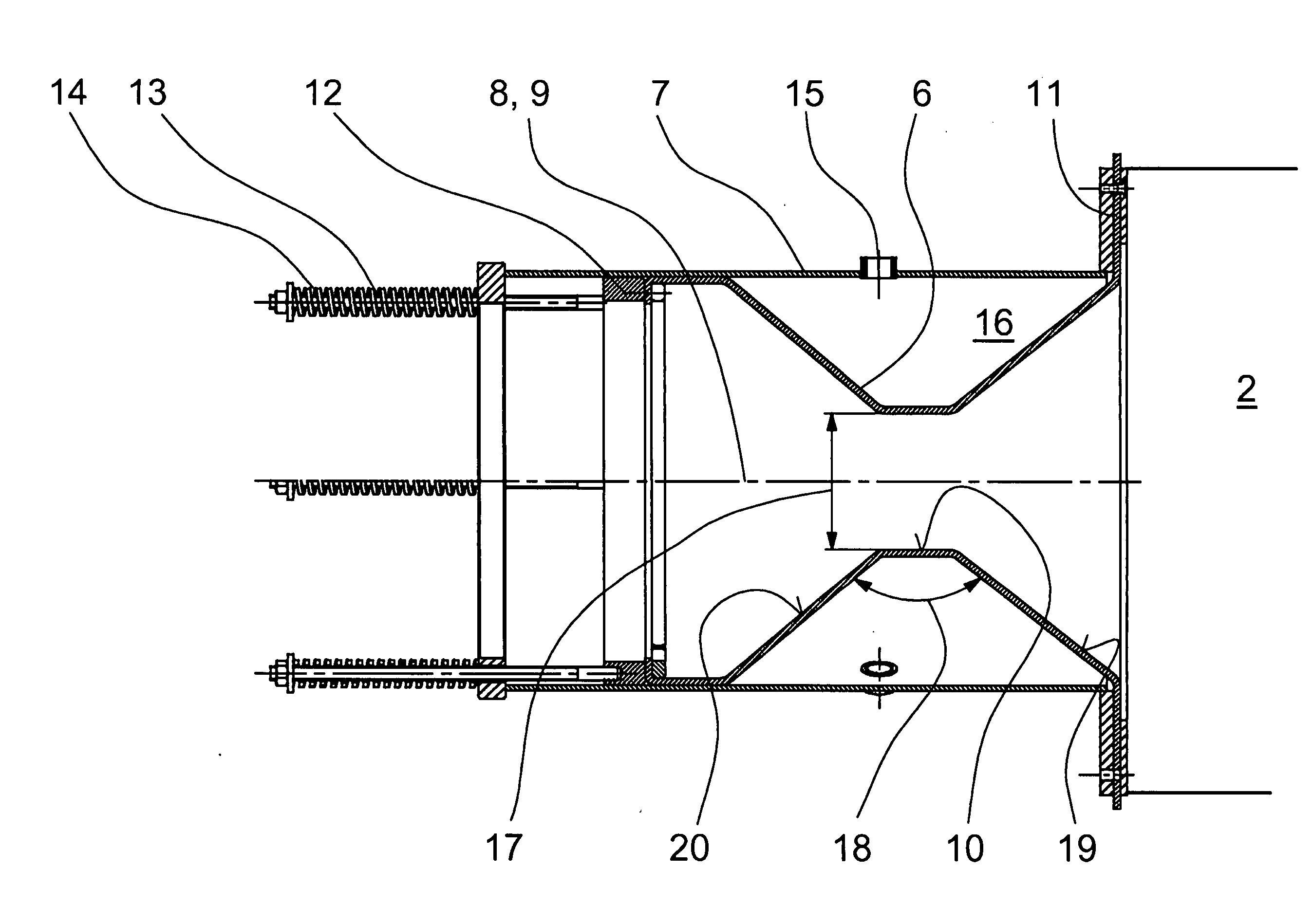
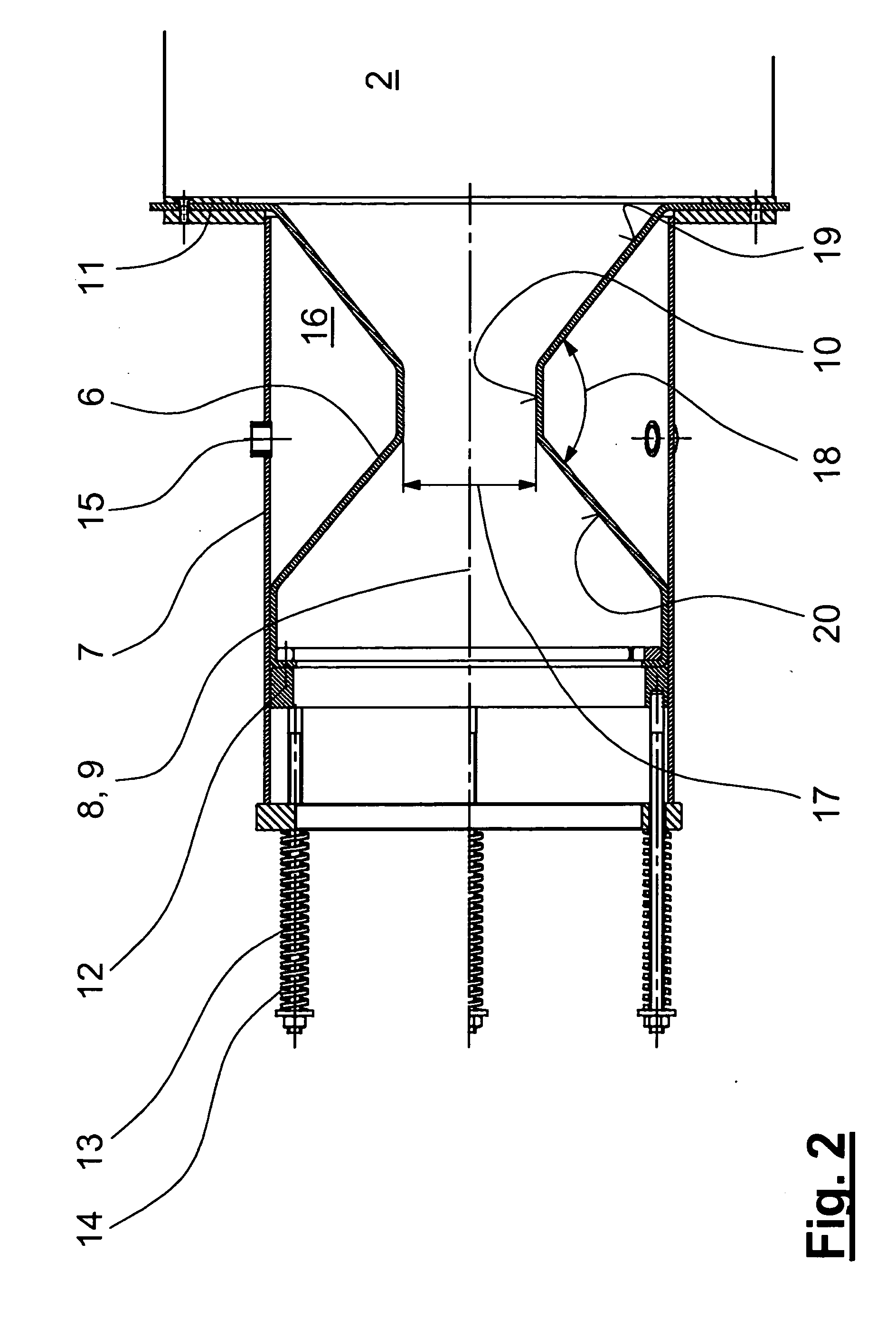
[0013]According to an embodiment, the stretching means is connected to guide rods, thus allowing a simple realisation of the greater or lesser stretching of the resilient material. In a further development, springs are provided on the guide rods so that a minimum tension is always applied to the resilient material. Of course, this adjustment can also be carried out by electric, pneumatic or hydraulic means. A control of this type is advantageously connected to the control of the extruder line so that specifications for the device can already be stored in the extruder line control and the device can be controlled centrally.
[0014]According to a further embodiment, the cavity in the annular cross section is filled with air or water. The measure of filling with a fluid also influences the sealing behaviour on the outer wall of the
pipe due to the
hydrostatic pressure, and this can be advantageous in the choice of a predetermined shape of the resilient material. The predetermined shape can provide different cross sections of the profile to be extruded or can influence the outer surface of the pipe.
[0015]At least one region of the resilient material is configured such that it is relatively wear-resistant. This can be achieved, for example by vulcanising in
graphite during the production of the resilient material. Likewise, it is possible to integrate fabric threads or a fabric web. As a result, the surfaces which are particularly loaded, namely the surfaces along which the extruded pipe slides are made to be more resistant to wear, thus increasing the service life of the entire device.
[0016]The device according to an embodiment of the invention can be used in the case of a vacuum calibration tank, but equally just for a cooling tank or for a combination of both.
[0017]In an embodiment of the invention, a method is characterised in that an
external pressure acts on the annular cross section and an
internal pressure prevails inside the annular cross section, in the cavity, and when the
external pressure and the
internal pressure are the same, the smallest passage cross section is formed, the passage cross section being enlarged as the difference of pressure between the
external pressure and the
internal pressure increases and the resilient material is stretched to a greater or lesser extent along the extrusion axis as a function of the difference of pressure.
[0018]Thus, it is provided that a hollow annular cross section is configured in its basic position (i.e. the hollow annular cross section assumes its geometric position without external influence, which means, for example, the effect of all types of forces) such that it rests against the outer wall of the plastics material pipe and thus has the smallest passage cross section. The pressure acting from outside on the annular cross section is equal to the internal pressure in the cavity. Therefore, under
normal conditions, in the initial state this would be substantially
atmospheric pressure.
[0019]In an embodiment, to alter the clear passage cross section for a profile, the annular cross section is evacuated, thus producing a difference of pressure between external pressure and internal pressure, as a result of which the annular cross section is pulled away from the outer wall of the profile and the passage cross section widens. To make this easier, the outer
peripheral shape should be fixedly attached to a further rigid suspension. This rigid suspension can be, for example, a cylinder which is arranged on the tank by a
flange. The resilient material can form the cavity together with this suspension or can be arranged on the suspension like a bicycle tube.
[0020]The annular cross section can also be subjected to slight excess pressure so that the region of the diameter
adaptation can be configured to be larger. A difference of pressure between internal pressure and external pressure would then be present and the resilient material would be slightly stretched, still with no folds forming on the annular cross section.


 Login to View More