Check patentability & draft patents in minutes with Patsnap Eureka AI!

Low-Power Class D Amplifier Using Multistate Analog Feedback Loops

a feedback loop and low-power technology, applied in the direction of dc amplifiers with modulator-demodulator, amplifiers, transmissions, etc., can solve the problems of quantization distortion, mosfets can still feature efficiency, and not 100% efficient, so as to improve performance

Active Publication Date: 2012-11-01
SMSC HLDG
View PDF1 Cites 14 Cited by
  • Summary
  • Abstract
  • Description
  • Claims
  • Application Information

AI Technical Summary

Benefits of technology

The patent describes a design for an amplifier that uses a special feedback system to improve performance. The amplifier has two integrators and a triangle signal generator, comparator, and Class-D amplifier. It also has a feedback lowpass filter with two different feedback positions. This filtering helps to remove noise and distortion introduced at the output of the amplifier. The amplifier converts the received digital audio signal by adding the outputs of multiple unit DAC elements together. The DEM component in the amplifier also helps to shape the output of the DAC to reduce errors caused by current source mismatch. The low-pass response of the amplifier's signal transfer function helps to reconstruct the signal and reduce quantization noise before it is driven out to the headphones by the Class-D amplifier. Overall, this design improves the quality of the amplified audio signal.

Problems solved by technology

The technical problem addressed in this patent text is the distortion and noise in the output of RF transceivers caused by the limited time resolution of the pulse width modulation (PWM) used in RF amplifiers, as well as non-linear output impedance and load-dependent frequency response of the output filter. The patent proposes a solution to minimize output noise and distortion using negative feedback and a PID controller.

Method used

the structure of the environmentally friendly knitted fabric provided by the present invention; figure 2 Flow chart of the yarn wrapping machine for environmentally friendly knitted fabrics and storage devices; image 3 Is the parameter map of the yarn covering machine
View more

Image

Smart Image Click on the blue labels to locate them in the text.
Viewing Examples
Smart Image
  • Low-Power Class D Amplifier Using Multistate Analog Feedback Loops
  • Low-Power Class D Amplifier Using Multistate Analog Feedback Loops
  • Low-Power Class D Amplifier Using Multistate Analog Feedback Loops

Examples

Experimental program
Comparison scheme
Effect test

Embodiment Construction

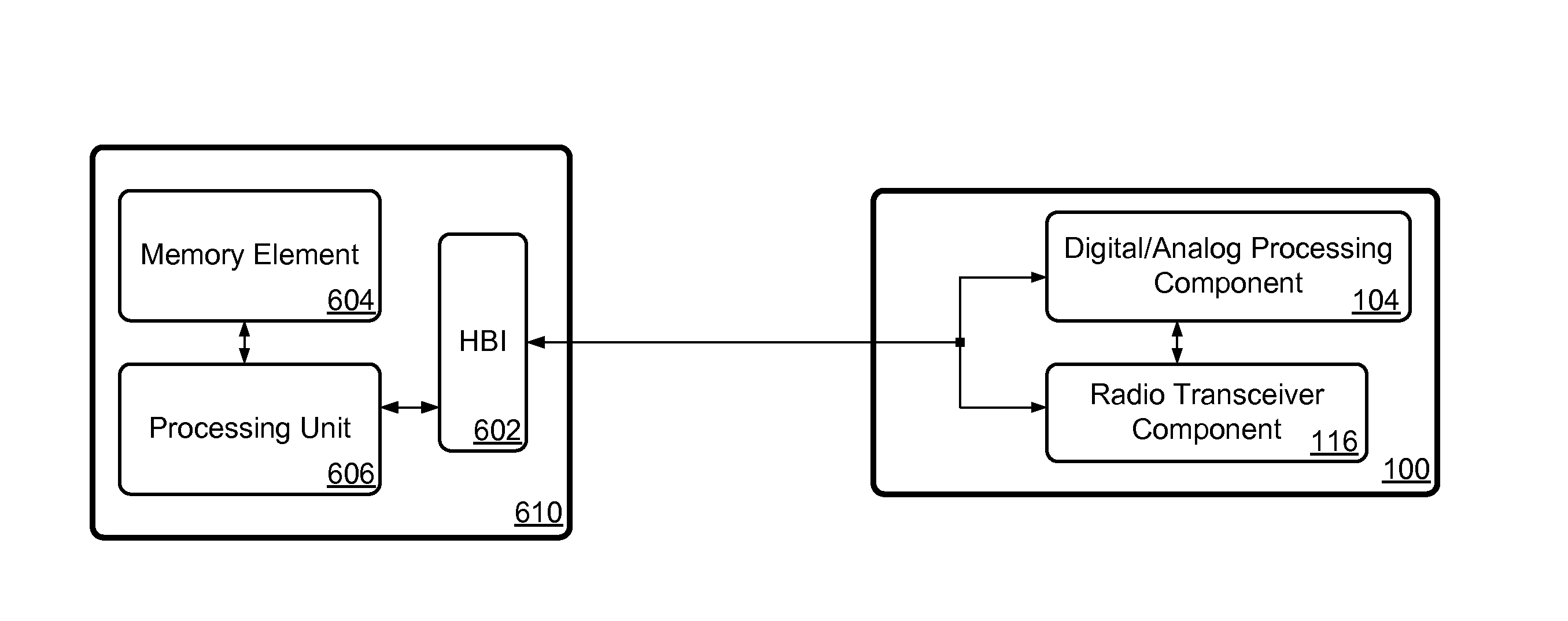
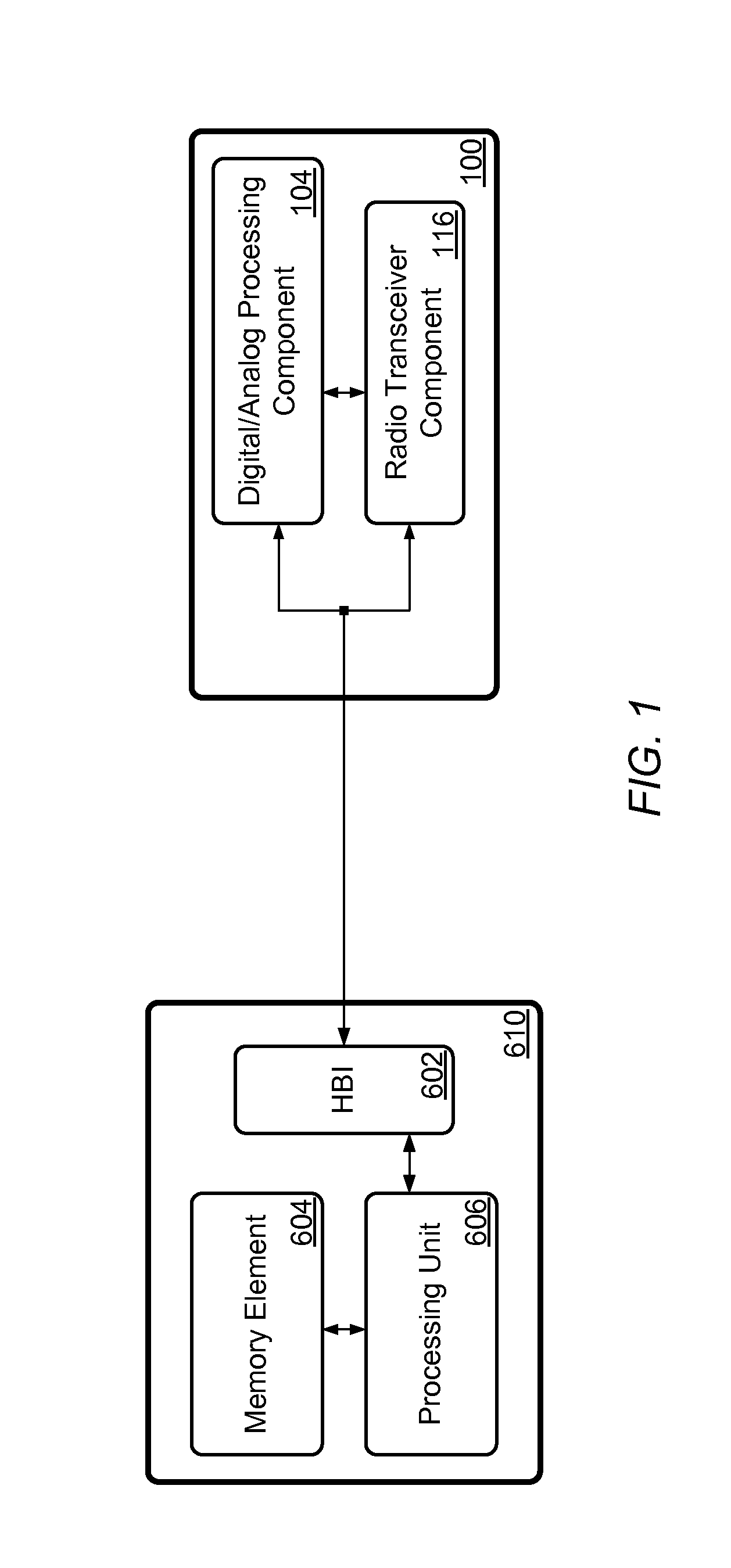
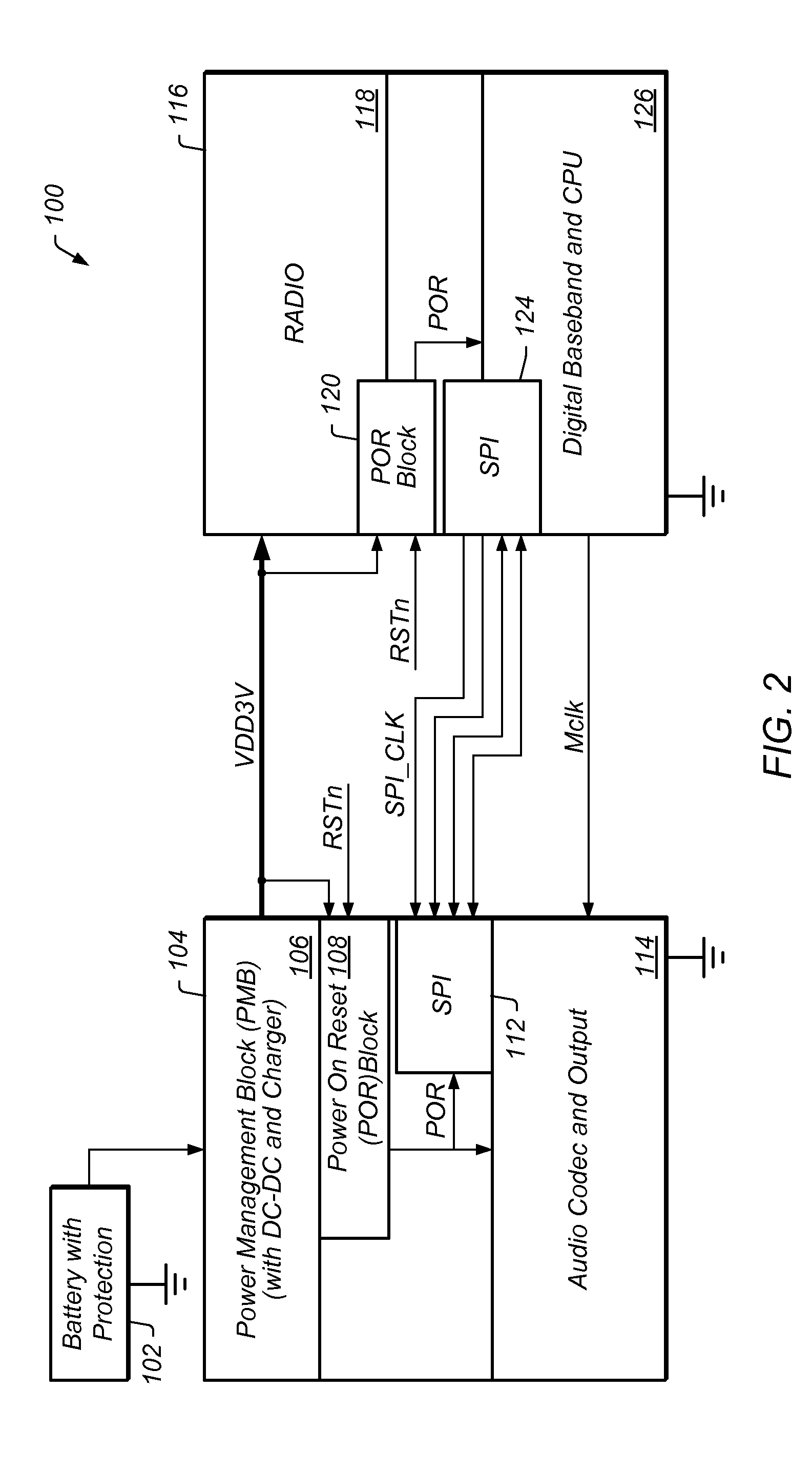
[0021]FIG. 1 shows the partial block diagram of one embodiment of a system that includes a Radio Frequency (RF) transceiver system 100 divided into two main functional components: a Digital / Analog Processing Component (DAPC) 104 and a Radio Transceiver Component (RTC) 116. DAPC 104 and RTC 116 may each be configured on an Integrated Circuit (IC) or on respective ICs, and may interface with each other via a number of signals (more details of RF transceiver system 100 are shown in FIG. 2 and are discussed in more detail below). DAPC 104 and RTC 116 may also couple to components of a host system 610 through a host bus interface (HBI) 602. Host system 610 may include one or more memory elements 604 that store program code executable by a processing unit 606 (which may be a general purpose central processing unit, or a microcontroller or some similar component) to perform various control operations on RF transceiver system 100. In turn, RF transceiver system 100 may provide certain feedb...

the structure of the environmentally friendly knitted fabric provided by the present invention; figure 2 Flow chart of the yarn wrapping machine for environmentally friendly knitted fabrics and storage devices; image 3 Is the parameter map of the yarn covering machine
Login to View More

PUM

No PUM Login to View More

Abstract

An audio amplifier system may include an audio CODEC/output (AOP) path featuring analog class-D amplifiers, and using Natural Sampling Pulse Width Modulation (PWM) to convert an analog input into a series of Rail-to-Rail pulses. The audio signal may be encoded in the average value of the PWM pulse train and may be recovered from the PWM signal by analog low pass filtering. The Class-D amplifiers may be designed with a negative feedback loop/network to compare the output signal with the input signal and suppress non-idealities introduced by the Class-D switching stage. Furthermore, operation of the AOP may be designed according to a separate signal transfer function and a separate noise transfer function, and 2nd order noise shaping may be performed at low power, with an optimized filter included in the feedback loop to achieve the best noise reduction at low power. Operation of the amplifier feedback network may be similar to that of a continuous time, low-pass delta-sigma modulator, but with a PWM loop wrapped around the class-D power amplifier.

Description

the structure of the environmentally friendly knitted fabric provided by the present invention; figure 2 Flow chart of the yarn wrapping machine for environmentally friendly knitted fabrics and storage devices; image 3 Is the parameter map of the yarn covering machine
Login to View More

Claims

the structure of the environmentally friendly knitted fabric provided by the present invention; figure 2 Flow chart of the yarn wrapping machine for environmentally friendly knitted fabrics and storage devices; image 3 Is the parameter map of the yarn covering machine
Login to View More

Application Information

Patent Timeline
no application Login to View More
Owner SMSC HLDG
Features
  • R&D
  • Intellectual Property
  • Life Sciences
  • Materials
  • Tech Scout
Why Patsnap Eureka
  • Unparalleled Data Quality
  • Higher Quality Content
  • 60% Fewer Hallucinations
Social media
Patsnap Eureka Blog
Learn More