
Method and system for controlling building energy use
a technology for building energy use and control, applied in the field of building energy conservation, can solve the problems of inefficient cooling, uncontrolled and rapid deterioration of mechanical system components, and simultaneous cooling and heating, and achieve the effect of reducing energy consumption
- Summary
- Abstract
- Description
- Claims
- Application Information
AI Technical Summary
Benefits of technology
Problems solved by technology
Method used
Image

Examples
Embodiment Construction
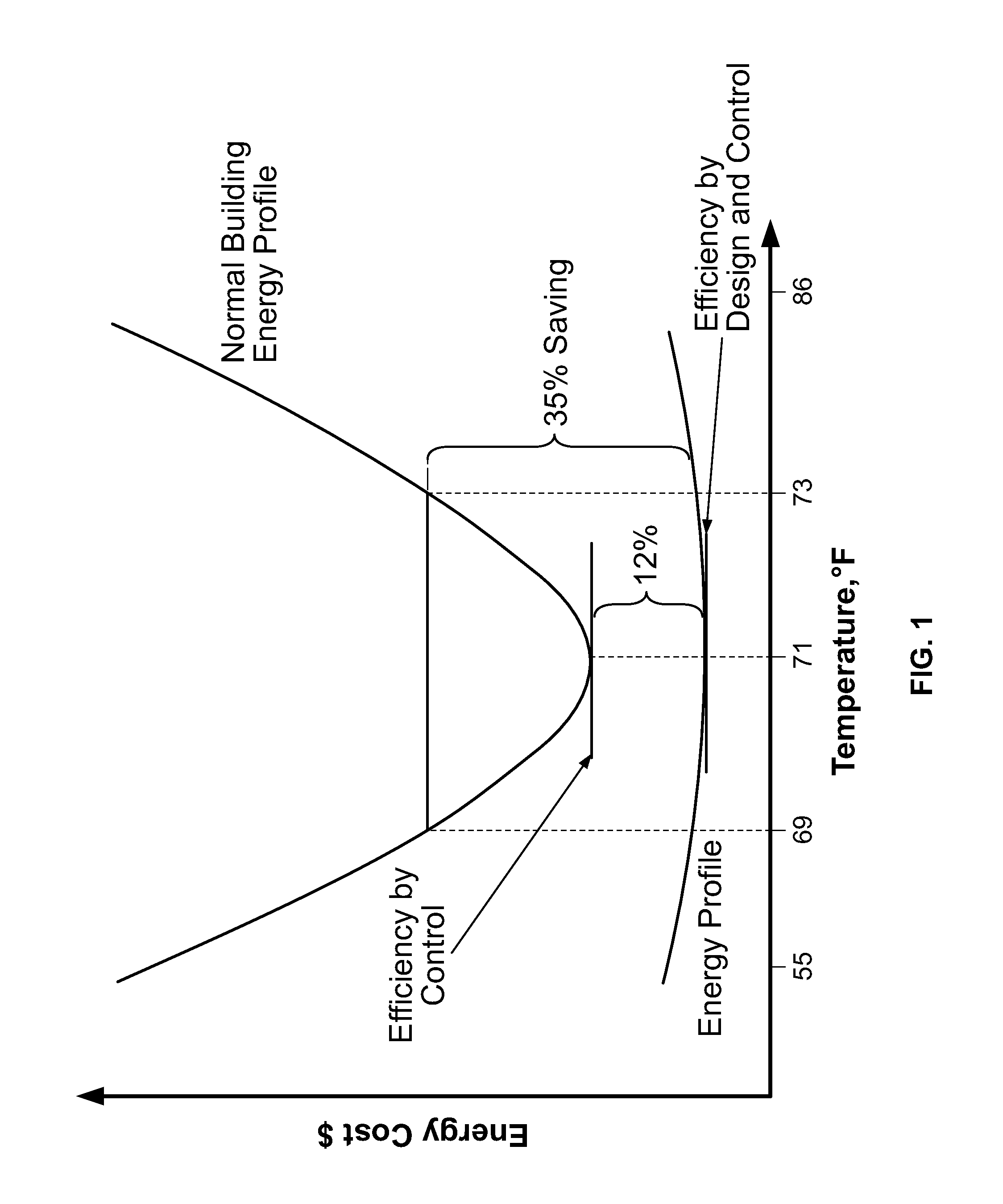
[0026]The present system deals with the above mentioned HVAC efficiencies, control and monitoring efficiencies because they generally have the fastest payback time (e.g., less than 3 years) in a retrofitted building. Relative efficiencies achievable with the present system are shown in FIG. 1 at the intermediate and lower curves. The present system provides HVAC optimization, monitoring and control application incorporating software similar to that offered commercially by Silver Springs Network, where the Silver Springs Network software is the “back end”, and the present system is the “front end with” applications on e.g. large buildings. The present system can be installed together with either commercially available Echelon (power line communication medium) or Silver Springs type software. The present system offers full time auto commissioning. The wireless (radio local area network) medium is that offered by e.g. Silver Springs Network, Echelon, their competitors or the Smart Grid...
PUM
 Login to View More
 Abstract
Description
Claims
Application Information
 Login to View More