However, such developments in smart-phones and tablet computers lead to an increase in
power consumption as compared to conventional communication-only electronic devices.
Furthermore, to facilitate graphic data presentation, the screen size of new generation smart-phones and tablet computers becomes bigger and, thus, vulnerable to crashes or scratches.
As a consequence, these two items are inseparable from each other, thus causing the following drawbacks.
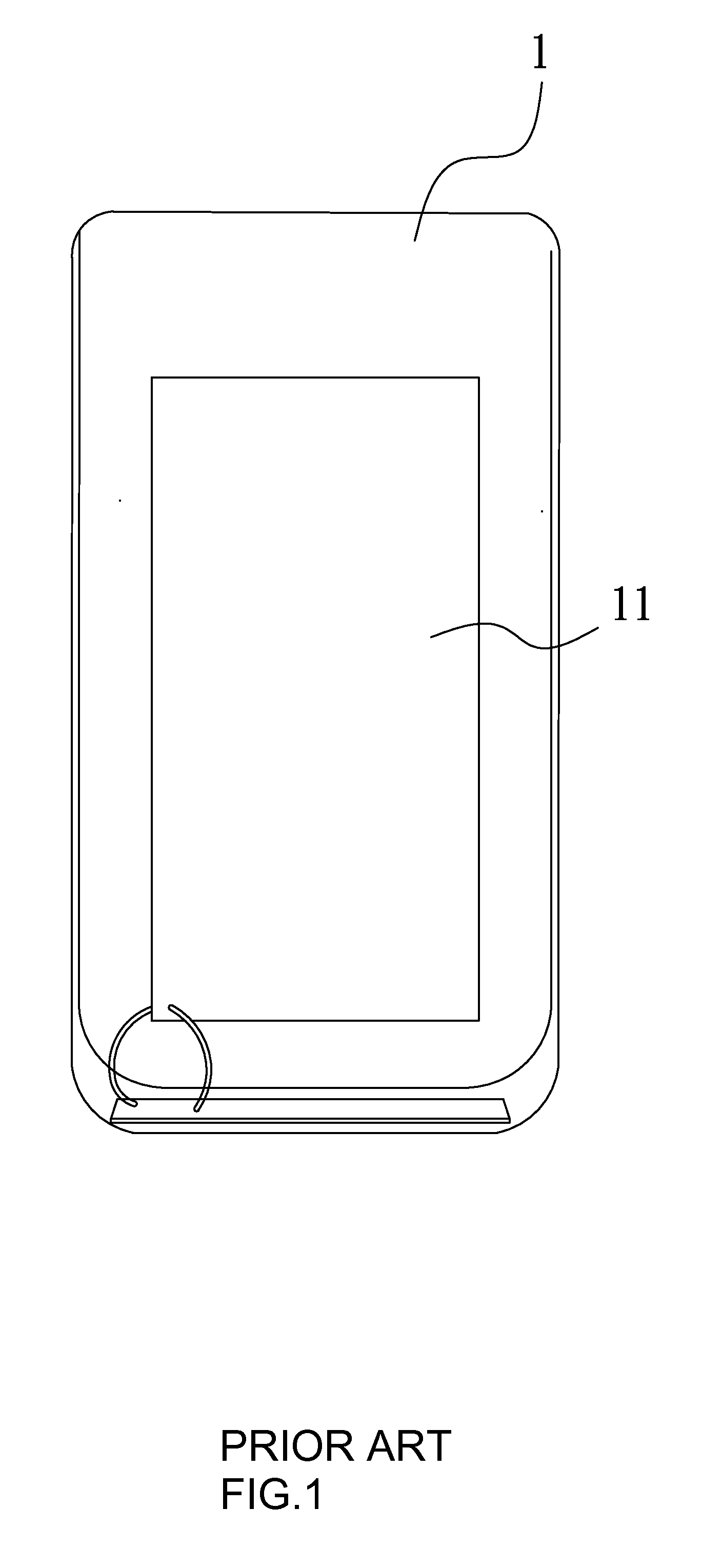
First, once the auxiliary rechargeable battery 11 has run out of
electricity, it is inevitable to uninstall it along with the protective case from the mobile communication device for recharging.
If the protection function is chosen to be retained, the battery still need be carried along and undesirably add extra burden even it is already known that the auxiliary rechargeable battery cannot supply power.
Meanwhile, if the user chooses to take off the auxiliary rechargeable battery for recharging, then the protective case need be detached as well and the original objective of protection for the mobile communication device may not be achieved.
Moreover, with such an inseparable design of case body along with the auxiliary battery, in case that the original battery of the mobile communication device itself is already well charged, the user is unable to simply select the protection feature alone and still has to carry an additional auxiliary rechargeable battery.
The design would causes inconvenience for extra weight, even though the user may feel reluctant to carry the auxiliary battery.
That it, although extra
electric power is not required, the user is nonetheless forced to bring the auxiliary rechargeable battery, otherwise the protective case cannot be applied to the mobile communication device.
However, such a situation is repugnant to user's demand for purchase, and also contrary to the initial goal of the
product design.
From the above-said descriptions, it can be seen that the user will inevitably face a dilemma of choice: whether or not to purchase a protective case that is provided with an auxiliary rechargeable battery.
Such a design apparently fails to fulfill the actual need of users and appears to be quite unfriendly to the users.
For example, if a traveler carries a high power consumptive device, such as a
mobile phone or a
tablet computer along a trip where power recharging may be inconvenient, it is pretty logical that a single auxiliary rechargeable battery would be insufficient for providing power to the device.
However, this approach would be hindered in the case where the auxiliary rechargeable battery cannot be detached from the protective case.
This situation completely reveals the inconvenience of the design.
A similar problem also exists in case of battery failure as the auxiliary rechargeable battery in the conventional design cannot be replaced.
The
usability of the protective case ends when the auxiliary rechargeable battery is ruined.
However, if more serious problems like
battery fluid leakage occur, the user will have to discard the battery in conjunction with the protective case, or else the mobile communication device or the user may be adversely influenced.


 Login to View More
  Login to View More