Radio parameter control apparatus, base station apparatus, radio parameter control method, and non-transitory computer readable medium
- Summary
- Abstract
- Description
- Claims
- Application Information
AI Technical Summary
Benefits of technology
Problems solved by technology
Method used
Image



Examples
first embodiment
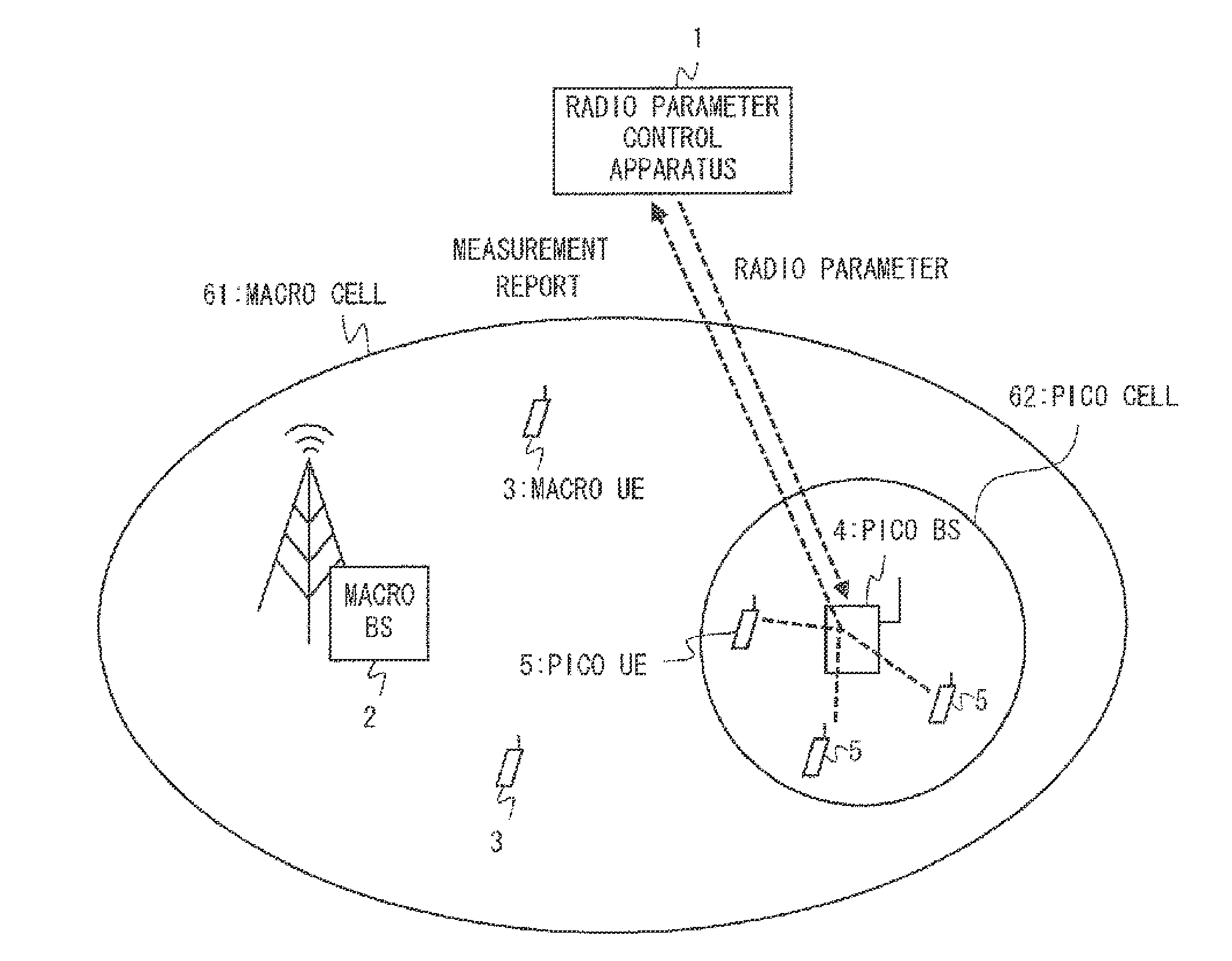
[0038]FIG. 1 is a diagram showing a configuration example of a network including a radio parameter control apparatus 1 according to this embodiment. A macro base station (macro BS) 2 form a macro cell 61 and performs bi-directional communication with a mobile station 3. Hereinafter, the mobile station 3 that connects to and communicates with the macro cell 61 is referred to as a macro mobile station (macro UE: User Equipment). The macro BS 2 is connected with an upper network (not shown) and relays traffic between the macro UE 3 and the upper network. The upper network includes a radio access network and a core network.
[0039]A pico base station (pico BS)4 is located within the macro cell 61, forms a pico cell 62 that has a smaller cell size than the macro cell 61, and performs bi-directional communication with a mobile station 5. Hereinafter, the mobile station 5 that connects to and communicates with the pico cell 62 is referred to as a pico mobile station (pico UE). The pico BS 4 ...
first specific example
[0056]In the first specific example, the radio parameter control apparatus 1 determines the updated value of a radio parameter so that a position in which the number of samples of radio quality of the pico cell 62 (i.e., the number of reports from UE) is smaller than the current value in the distribution of radio quality of the pico cell 62, which is obtained using a plurality of measurement reports, becomes the cell edge. To be more specific, the radio parameter control apparatus 1 calculates the current value of the number of cell-edge UEs and the predicated value of the number of cell-edge UEs by assuming that the transmission power of the pico BS 4 is changed, using measurement reports from the pico UE 5, without using measurement reports from the macro UE 3. Then, the radio parameter control apparatus 1 determines, as the updated value of the radio parameter, a value of the radio parameter (i.e., the transmission power of the pico BS 4 in this example) that gives a predicated v...
second specific example
[0073]A second specific example of a process of determining a radio parameter updated value by the radio parameter control apparatus 1 is described here. In the second specific example, the radio parameter control apparatus 1 calculates a current value of the number of cell-edge UEs using measurement reports from the pico UE 5, without using measurement reports from the macro UE 3. Then, the radio parameter control apparatus 1 repeatedly calculates “a current value” of the number of cell-edge UEs each time the radio parameter is changed, compares the calculated “current value” with the “past value” of the number of cell-edge UEs (i.e., the number of cell-edge UEs under the previous radio parameter) and thereby determines the value of the radio parameter by which a smaller number of cell-edge UEs is obtained.
[0074]FIG. 11 is a flowchart showing the second specific example. Steps S101 to S103 of FIG. 11 are the same as Steps S101 to S103 of FIG. 7. In Step S204, the radio parameter de...
PUM
 Login to View More
 Abstract
Description
Claims
Application Information
 Login to View More