Adaptive Reference/Non-reference Frame Determination for Video Encoding
a video coding and reference frame technology, applied in the field of video coding process and video coding system, can solve the problems of more dependent video compression cost on the quantity of coded bits, more on the distortion (or image quality), and predetermined frame type structure with fixed lambda table may not perform well in terms of video compression for all scenes
- Summary
- Abstract
- Description
- Claims
- Application Information
AI Technical Summary
Benefits of technology
Problems solved by technology
Method used
Image

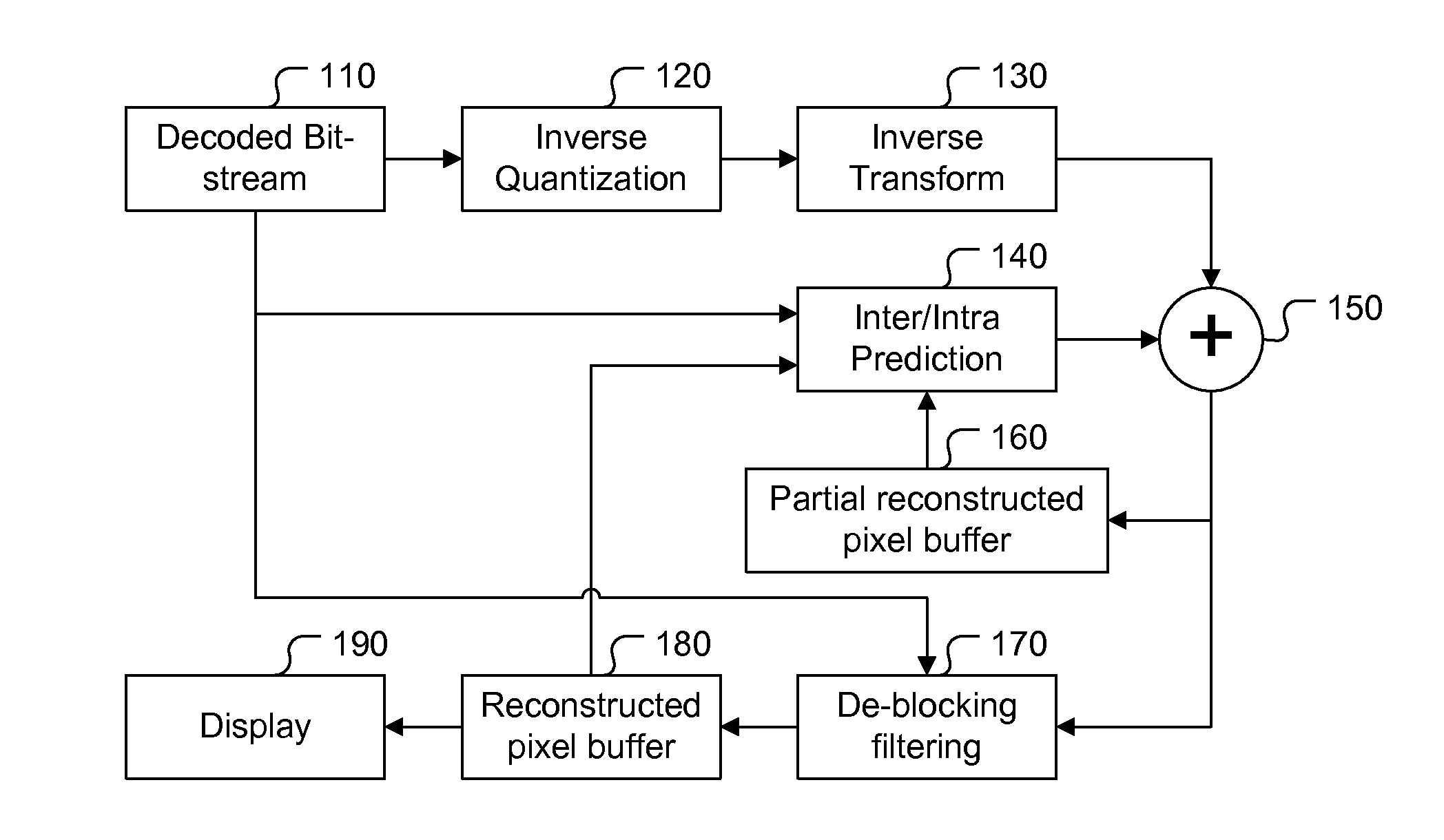


Examples
Embodiment Construction
[0031]In the invention, a method of adaptively determining reference / non-reference type and lambda table for image units in a video coding system is illustrated. The image unit can be a frame or a slice, where each slice consists of a group of coding units. The reference type denotes each image unit to be referenced or non-referenced by other image units. Therefore, the image unit can be assigned to be a reference Intra coded type, non-reference Intra coded type, reference predicted type, non-reference predicted type, reference bi-directional predicted type, and non-reference bi-directional predicted type and so on. Thus, one frame can be determined as a reference I-frame, non-reference I-frame, reference P-frame, non-reference P-frame, reference B-frame or non-reference B-frame, etc.
[0032]To determine the image unit (e.g. frame or slice) type structure of a video sequence or a group of image units, adaptive methods are used to determine a reference type of each image unit. Then the...
PUM
 Login to View More
 Abstract
Description
Claims
Application Information
 Login to View More