Unlock instant, AI-driven research and patent intelligence for your innovation.

Autonomous seismic nodes for the seabed

a technology of autonomous seismic nodes and seabed, applied in the field of marine seismic systems, can solve the problems of cumbersome connection wire approach, less than ideal storage, handling and stability, and handling and assembly errors

Active Publication Date: 2016-02-11
SEABED GEOSOLUTIONS
View PDF9 Cites 38 Cited by
  • Summary
  • Abstract
  • Description
  • Claims
  • Application Information

AI Technical Summary

Benefits of technology

The patent text describes different embodiments of an autonomous seismic node that can be used on the seabed. The node has a unique design that allows for easy storage, handling, and deployment. It has a modular design that allows for flexibility and customization, and can be used to carry various other devices or payloads. The technical benefits of this new design include improved efficiency, flexibility, and customization options for seismic monitoring.

Problems solved by technology

Traditional prior art nodes are often made of tubes of various shapes that are joined and / or coupled together with cables, which can be vulnerable to handling and assembly errors.
Other prior nodes can be made of spherical glass pressure housings that need additional protection and are less than ideal for storage, handling, and stability when on the seabed.
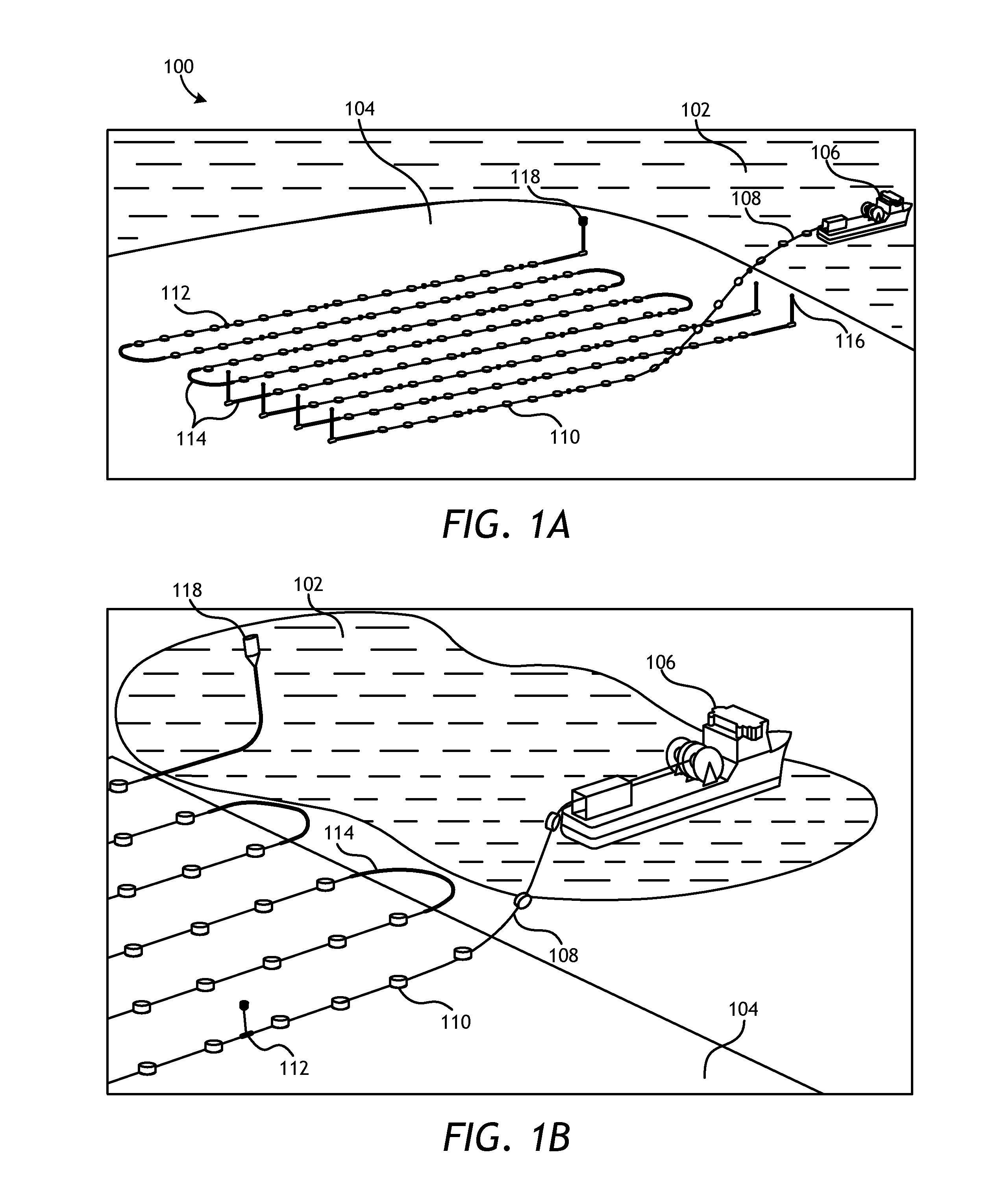
This connecting wire approach is cumbersome because the wires can get tangled or knotted, and the seismic nodes and related wiring can become snagged or tangled with structures or debris in the water or on the sea floor or on the marine vessel.
One problem with integration of the casings with the deployment line is that the deployment line becomes difficult to manage and store.
The integrated casings make the line difficult to wind onto spools or otherwise store manageably.
In these embodiments, the node casings remain attached directly in-line with the cable, and therefore, this is a difficult and complex operation to separate the electronics sensor package from the node casings.
The referenced shortcomings are not intended to be exhaustive, but rather are among many that tend to impair the effectiveness of previously known techniques in seafloor deployment systems; however, those mentioned here are sufficient to demonstrate that the methodologies appearing in the art have not been satisfactory and that a significant need exists for the systems, apparatuses, and techniques described and claimed in this disclosure.
As an example, attaching a node to a rope that is coupled to the deployment line often gets tangled during deployment and / or retrieval to the seabed, and does not consistently land flat on the seabed, which can cause poor seabed / node coupling and noise.
The spiraling of the tether cable can also cause problems during the retrieval when separating the node from the cable.
Further, prior techniques of pre-mounted node casings on the deployment line or pre-cut connecting ropes / wires between the node and the deployment line do not allow for a flexible change in adjacent node spacing / distance; any change of node spacing requires significant amount of cost and time.
Further, the techniques in which such nodes are deployed and retrieved from a marine vessel, as well as the manner in which such nodes are stored and handled on the vessel, suffer from many disadvantages.

Method used

the structure of the environmentally friendly knitted fabric provided by the present invention; figure 2 Flow chart of the yarn wrapping machine for environmentally friendly knitted fabrics and storage devices; image 3 Is the parameter map of the yarn covering machine
View more

Image

Smart Image Click on the blue labels to locate them in the text.
Viewing Examples
Smart Image
  • Autonomous seismic nodes for the seabed
  • Autonomous seismic nodes for the seabed
  • Autonomous seismic nodes for the seabed

Examples

Experimental program
Comparison scheme
Effect test

Embodiment Construction

[0024]Various features and advantageous details are explained more fully with reference to the non-limiting embodiments that are illustrated in the accompanying drawings and detailed in the following description. Descriptions of well-known starting materials, processing techniques, components, and equipment are omitted so as not to unnecessarily obscure the invention in detail. It should be understood, however, that the detailed description and the specific examples, while indicating embodiments of the invention, are given by way of illustration only, and not by way of limitation. Various substitutions, modifications, additions, and / or rearrangements within the spirit and / or scope of the underlying inventive concept will become apparent to those skilled in the art from this disclosure. The following detailed description does not limit the invention.

[0025]Reference throughout the specification to “one embodiment” or “an embodiment” means that a particular feature, structure, or chara...

the structure of the environmentally friendly knitted fabric provided by the present invention; figure 2 Flow chart of the yarn wrapping machine for environmentally friendly knitted fabrics and storage devices; image 3 Is the parameter map of the yarn covering machine
Login to View More

PUM

No PUM Login to View More

Abstract

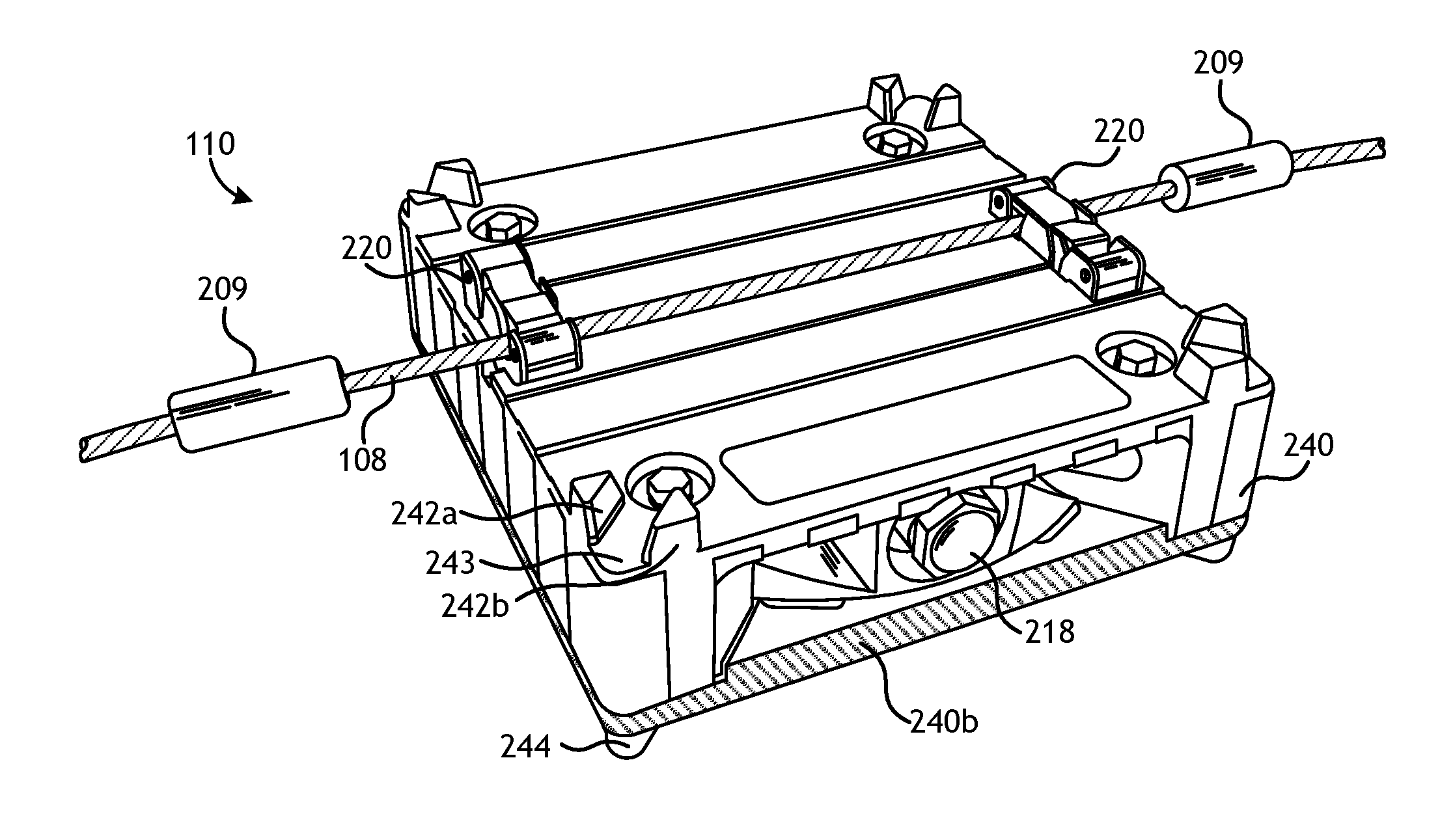
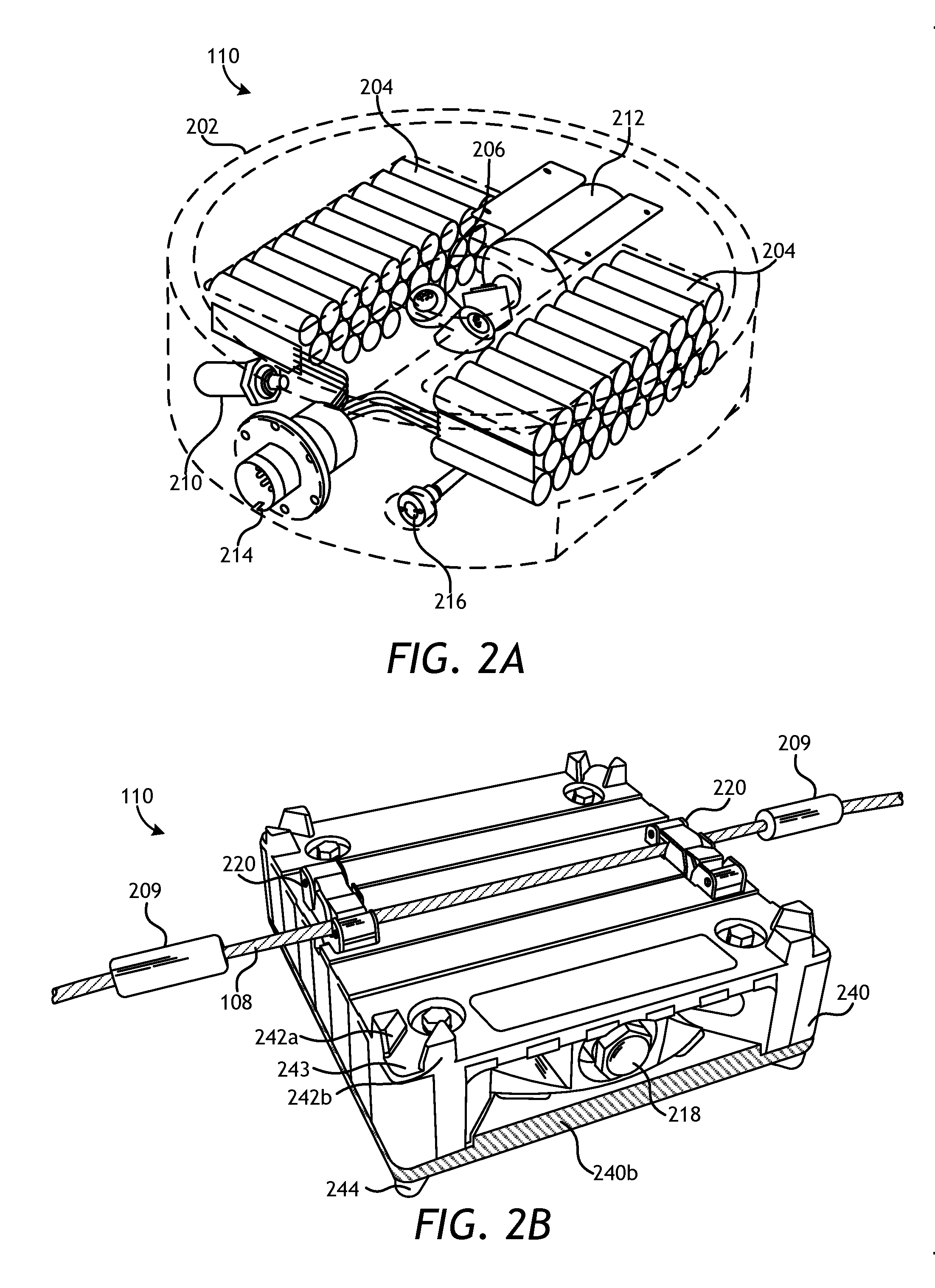
Embodiments of an autonomous seismic node that can be positioned on the seabed are disclosed. The autonomous seismic node comprises a pressurized node housing substantially surrounded and / or enclosed by a non-pressurized node housing. The seismic node may be substantially rectangular or square shaped for node storage, handling, and deployment. One or more node locks may be coupled to either (or both) of the pressurized node housing or the non-pressurized node housing. The pressurized node housing may be formed as a cast monolithic titanium structure and may be a complex shape with irregularly shaped sides and be asymmetrical. In other embodiments, a non-pressurized housing may substantially enclose other devices or payloads besides a node, such as weights or transponders, and be coupled to a plurality of protrusions.

Description

PRIORITY[0001]This application claims priority to U.S. provisional patent application No. 62 / 034,584, filed on Aug. 7, 2014, and U.S. provisional patent application No. 62 / 044,471, filed on Sep. 2, 2014, the entire contents of which is incorporated herein by reference.BACKGROUND OF THE INVENTION[0002]1. Field of the Invention[0003]This invention relates to marine seismic systems and more particularly relates to autonomous seismic nodes that may be deployed on the seabed.[0004]2. Description of the Related Art[0005]Marine seismic data acquisition and processing generates a profile (image) of a geophysical structure under the seafloor. Reflection seismology is a method of geophysical exploration to determine the properties of the Earth's subsurface, which is especially helpful in determining an accurate location of oil and gas reservoirs or any targeted features. Marine reflection seismology is based on using a controlled source of energy (typically acoustic energy) that sends the ene...

Claims

the structure of the environmentally friendly knitted fabric provided by the present invention; figure 2 Flow chart of the yarn wrapping machine for environmentally friendly knitted fabrics and storage devices; image 3 Is the parameter map of the yarn covering machine
Login to View More

Application Information

Patent Timeline
no application Login to View More
IPC IPC(8): G01V1/18G01V1/38
CPCG01V1/18G01V2210/1427G01V1/3852G01V1/38
Inventor NAES, JOHAN FREDRIKHENMAN, RICHARD EDWARDROKKAN, ARNE HENNINGLARSEN, LEIF JOHANERVIK, MARIANN
Owner SEABED GEOSOLUTIONS