Unlock instant, AI-driven research and patent intelligence for your innovation.

Systems and methods for determining a position of a transmitter of a bistatic radar system

Active Publication Date: 2016-02-18
THE BOEING CO
View PDF4 Cites 3 Cited by
  • Summary
  • Abstract
  • Description
  • Claims
  • Application Information

AI Technical Summary

Benefits of technology

The present patent provides a bistatic radar system and method that can determine the position of a transmitter based on the distance between the transmitter and a target, as well as the angle between reflected and direct radar signals. This can be useful in various applications such as in autonomous vehicles. The system includes a transmitter position determination unit that can determine the position of the transmitter without communicating it. The system can also determine the elevation of the transmitter and target relative to the receiver. Overall, the technical effect of this patent is to provide a more accurate and efficient bistatic radar system for positioning and navigation.

Problems solved by technology

However, providing a communication system between the transmitter and the receiver increases the cost and complexity of a radar system.
Further, if the communication system malfunctions or is inoperative, the entire radar system is also inoperative.
Additionally, if the transmitter and the receiver are controlled by separate and distinct entities, the system may not be able to operate.

Method used

the structure of the environmentally friendly knitted fabric provided by the present invention; figure 2 Flow chart of the yarn wrapping machine for environmentally friendly knitted fabrics and storage devices; image 3 Is the parameter map of the yarn covering machine
View more

Image

Smart Image Click on the blue labels to locate them in the text.
Viewing Examples
Smart Image
  • Systems and methods for determining a position of a transmitter of a bistatic radar system
  • Systems and methods for determining a position of a transmitter of a bistatic radar system
  • Systems and methods for determining a position of a transmitter of a bistatic radar system

Examples

Experimental program
Comparison scheme
Effect test

Embodiment Construction

[0027]The foregoing summary, as well as the following detailed description of certain embodiments will be better understood when read in conjunction with the appended drawings. As used herein, an element or step recited in the singular and proceeded with the word “a” or “an” should be understood as not excluding plural of the elements or steps, unless such exclusion is explicitly stated. Further, references to “one embodiment” are not intended to be interpreted as excluding the existence of additional embodiments that also incorporate the recited features. Moreover, unless explicitly stated to the contrary, embodiments “comprising” or “having” an element or a plurality of elements having a particular property may include additional elements not having that property.

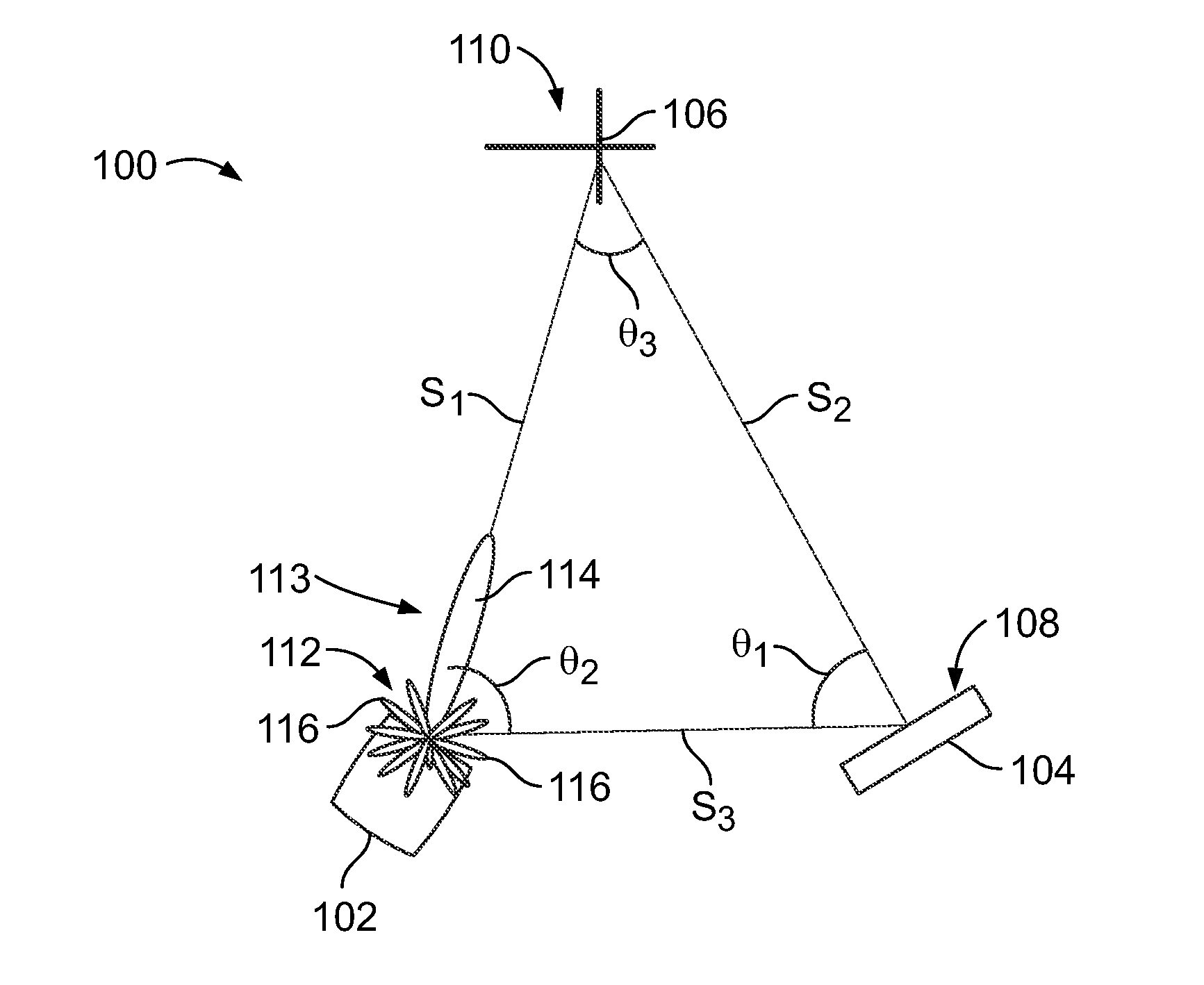
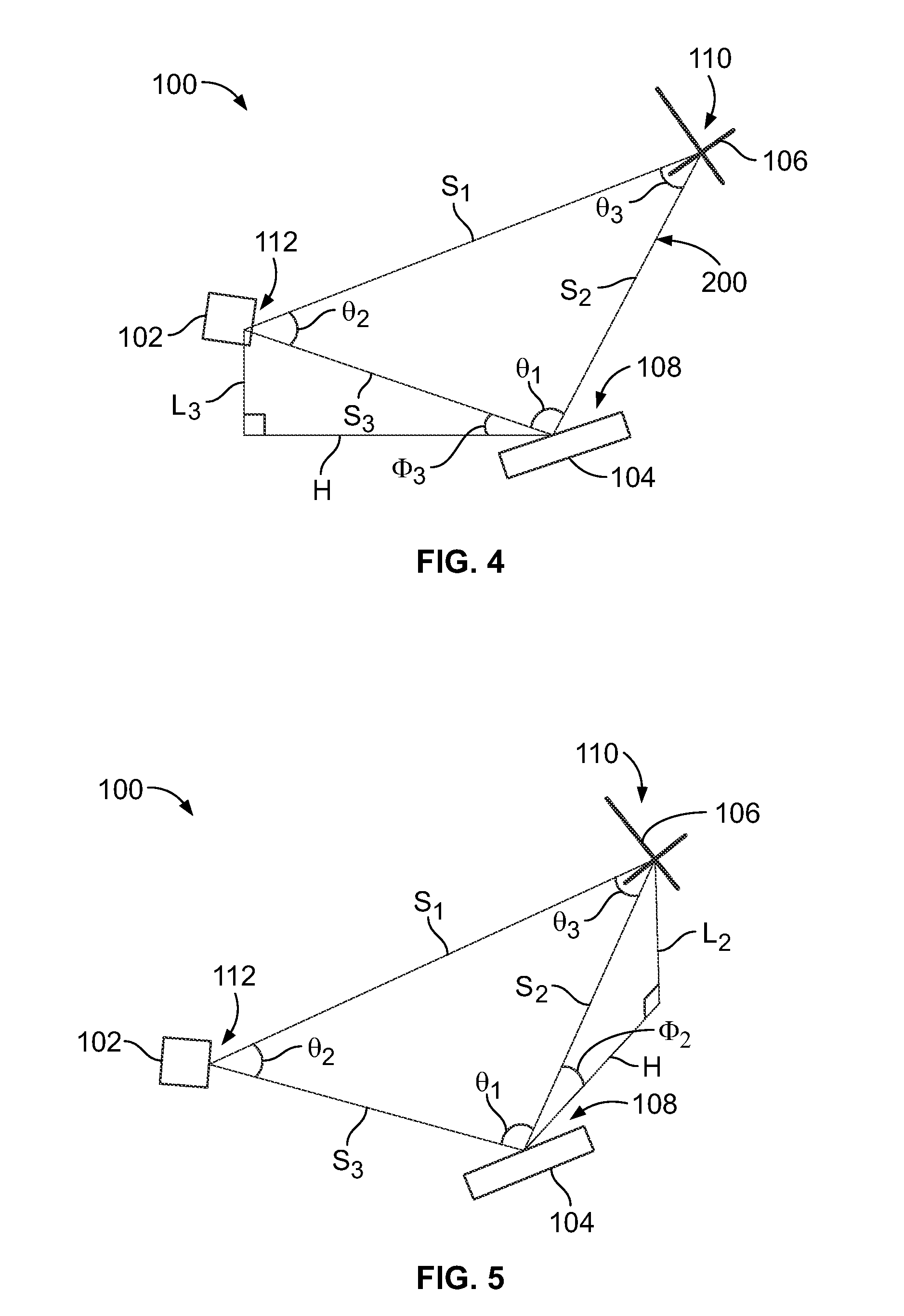
[0028]Embodiments of the present disclosure provide systems and methods of determining a position of a transmitter of a bistatic radar system. The transmitter may refrain from communicating with a receiver. For example, t...

the structure of the environmentally friendly knitted fabric provided by the present invention; figure 2 Flow chart of the yarn wrapping machine for environmentally friendly knitted fabrics and storage devices; image 3 Is the parameter map of the yarn covering machine
Login to View More

PUM

No PUM Login to View More

Abstract

A bistatic radar system may include a transmitter, a target at a first known position, a receiver at a second known position, and a transmitter position determination unit. The receiver is configured to receive one or more reflected radar signals transmitted from the transmitter and reflected off the target. The receiver is configured to receive one or more direct radar signals transmitted from the transmitter. The transmitter position determination unit is configured to determine a position of the transmitter based on a determination of a distance between the first and second known positions and a determination of a first angular difference between the reflected radar signal(s) and the direct radar signal(s) that are received by the receiver.

Description

BACKGROUND OF THE DISCLOSURE[0001]Embodiments of the present disclosure generally relate to radar systems and methods.[0002]Radio detection and ranging (radar) systems generally use radio waves to determine a range, altitude, direction and / or speed of objects. Radar systems may be used to detect aircraft, ships, vehicles, guided missiles, weather, terrain, and the like. In general, a radar transmitter or illuminator includes an antenna that transmits pulses of radio waves or microwaves that encounter and reflect off an object. A portion of the energy of the reflected wave is received by an antenna of a radar receiver.[0003]In a monostatic radar system, the transmitter and receiver are located at the same position (that is, collocated). In contrast, a bistatic radar system includes a transmitter and a receiver at separate and distinct positions. For example, the transmitter and receiver of a bistatic radar system may be separated by hundreds of miles.[0004]In order for a bistatic rad...

Claims

the structure of the environmentally friendly knitted fabric provided by the present invention; figure 2 Flow chart of the yarn wrapping machine for environmentally friendly knitted fabrics and storage devices; image 3 Is the parameter map of the yarn covering machine
Login to View More

Application Information

Patent Timeline
no application Login to View More
IPC IPC(8): G01S5/02G01S13/00
CPCG01S13/003G01S5/0273G01S5/02G01S5/06G01S3/02
Inventor BAKER, JAMES BRYANRAY, GARY ALAN
Owner THE BOEING CO