Check patentability & draft patents in minutes with Patsnap Eureka AI!

Sample preparation method for analysis of acrylamide

Active Publication Date: 2016-07-21
BIOTAGE INC
View PDF18 Cites 5 Cited by
  • Summary
  • Abstract
  • Description
  • Claims
  • Application Information

AI Technical Summary

Benefits of technology

The patent is about a way to extract acrylamide from a food matrix using a special technique called Supported Liquid Extraction. Essentially, this method involves using a water-proof organic solvent to remove the acrylamide from the context in which it's found - which can be helpful in reducing the amount of the potentially harmful chemical in food products.

Problems solved by technology

Because of its polar nature it is extremely difficult to measure using techniques employed by laboratories which are normally designed for the analysis of larger more non polar compounds.
Due to its high polarity and the difficult nature of the matrices many sensitive methods for acrylamide analysis in the literature involve two separate extraction procedures (one performed directly after the other) with methods being expensive, complicated and time consuming to perform.
The majority of literature methods require two solid phase extractions (e.g. (Roach, et al., 2003)), one after the other, making analysis both time consuming and expensive.
Polar analytes are more water soluble, preferring to remain in the water phase and are more difficult to extract into the water immiscible organic solvent using LLE or SLE.

Method used

the structure of the environmentally friendly knitted fabric provided by the present invention; figure 2 Flow chart of the yarn wrapping machine for environmentally friendly knitted fabrics and storage devices; image 3 Is the parameter map of the yarn covering machine
View more

Image

Smart Image Click on the blue labels to locate them in the text.
Viewing Examples
Smart Image
  • Sample preparation method for analysis of acrylamide
  • Sample preparation method for analysis of acrylamide
  • Sample preparation method for analysis of acrylamide

Examples

Experimental program
Comparison scheme
Effect test

example 1

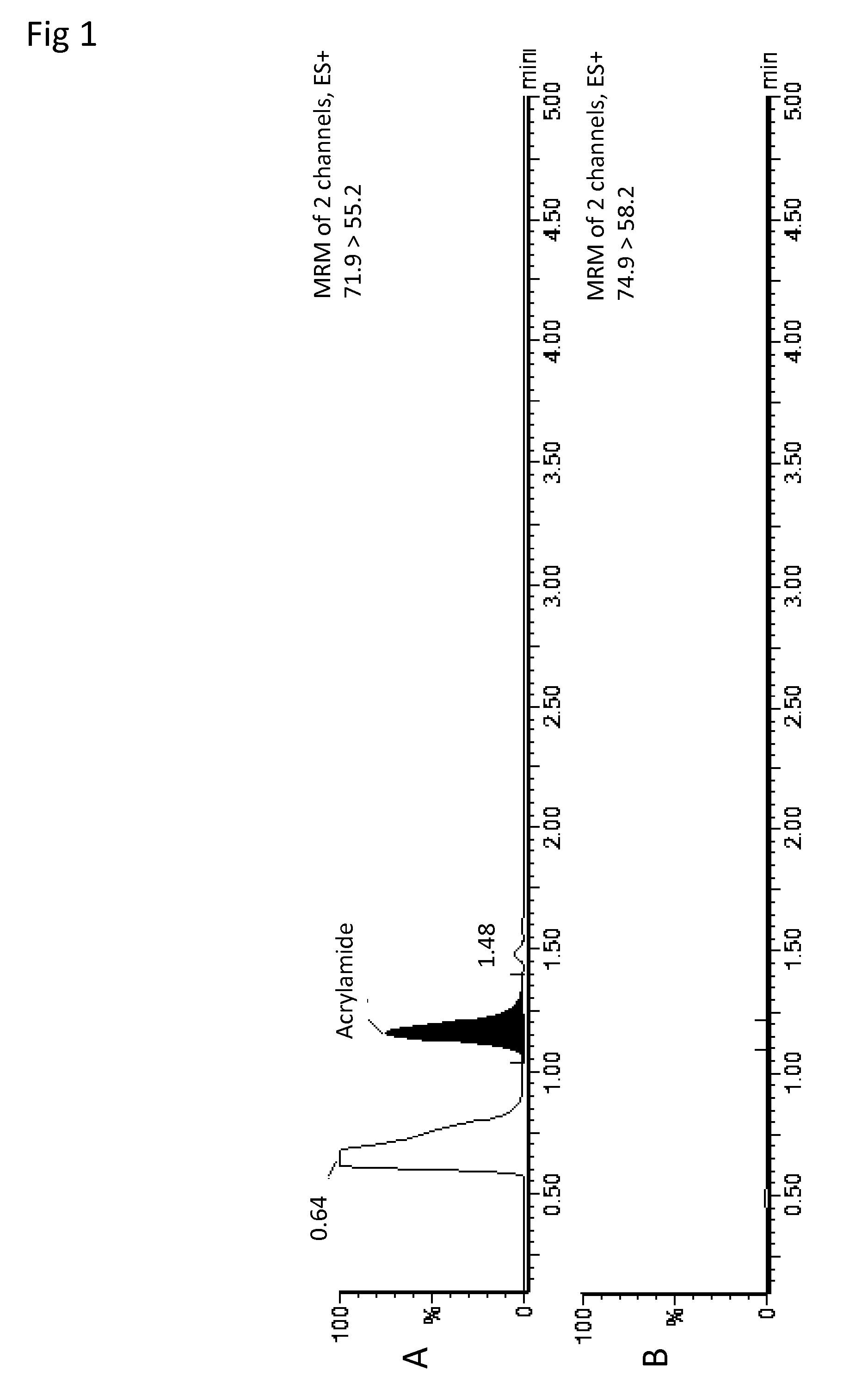
Extraction of Acrylamide from Fried Potato Chips (Crisps) Using ISOLUTE SLE+ Prior to LC-MS / MS Analysis

[0045]This example describes a Supported Liquid Extraction (SLE) protocol for the extraction of Acrylamide from potato chips / crisps using ISOLUTE SLE+ plates with LC-MS / MS detection.

[0046]This method achieves high recoveries of acrylamide in fried potato chips (crisps). The method is potentially sensitive enough to measure levels as low as 10 ppb if necessary in a range of potato chips including a selection of flavored and hand fried varieties.

[0047]Sample Preparation Procedure

[0048]Column Configuration:

[0049]ISOLUTE® SLE+ 1000 supported liquid extraction plate, (Biotage, Uppsala Sweden, part number 820-0140-C)

[0050]Sample Pre-Treatment:

[0051]25 g of crisps were finely crushed to a consistent sample using a pestle and mortar before being transferred to an airtight container. When required, between 0.99 and 1.01 g of crushed crisps was accurately weighed into a 15 mL screw capped ce...

example 2

Extraction of Acrylamide from Coffee Using ISOLUTE SLE+ Prior to LC-MS / MS Analysis

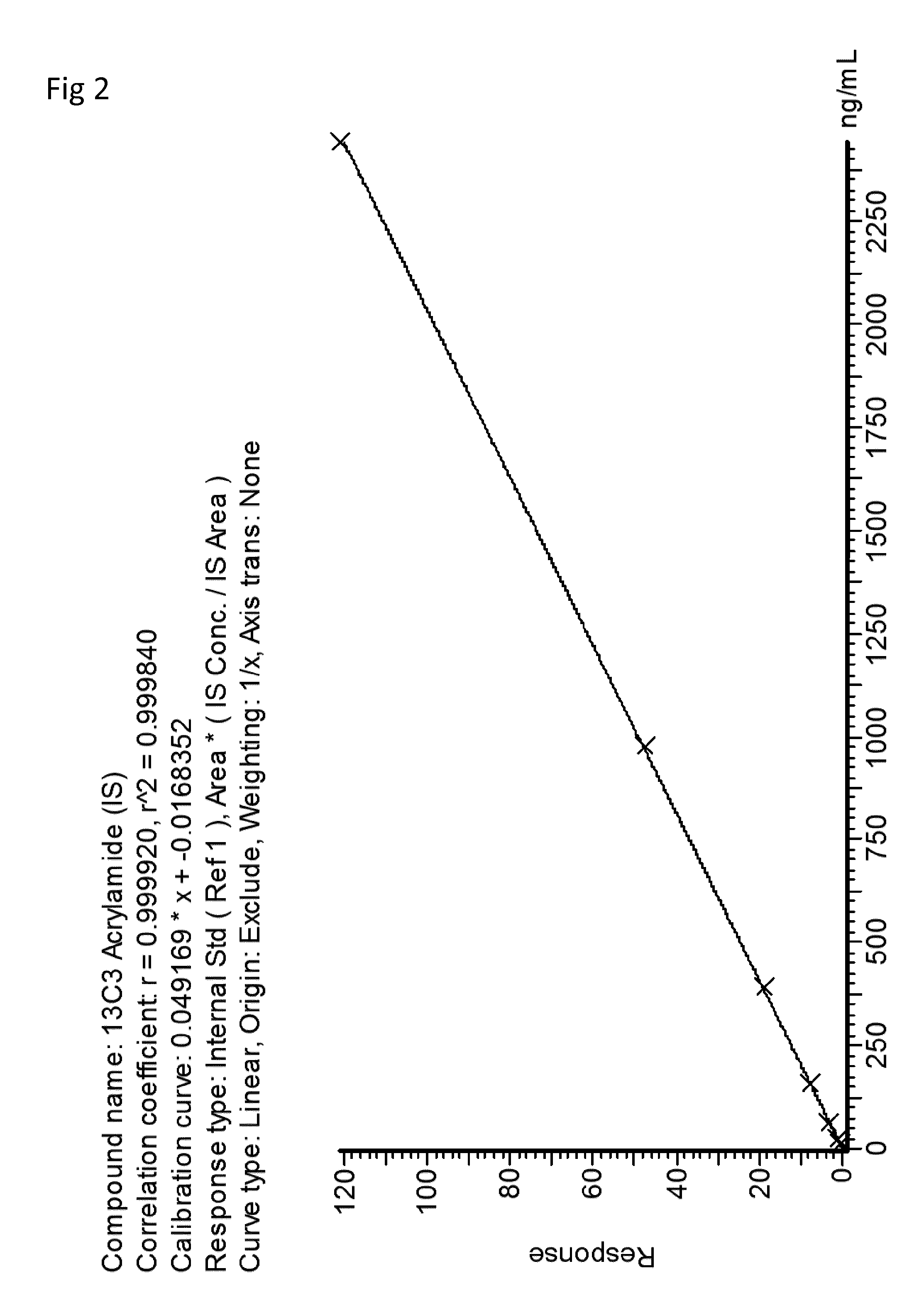
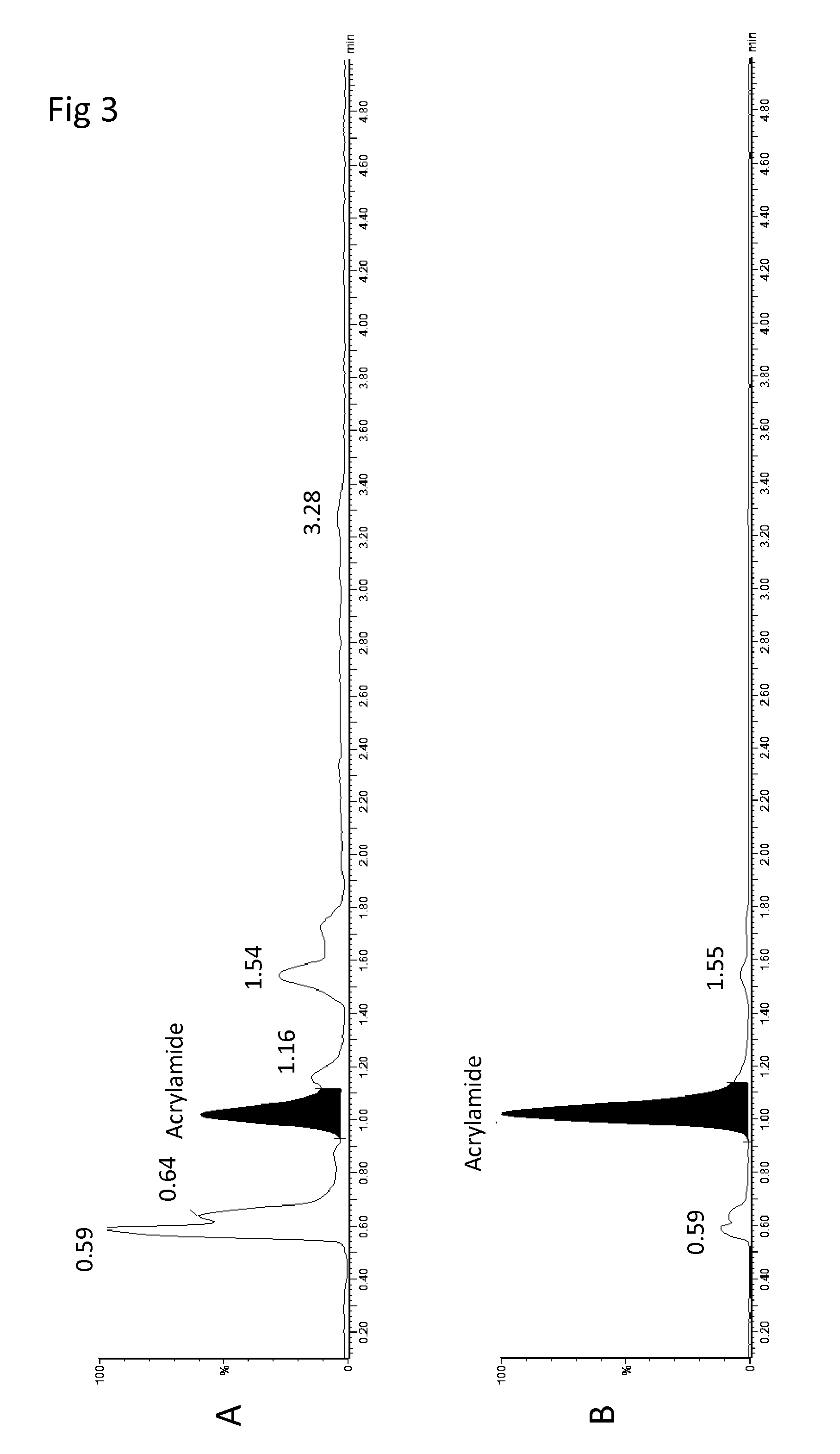
[0089]This example describes a Supported Liquid Extraction (SLE) protocol for the extraction of Acrylamide from coffee using ISOLUTE SLE+ plates with LC-MS / MS detection.

[0090]Introduction

[0091]The method described in this example achieves high recoveries of acrylamide in coffee. The method is sensitive enough to measure levels as low as 1 ng / mL in coffee (solution), 25 ppm in ground coffee (solid) or 125 ppm in instant coffee (solid, traditional or decaffeinated) and gives good selectivity from what is a challenging matrix.

[0092]Sample Preparation Procedure

[0093]Column Configuration:

[0094]ISOLUTE® SLE+ 1000 supported liquid extraction plate, (Biotage, Uppsala Sweden, part number 820-0140-C).

[0095]Sample Pre-Treatment:

[0096]Coffee was prepared in the same way that it would normally be consumed. In the case of ground coffee 60 g of ground coffee was percolated with 1500 mL of boiling water. For instant c...

example 3

Comparison of Different SLE Environments

[0137]It was decided to test the extraction of acrylamide on a variety of SLE environments including different types of SLE from different manufacturers and in different quantities from both crisp extract and coffee.

[0138]SLE Types Investigated

[0139]Isolute SLE+ 400 (Biotage, Sweden)

[0140]Isolute HM-N 1 mL (Biotage, Sweden)

[0141]Thermo Hypersep 7 (Thermo Scientific)

[0142]Thermo Hypersep 9 (Thermo Scientific)

[0143]Method

[0144]Work-Up for Crisp Analysis:

[0145]1 g crisp samples (+ / −0.01 g) were weighed into 15 mL centrifuge tubes

[0146]10 μL of internal standard was added to the tubes and allowed to dry for 30 minutes.

[0147]Add 10 mL water, rotate for 1 hour and centrifuge. The finished tubes had a thin oil layer above an aqueous extract layer above a solid (potato starch).

[0148]Work-Up for Coffee Analysis:

[0149]Remove 20 mL of coffee from the office coffee percolator

[0150]Allow to cool and then add 0.4 mL of concentrated ammonia solution

[0151]Mix...

the structure of the environmentally friendly knitted fabric provided by the present invention; figure 2 Flow chart of the yarn wrapping machine for environmentally friendly knitted fabrics and storage devices; image 3 Is the parameter map of the yarn covering machine
Login to View More

PUM

No PUM Login to View More

Abstract

The present invention relates to a method for extracting acrylamide from a matrix comprising matrix components and acrylamide, comprising the steps: bringing said matrix in contact with water to obtain an aqueous extract, and, optionally, adding a base to the aqueous extract; loading a portion of the aqueous extract obtained in the previous step onto an inert support; allowing the inert support to absorb the aqueous extract; extracting acrylamide from the aqueous extract by passing a water immiscible organic solvent through the inert support; thereby obtaining an organic extract. It further relates to a method for analysing acrylamide content in a matrix comprising matrix components and acrylamide.

Description

FIELD OF THE INVENTION[0001]The present invention relates to preparation of samples for analysis of acrylamide. In particular, it relates to preparation of food samples by Supported Liquid Extraction (SLE).BACKGROUND OF THE INVENTION[0002]Acrylamide analysis has become an area for expansion in recent years with the linking of the carcinogenic molecule with a number of fried or roasted foods and drinks. Tareke et al. (Tareke, et al., 2002) highlighted the potentially carcinogenic properties of the analyte combined with the levels present in foods that have been fried or baked. Analysis in industry is particularly common for coffee and fried potato chips (crisps).[0003]Acrylamide is a very small and polar compound. Because of its polar nature it is extremely difficult to measure using techniques employed by laboratories which are normally designed for the analysis of larger more non polar compounds. Due to its high polarity and the difficult nature of the matrices many sensitive metho...

Claims

the structure of the environmentally friendly knitted fabric provided by the present invention; figure 2 Flow chart of the yarn wrapping machine for environmentally friendly knitted fabrics and storage devices; image 3 Is the parameter map of the yarn covering machine
Login to View More

Application Information

Patent Timeline
no application Login to View More
IPC IPC(8): G01N1/40G01N33/10G01N33/02G01N33/14
CPCG01N1/405G01N33/025G01N33/10G01N33/14B01D11/02G01N33/02G01N1/4055G01N2001/4061G01N2030/062
Inventor EDGINGTON, ALANWILLIAMS, LEE
Owner BIOTAGE INC
Features
  • R&D
  • Intellectual Property
  • Life Sciences
  • Materials
  • Tech Scout
Why Patsnap Eureka
  • Unparalleled Data Quality
  • Higher Quality Content
  • 60% Fewer Hallucinations
Social media
Patsnap Eureka Blog
Learn More