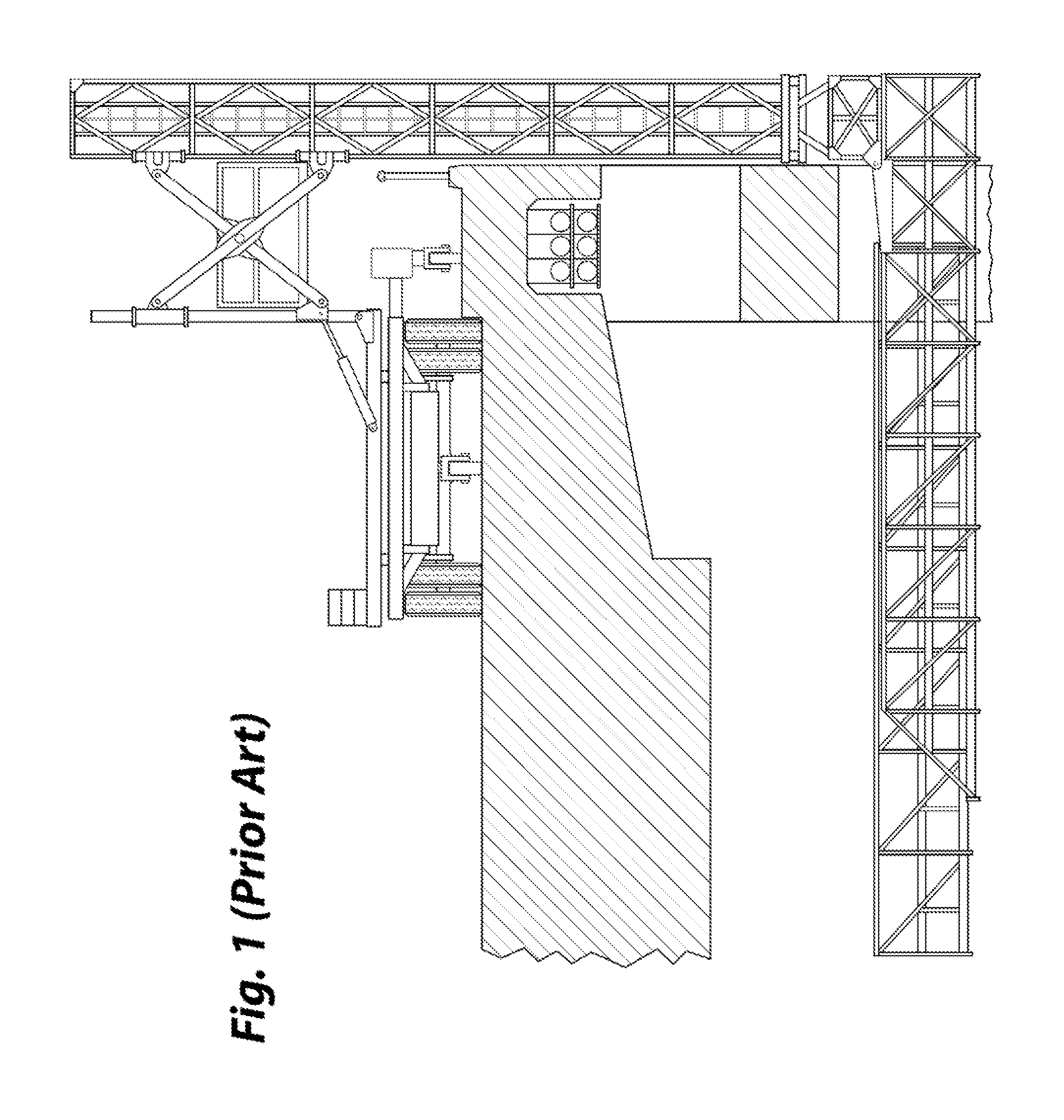
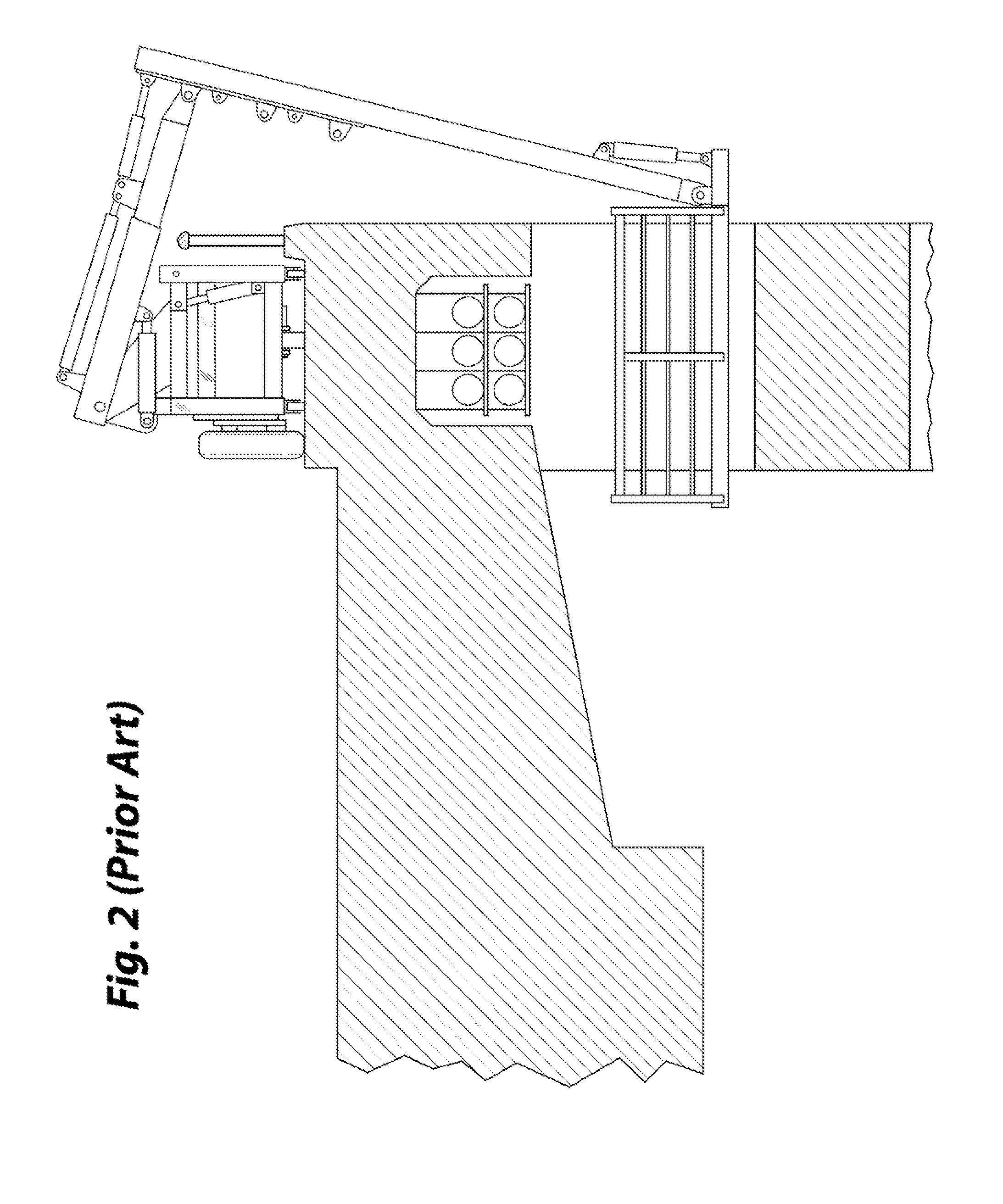
Therefore, the prior-art boom trailers are limited and expensive, and require additional boom trailers to maintain and service bridges.2) No prior art (FIGS. 1 (PRIOR ART) and 2 (PRIOR ART) mention or disclose any boom trailer (having unique dimensions), which can maneuver and work in small areas, nooks, and crannies (for example, in a less-than-30-inch-wide nook or cranny) over and under all:small and large suspension-cable-type bridges (suspension bridges),small and large truss-type bridges,small and large low-power-line bridges,small and large high-power-line bridges,small and large short-supporting-column bridges,small and large tall-supporting-column bridges,small and large single-lane bridges,small and large multiple-lane bridges,small and large regular bridges, andsmall and large rail-road bridges.
Therefore, the prior-art boom trailers are limited in maneuvering through many narrow openings, and require a lot of labor, time, and money to maintain and service bridges.3) No prior art (FIGS. 1 (PRIOR ART) and 2 (PRIOR ART) mention or disclose any boom trailer (having unique capabilities), which can work with all:small and large suspension-cable-type bridges (suspension bridges),small and large truss-type bridges,small and large low-power-line bridges,small and large high-power-line bridges,small and large short-supporting-column bridges,small and large tall-supporting-column bridges,small and large single-lane bridges,small and large multiple-lane bridges,small and large regular bridges, andsmall and large rail-road bridges.
Therefore, the prior-art boom trailers are limited and expensive, and require additional boom trailers to maintain and service bridges.4) No prior art (FIGS. 1 (PRIOR ART) and 2 (PRIOR ART) mention or disclose any boom trailer (having unique dimensions, roadworthy chassis, roadworthy wheels, roadworthy tires, and four independently-adjustable trailer-leveling motorized legs), which can operate entirely within the width of a sidewalk, can be towed on the road at highway speed, and can be leveled when situated on uneven
terrain.
And therefore, the prior-art boom trailers are inconvenient, cumbersome, labor-intensive, time-consuming, and expensive to operate.5) No prior art (FIG. 2 (PRIOR ART) mention or disclose any boom trailer (having unique dimensions, roadworthy chassis, roadworthy wheels, and roadworthy tires), which is compact, pre-installed, ready for operation, cheap to operate and maintain, and can be towed by a small, affordable, regular
truck, which does not require any special driving
license to be operated.
Therefore, the prior-art boom trailers require a lot of setup time, are inefficient in accessing and maneuvering in tight spaces over and under bridges, are inconvenient, and waste time and money.7) No prior art (FIG. 1 (PRIOR ART) mention or disclose any boom trailer (having unique low compact profile sticking up in the air), which:Can work, safely, in the proximity of low power lines on bridges,Can deploy within a bridge sidewalk, andCan deploy within a bridge sidewalk and / or one traffic lane, with its compact boom & basket assembly never encroaching into the second traffic lane.
Therefore, the prior-art boom trailers cause a lot of injuries, property damage,
medical expenses, and waste a lot of time and money.8) No prior art (FIGS. 1 (PRIOR ART) and 2 (PRIOR ART) mention or disclose any boom trailer (having unique extendable and interchangeable quick-release boom assembly, extendable and interchangeable quick-release ladder assembly, extendable and interchangeable anti-slip-grid catwalk assembly, and vertically telescopic adjustable safety
handrail on its catwalk), which can be reconfigured on site for a large variety of maintenance and service projects.
Therefore, the prior-art boom trailers require a lot of storage space, are cumbersome to transport, are cumbersome to maneuver together on a bridge, block traffic in multiple lanes, are expensive to operate, and are impossible to combine into one boom trailer.



 Login to View More
  Login to View More