Unlock instant, AI-driven research and patent intelligence for your innovation.

Integrated sensor-array processor

a sensor array and processor technology, applied in speech analysis, speech recognition, instruments, etc., can solve the problems of limiting the usability of audio signals, poor performance, and often corrupted sensor reception of signals originating in a 3d environmen

Active Publication Date: 2016-09-22
AAWTEND
View PDF7 Cites 2 Cited by
  • Summary
  • Abstract
  • Description
  • Claims
  • Application Information

AI Technical Summary

Benefits of technology

The processor effectively suppresses noise and interference, improves signal quality, and reduces latency, enabling more efficient processing and integration of multiple filtering and echo cancellation functions, thus enhancing performance in speech recognition and other applications.

Problems solved by technology

Sensor reception of signals originating in a 3D environment are often corrupted by noise and interference.
For example, a microphone that acquires speech audio from a human speaker in a noisy room will contain noise and interference.
The noise and interference often limits the usability of the audio signal for many applications such as automatic speech recognition (ASR).
The performance is worse when interference from other locations is simultaneously adding to the microphone sensor input signals.
Such interference can be generated by air conditioning vents on the floor or ceiling, a fireplace fan, a set of surround speakers with music or speech playback signals, or even other human speakers talking simultaneously.
This problem also occurs in other domains such as sonar, radar, and ultrasonic sensing.
However, those skilled in the art will recognize that ideal filters can never be realized in practice due to fundamental signal processing and physics principles that limit the ability to completely separate signals in space or time.
However, the complexity and computational cost of frequency domain processing can be significantly higher than processing in the time domain.
In particular, the additional latency of frequency domain processing versus time-domain processing is significant.
In contrast, a time-domain filter can be as low as 0 or 1 sample (but with lower filtering performance).
This can lower latency to 2*N / 4, but now the computation cost has increased 4X.
The FFT example also illustrates a problem with uniform frequency spacing in that every transform has N bins, meaning the frequency resolution is the input sample rate / N.
For many applications that require high resolution in some frequencies (i.e. 1024 to 16K), a particularly large computation cost is incurred when oversampling frame rates.

Method used

the structure of the environmentally friendly knitted fabric provided by the present invention; figure 2 Flow chart of the yarn wrapping machine for environmentally friendly knitted fabrics and storage devices; image 3 Is the parameter map of the yarn covering machine
View more

Image

Smart Image Click on the blue labels to locate them in the text.
Viewing Examples
Smart Image
  • Integrated sensor-array processor
  • Integrated sensor-array processor
  • Integrated sensor-array processor

Examples

Experimental program
Comparison scheme
Effect test

Embodiment Construction

[0031]In the following detailed description, reference is made to the accompanying drawings that form a part hereof, and in which is shown by way of illustration, specific embodiments in which the invention may be practiced. These embodiments are described in sufficient detail to enable those skilled in the art to practice the invention, and it is to be understood that other embodiments may be utilized. It is also to be understood that structural, procedural and system changes may be made without departing from the spirit and scope of the present invention. In addition, well-known structures, circuits and techniques have not been shown in detail in order not to obscure the understanding of this description. The following detailed description is, therefore, not to be taken in a limiting sense, and the scope of the present invention is defined by the appended claims and their equivalents.

[0032]As used in the specification and in the appended claims, the singular forms “a”, “an”, and “...

the structure of the environmentally friendly knitted fabric provided by the present invention; figure 2 Flow chart of the yarn wrapping machine for environmentally friendly knitted fabrics and storage devices; image 3 Is the parameter map of the yarn covering machine
Login to View More

PUM

No PUM Login to View More

Abstract

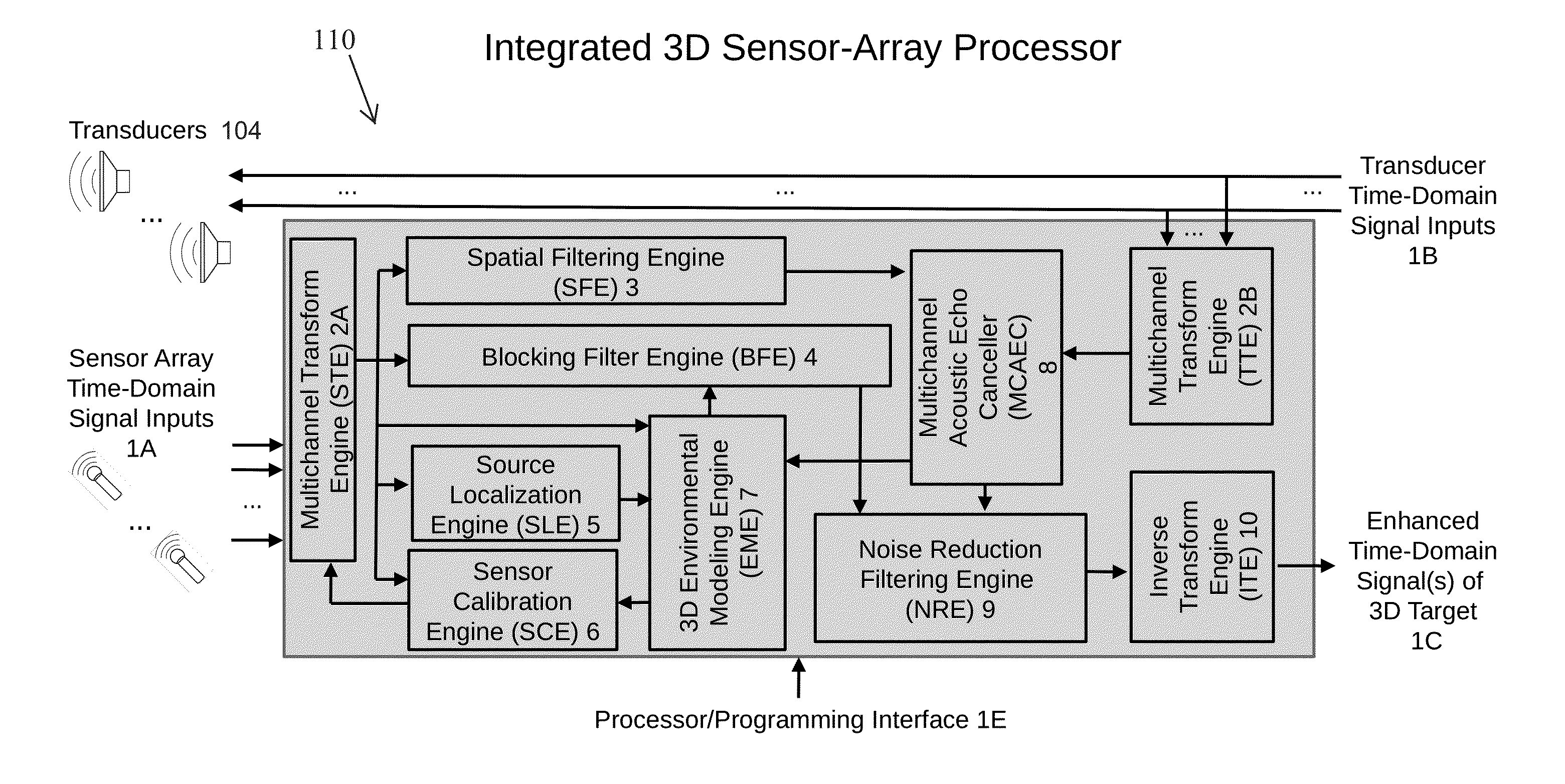
An integrated sensor-array processor and method includes sensor array time-domain input ports to receive sensor signals from time-domain sensors. A sensor transform engine (STE) creates sensor transform data from the sensor signals and applies sensor calibration adjustments. Transducer time-domain input ports receive time-domain transducer signals, and a transducer output transform engine (TTE) generates transducer output transform data from the transducer signals. A spatial filter engine (SFE) applies suppression coefficients to the sensor transform data, to suppress target signals received from noise locations and / or amplification locations. A blocking filter engine (BFE) applies subtraction coefficients to the sensor transform data, to subtract the target signals from the sensor transform data. A noise reduction filter engine (NRE) subtracts noise signals from the BFE output. An inverse transform engine (ITE) generates time-domain data from the NRE output.

Description

RELATED APPLICATION[0001]This application is a Continuation of co-pending U.S. patent application Ser. No. 14 / 205,691, entitled Integrated Sensor-Array Processor, filed on Mar. 12, 2014, which claims the benefit of U.S. Provisional Patent Application Ser. No. 61 / 777,624, entitled Speech Recognition, filed on Mar. 12, 2013, the contents all of which are incorporated herein by reference in their entirety for all purposes.BACKGROUND[0002]1. Technical Field[0003]This invention relates to speech recognition, and more particularly to an integrated sensor-array processor and method for use in various speech-enabled applications.[0004]2. Background Information[0005]Throughout this application, various publications, patents and published patent applications are referred to by an identifying citation. The disclosures of the publications, patents and published patent applications referenced in this application are hereby incorporated by reference into the present disclosure.[0006]Sensor recept...

Claims

the structure of the environmentally friendly knitted fabric provided by the present invention; figure 2 Flow chart of the yarn wrapping machine for environmentally friendly knitted fabrics and storage devices; image 3 Is the parameter map of the yarn covering machine
Login to View More

Application Information

Patent Timeline
no application Login to View More
Patent Type & Authority Applications(United States)
IPC IPC(8): G10L21/0224G10L15/20G10L19/022G10L19/02G10L19/26
CPCG10L21/0224G10L19/0212G10L19/26G10L2021/02082G10L15/20G10L2021/02166G10L19/022G10L21/0208
Inventor EDDINGTON, JR., RONALD C.
Owner AAWTEND
Features
  • R&D
  • Intellectual Property
  • Life Sciences
  • Materials
  • Tech Scout
Why Patsnap Eureka
  • Unparalleled Data Quality
  • Higher Quality Content
  • 60% Fewer Hallucinations
Social media
Patsnap Eureka Blog
Learn More