

System and method for power verification using efficient merging of power state tables
a power state table and power state technology, applied in the field of integrated circuits verification, can solve the problems of increasing verification times, increasing the size of the power state table (pst), and the time needed to create it, and facilitating an interactive human interface, reducing resources
- Summary
- Abstract
- Description
- Claims
- Application Information
AI Technical Summary
Benefits of technology
Problems solved by technology
Method used
Image



Examples
Embodiment Construction
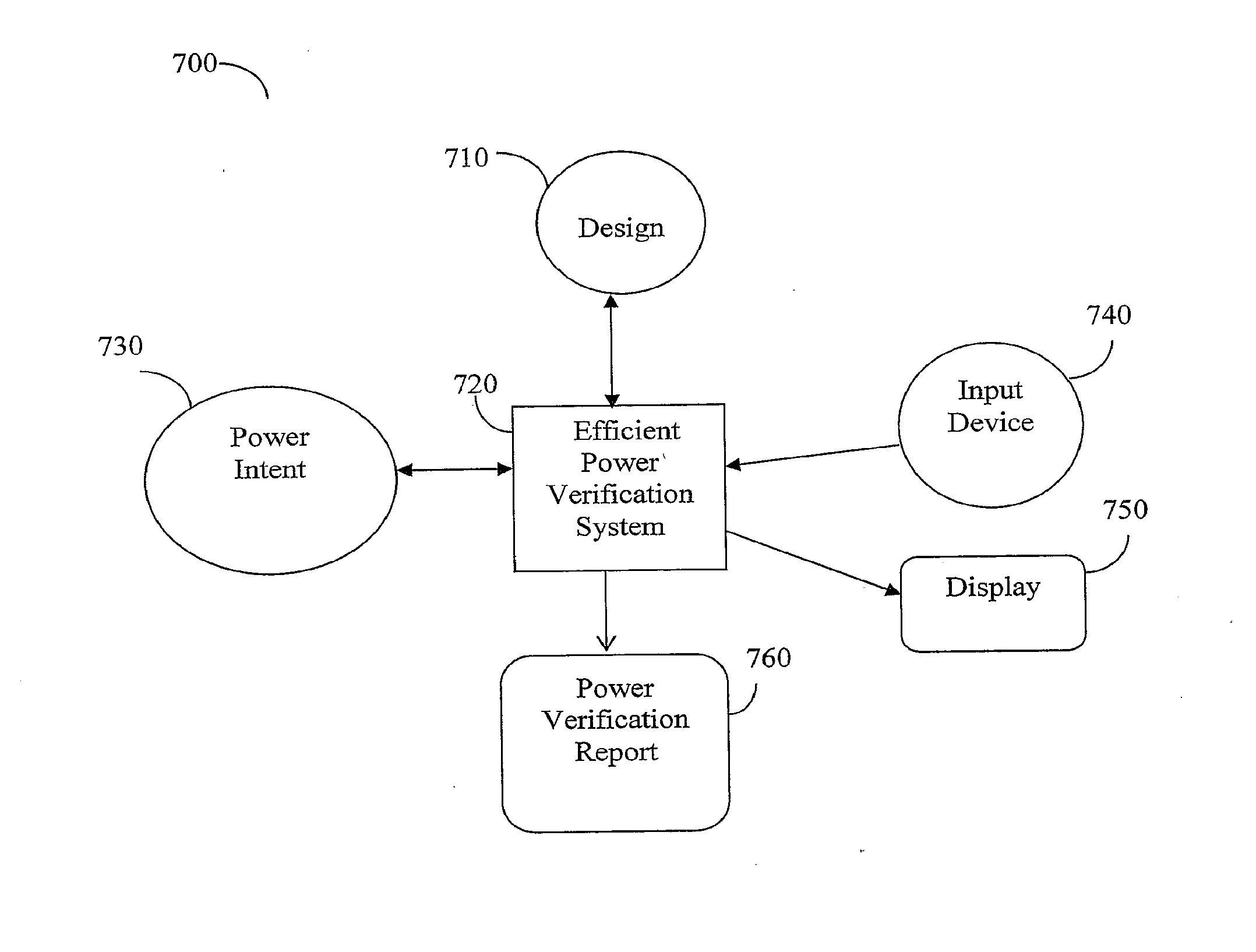
[0024]The Efficient Power Verification System (EPVS) verifies the power implementation of an electronic design by efficiently deriving relationships between power supplies. The EPVS accepts as inputs a Power Intent written using a format such as Unified Power Format
[0025](UPF), and a circuit design provided in a netlist or written in a hardware description language such as RTL (such as Verilog). The EPVS can accept queries via a GUI widget and can provide determination of power relationships interactively in real-time.
[0026]A Soc may have many independent modules, each powered by several different power supplies, many of which are common to more than one module. The EPVS determines the power supplies for each module, and all allowed combinations of ON / OFF an possibly other states (voltage values) for the power supplies of each module. This information is represented by a power state table for the module (PST). A PST has a column for each of the different power supplies powering the ...
PUM
 Login to View More
 Abstract
Description
Claims
Application Information
 Login to View More