Multifunctional beads and methods of use for capturing rare cells

a multi-functional, rare cell technology, applied in the field of multi-functional beads and methods of use for capturing rare cells, can solve the problems of high cell loss associated with the manipulation of sorted sample, loss of rare cells and/or rare cells from very small sample volumes, and device failure to function with “raw” samples

a multi-functional, rare cell technology, applied in the field of multi-functional beads and methods of use for capturing rare cells, can solve the problems of high cell loss associated with the manipulation of sorted sample, loss of rare cells and/or rare cells from very small sample volumes, and device failure to function with “raw” samples

US20170205404A1Inactive Publication Date: 2017-07-20GLOBAL LIFE SCI SOLUTIONS USA LLC

Image

Smart Image Click on the blue labels to locate them in the text.
Viewing Examples
Smart Image
  • Multifunctional beads and methods of use for capturing rare cells
  • Multifunctional beads and methods of use for capturing rare cells
  • Multifunctional beads and methods of use for capturing rare cells

Examples

Experimental program
Comparison scheme
Effect test

Embodiment Construction

[0022]Extraction of rare target cells from biological samples remains one of the key requirements for modern diagnostics and cell biology research. New techniques such as Drop-Seq have ushered in methods for parallel analysis of many single cells (transcriptomes). However, these techniques still require relatively large starting volumes and cell numbers (recommendation is 100 cells / uL). As such there still exist major constraints in designing mechanism of action studies in clinical trials for which the biological samples collected contain rare and limited cell numbers.

[0023]Further, restricted amounts of tissue, cells and fluids are common in many clinical studies, including samples collected from pediatric or immunocompromised patients. Novel, multi-parameter, sample sparing assays are needed to obtain maximal information from limited amounts of biological materials, which may also be referred to as a biological sample. As used herein a biological sample may include, but is not lim...

the structure of the environmentally friendly knitted fabric provided by the present invention; figure 2 Flow chart of the yarn wrapping machine for environmentally friendly knitted fabrics and storage devices; image 3 Is the parameter map of the yarn covering machine
Login to View More

PUM

PropertyMeasurementUnit
sizeaaaaaaaaaa
sizeaaaaaaaaaa
diameteraaaaaaaaaa
Login to View More

Abstract

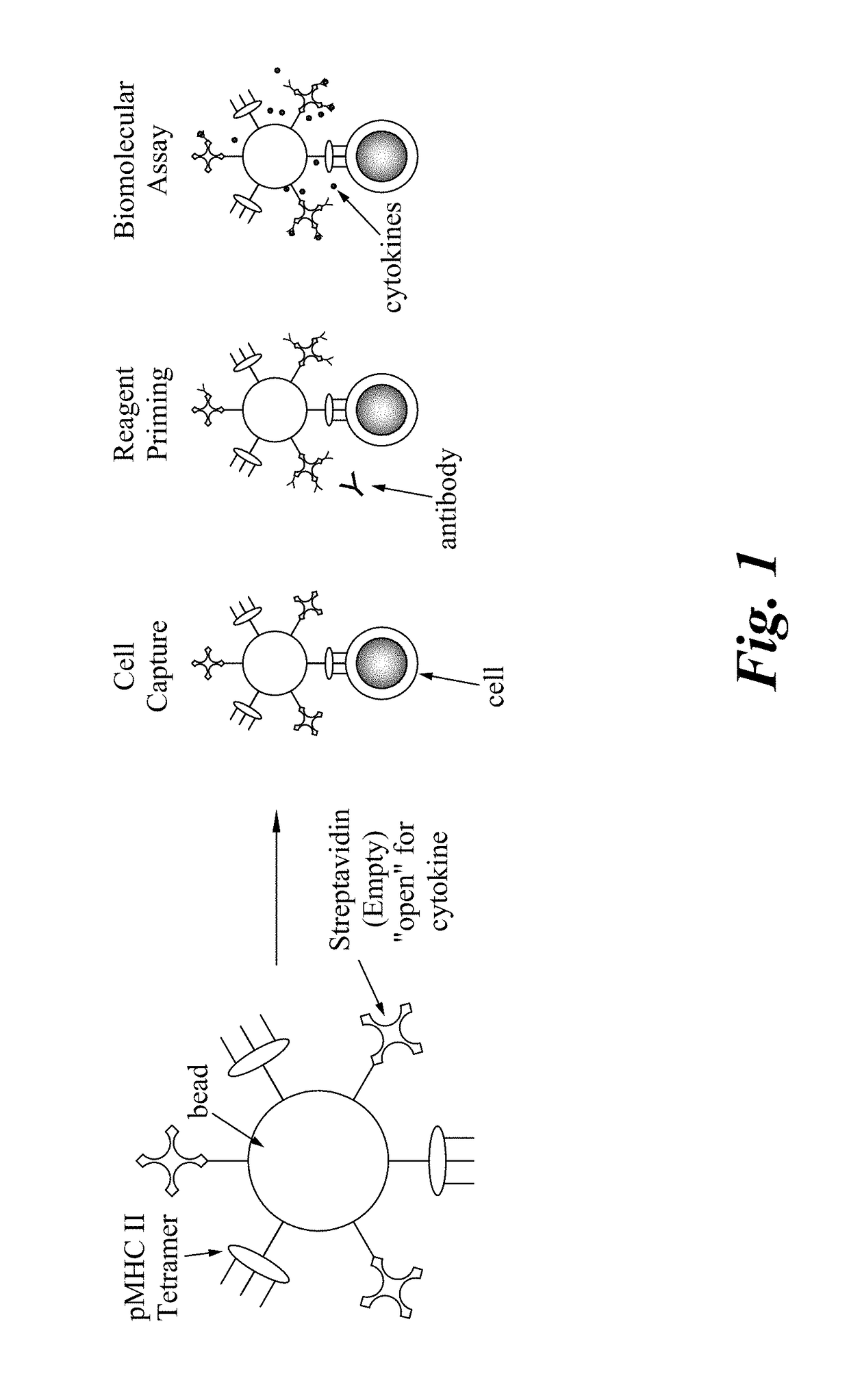
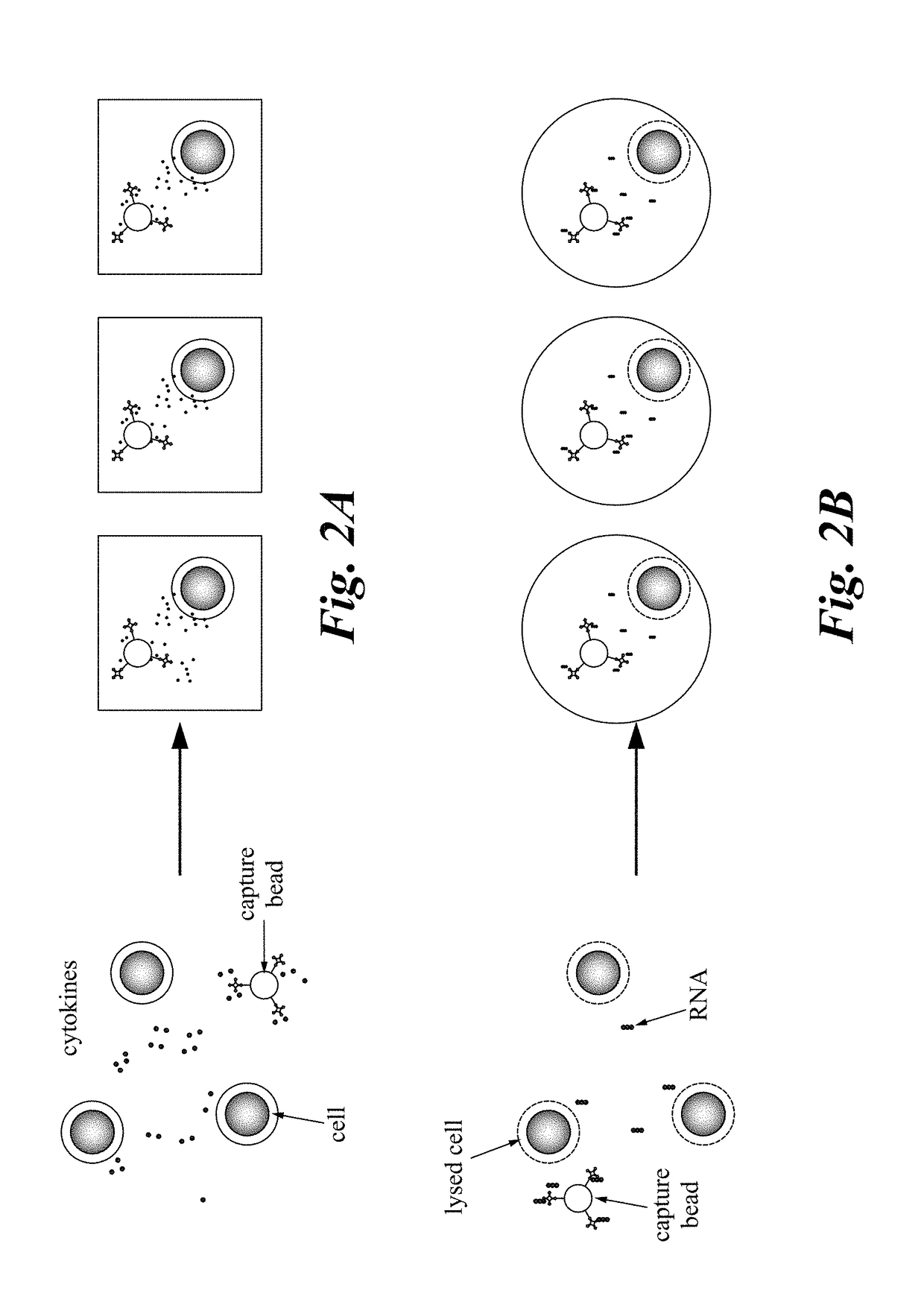
Described are multi-functional beads and methods to capture rare cells directly from low-volume biological samples and perform both functional and genomic assays from those cells. This is accomplished using a multifunctional capture bead that allows co-localization of both the single cell capture element and the molecular assay components. When combined with a digital microfluidic platform this enables encoding and / or barcoding of specific single cells.

Description

CROSS-REFERENCE TO RELATED APPLICATIONS[0001]This application is a non-provisional of and claims priority from U.S. provisional application, Ser. No. 62 / 280,244, filed Jan. 19, 2016, the entire disclosure of which is incorporated herein by reference.FEDERAL SUPPORT CLAUSE[0002]This invention was made with Government support under contract number 1U24AI118667-01 awarded by the National Institutes of Health. The Government has certain rights in the invention.BACKGROUND[0003]Current methods of selecting specific cells from a mixed population require large sample volumes and many cells. These techniques include MACS (magnetic activated cell sorting) and FACS (fluorescence activated cell sorting). This is due to the need to capture specific cells and then transfer them to follow-on assays. Cell loss associated with manipulation of the sorted sample remains high, and rare cells and / or cells from very small sample volumes are lost.[0004]Other techniques such as single cell analysis in digi...

Claims

the structure of the environmentally friendly knitted fabric provided by the present invention; figure 2 Flow chart of the yarn wrapping machine for environmentally friendly knitted fabrics and storage devices; image 3 Is the parameter map of the yarn covering machine
Login to View More

Application Information

Patent Timeline
20 Jul 2017
Publication
US20170205404A1
IPC
G01N33/543; G01N33/569
CPC
G01N33/56972; G01N33/54326; G01N33/505; G01N33/54346; B01L3/50273; B01L3/502753; B01L2200/0668; B01L2200/141
Inventors
PULEO, CHRISTOPHER MICHAEL; KOVACS, ERNEST WILLIAM