Swing analysis method using a sweet spot trajectory

US20180021653A1Active Publication Date: 2018-01-25NEWLIGHT CAPITAL LLC

Image

Smart Image Click on the blue labels to locate them in the text.
Viewing Examples
Smart Image
  • Swing analysis method using a sweet spot trajectory
  • Swing analysis method using a sweet spot trajectory
  • Swing analysis method using a sweet spot trajectory

Examples

Experimental program
Comparison scheme
Effect test

Embodiment Construction

[0047]A baseball swing analysis method using a sweet spot trajectory will now be described. In the following exemplary description numerous specific details are set forth in order to provide a more thorough understanding of the ideas described throughout this specification. It will be apparent, however, to an artisan of ordinary skill that embodiments of ideas described herein may be practiced without incorporating all aspects of the specific details described herein. In other instances, specific aspects well known to those of ordinary skill in the art have not been described in detail so as not to obscure the disclosure. Readers should note that although examples of the innovative concepts are set forth throughout this disclosure, the claims, and the full scope of any equivalents, are what define the invention.

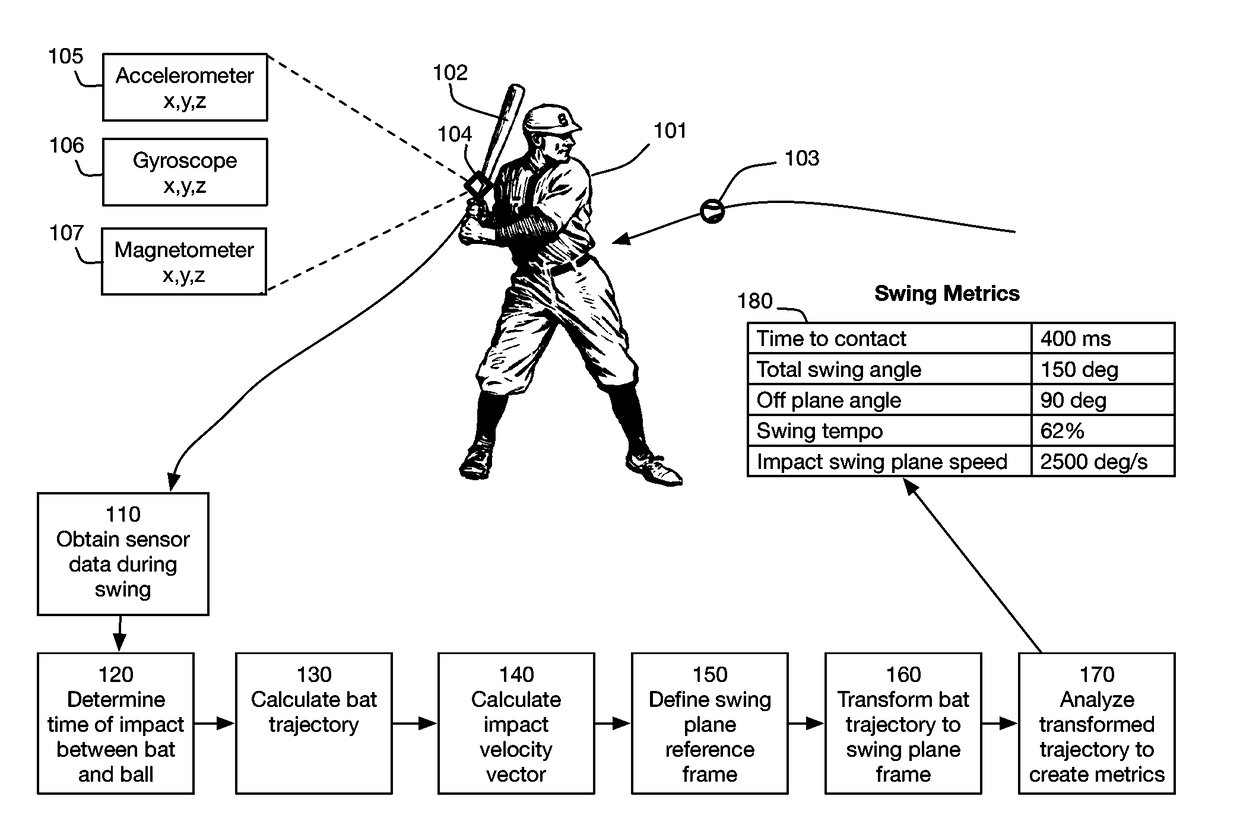
[0048]FIG. 1 shows an overview of an embodiment of the invention. User 101 swings a baseball bat 102 to hit an incoming ball 103. Data is collected throughout the swing from ...

the structure of the environmentally friendly knitted fabric provided by the present invention; figure 2 Flow chart of the yarn wrapping machine for environmentally friendly knitted fabrics and storage devices; image 3 Is the parameter map of the yarn covering machine
Login to View More

PUM

No PUM Login to View More

Abstract

A method for analyzing sensor data from baseball swings (or swings in similar sports) that transforms data into a reference frame defined by the bat orientation and velocity at impact. The trajectory of the sweet spot of the bat is tracked through the swing, and is analyzed to generate metrics describing the swing. A two-lever model of the swing may be used to model the effects of body rotation and wrist rotation. Data may be analyzed to identify relevant events during the swing such as start of downswing, commit (wrist release), on-plane, peak bat speed, and impact. Illustrative swing metrics derived from the sweet spot trajectory, the swing plane reference frame, and the two-lever model include: forward bat speed, on-plane rotation, hinge angle at commit, hinge angle at impact, body rotation ratio, body tilt angle, and swing plane tilt angle.

Description

[0001]This application is a continuation-in-part of U.S. Utility patent application Ser. No. 15 / 214,339 filed 19 Jul. 2016, the specification of which is hereby incorporated herein by reference.BACKGROUND OF THE INVENTIONField of the Invention[0002]One or more embodiments setting forth the ideas described throughout this disclosure pertain to the field of motion capture sensors and analysis of motion capture data. More particularly, but not by way of limitation, one or more aspects of the invention enable a method for analysis of a baseball swing using data captured from a motion sensor on the bat.Description of the Related Art[0003]Methods for analyzing swings of a piece of equipment, such as a golf club, tennis racquet or baseball swings for example include video capture systems that record high speed video of a swing and that analyze the motion of the piece of equipment, club, racquet or bat, etc., and the player from the video. These systems are typically expensive and complex, ...

Claims

the structure of the environmentally friendly knitted fabric provided by the present invention; figure 2 Flow chart of the yarn wrapping machine for environmentally friendly knitted fabrics and storage devices; image 3 Is the parameter map of the yarn covering machine
Login to View More

Application Information

Patent Timeline
25 Jan 2018
Publication
US20180021653A1
IPC
A63B69/36; G01P15/08; G01C21/16
CPC
A63B69/3685; A63B69/3635; G01C21/16; A63B2220/18; A63B2069/0008; A63B2220/833; G01P15/0888; G01C21/00
Inventors
THORNBRUE, JAMES; CHERVENY, PATRICK