Unlock instant, AI-driven research and patent intelligence for your innovation.

Cancer Detection Method

Inactive Publication Date: 2018-08-23
SIENNA CANCER DIAGNOSTICS
View PDF0 Cites 1 Cited by
  • Summary
  • Abstract
  • Description
  • Claims
  • Application Information

AI Technical Summary

Benefits of technology

The present disclosure can be used to accurately detect malignant cells in a single procedure.

Problems solved by technology

The development and progression of cancer places a significant emotional and financial burden on society.
However, clinical diagnosis of cancer can be a difficult process, particularly in the early stages of cancer development.
For example, low grade cancer pathology can have poor sensitivity leading to inconclusive or inaccurate findings.
A drawback of cystoscopy is that it requires an invasive procedure.
In addition to being invasive and expensive, obtaining a biopsy via cystoscopy can have potential adverse outcomes for the patient.
Given these limitations, it is very difficult to obtain patient samples via cystoscopy, repeatedly from a large number of individuals.

Method used

the structure of the environmentally friendly knitted fabric provided by the present invention; figure 2 Flow chart of the yarn wrapping machine for environmentally friendly knitted fabrics and storage devices; image 3 Is the parameter map of the yarn covering machine
View more

Image

Smart Image Click on the blue labels to locate them in the text.
Viewing Examples
Smart Image
  • Cancer Detection Method
  • Cancer Detection Method
  • Cancer Detection Method

Examples

Experimental program
Comparison scheme
Effect test

example 1

Samples

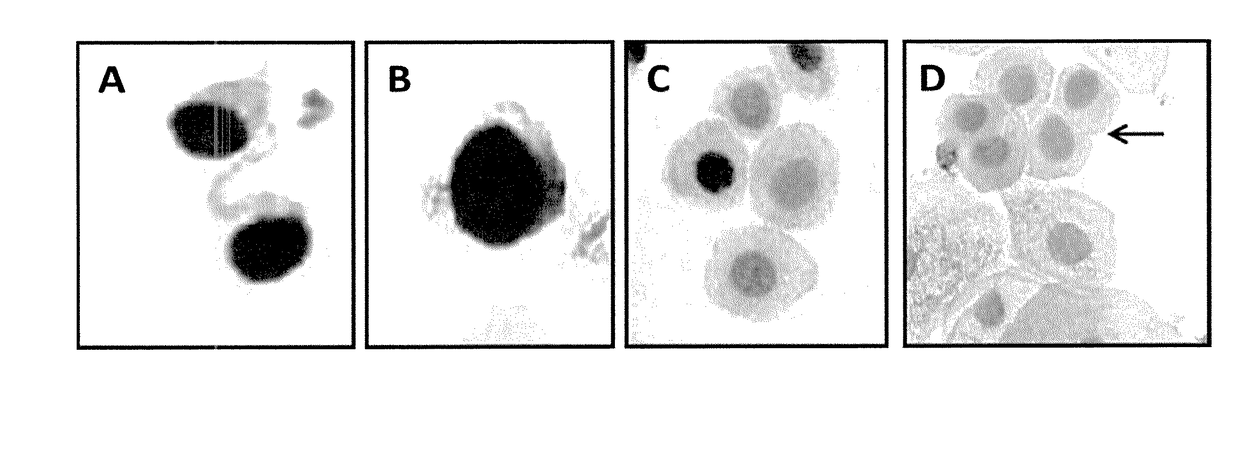
[0133]An ethics-controlled and approved proof of concept study on clinical material from urological patients suspected of having, or with a history of, bladder cancer (urothelial cell carcinoma) was performed in order to demonstrate the clinical diagnostic potential of telomerase hTERT protein immunostaining. Furthermore, the study aimed to demonstrate that hTERT immunostaining can differentiate samples obtained from low grade versus high grade patients.

[0134]In this study, clinically positive patients had biopsy proven bladder cancer (including both non-invasive and muscle-invasive). All stage and grade determinations were by histology. In the case where a patient had multiple bladder cancer foci at different stages / grades, the higher stage / grade was recorded.

[0135]Clinically negative patients were all asymptomatic individuals in good health with no history of genitourinary disease or all disease-free patients presenting, for the first time or under monitoring for prior blad...

example 2

n and Processing of Samples

[0147]Voided urine from patients was either processed immediately, or maintained at 4° C. for a period no longer than 4-6 hours prior to processing. Samples were transferred into sterile 50 mL centrifuge tubes and centrifuged at 600 g for 10 minutes at 4° C. The tubes were removed and the supernatant discarded. Cell pellets were resuspended in 15 mL 1×PBS and transferred into sterile 15 mL centrifuge tubes. Samples were re-centrifuged at 600 g for 10 minutes at 4° C. and the supernatant again discarded. Cell pellets were finally resuspended in 1 ml 1×PBS prior to cell counting.

[0148]Approximately 30,000 cells per sample were transferred to sterile 15 mL centrifuge tubes and the volume adjusted to 10 mL with Shandon Cytospin Collection Fluid (Thermo Scientific, Ref No: 6768001, Lot No: 226955). Tubes were again centrifuged at 600 g for 10 minutes at 4° C. The supernatant was discarded prior to resuspending in Shandon Cytospin Collection Fluid at a ratio of ...

example 3

ining of Telomerase in Bladder Cancer Samples Correlates with Disease

[0154]85 clinical samples were processed onto microscope slides and stained using the protocol described above. Minor adjustments to antibody conditions or cell sample preparation were empirically determined on a sample-to-sample basis. Every sample that received telomerase immunostaining also underwent standard cytological assessment of cell morphology on the same sample. Cytological assessment of cell morphology was scored as positive, negative, or atypical.

[0155]Cytological assessment of cell morphology and telomerase immunostaining results were compared in clinically positive (Table 2) and clinically negative samples (Table 3). 22 clinically positive results were assessed with 16 having telomerase positive staining. Of the 6 remaining clinically positive samples 6 were identified as benign following cytological assessment of cell morphology. Accordingly, telomerase was indicative of 16 out of 22 (72%) malignant...

the structure of the environmentally friendly knitted fabric provided by the present invention; figure 2 Flow chart of the yarn wrapping machine for environmentally friendly knitted fabrics and storage devices; image 3 Is the parameter map of the yarn covering machine
Login to View More

PUM

No PUM Login to View More

Abstract

The present disclosure relates to methods of determining whether a subject has cancer. More particularly, the present disclosure relates to a method of determining whether a subject has cancer when a pathological assessment of cell morphology is negative for the cancer. More particularly, the present disclosure relates to a method of determining whether a morphologically normal cell is malignant. Identification of malignant cells, when a pathological assessment of cell morphology is negative for cancer, is based upon detecting the binding of an anti-telomerase antibody to clinically relevant cells.

Description

TECHNICAL FIELD[0001]The present disclosure relates to methods of determining whether a subject has cancer. More particularly, the present disclosure relates to a method of determining whether a subject has cancer when a pathological assessment of cell morphology is negative for the cancer.BACKGROUND OF THE INVENTION[0002]The development and progression of cancer places a significant emotional and financial burden on society.[0003]Pathological examination (both cytology and histology) is used for diagnosis in many cancers. However, clinical diagnosis of cancer can be a difficult process, particularly in the early stages of cancer development. For example, low grade cancer pathology can have poor sensitivity leading to inconclusive or inaccurate findings.[0004]In bladder cancer, cystoscopy and urine cytology are the most important tools in the diagnosis and follow-up of bladder cancer. However, cystoscopy with biopsy and histological assessment is generally considered the gold standa...

Claims

the structure of the environmentally friendly knitted fabric provided by the present invention; figure 2 Flow chart of the yarn wrapping machine for environmentally friendly knitted fabrics and storage devices; image 3 Is the parameter map of the yarn covering machine
Login to View More

Application Information

Patent Timeline
no application Login to View More
IPC IPC(8): G01N33/574
CPCG01N33/57484G01N2333/901G01N33/57415G01N33/57411G01N33/57434G01N2333/9125
Inventor HOSKIN, MATTHEWLALLA, MINESHTURNBULL, SHANNON
Owner SIENNA CANCER DIAGNOSTICS