
Traction-impact device and force transmission unit having such a traction-impact device
a technology of traction-impact device and force transmission unit, which is applied in the direction of yielding coupling, buffer cars, railway coupling accessories, etc., can solve the problems of inability to produce simple use inability to easily remove energy input intended for deformation work, and inability to produce energy with very little structural space available. , to achieve the effect of high recycling potential and short installation spa
- Summary
- Abstract
- Description
- Claims
- Application Information
AI Technical Summary
Benefits of technology
Problems solved by technology
Method used
Image

Examples
first embodiment
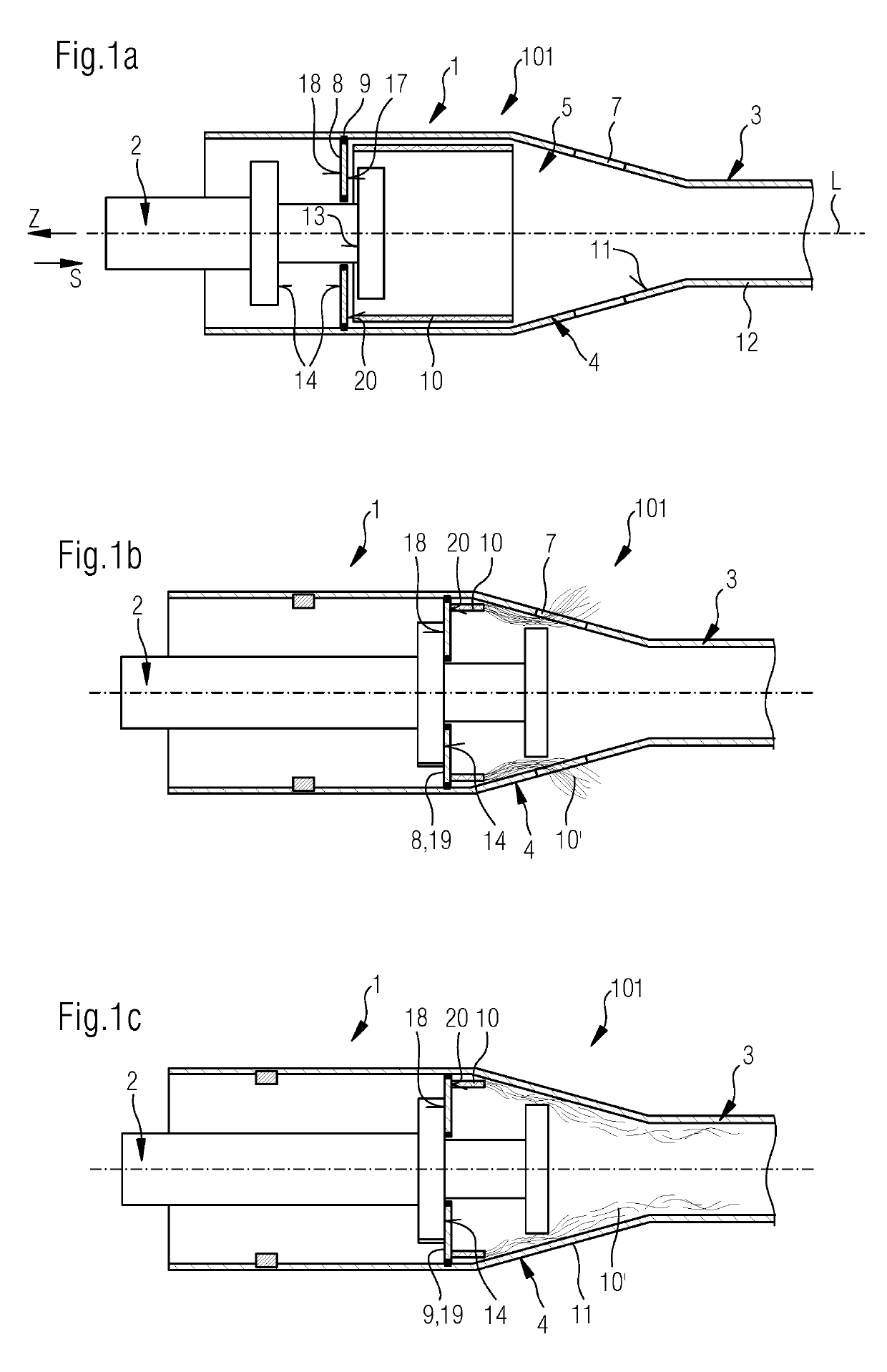
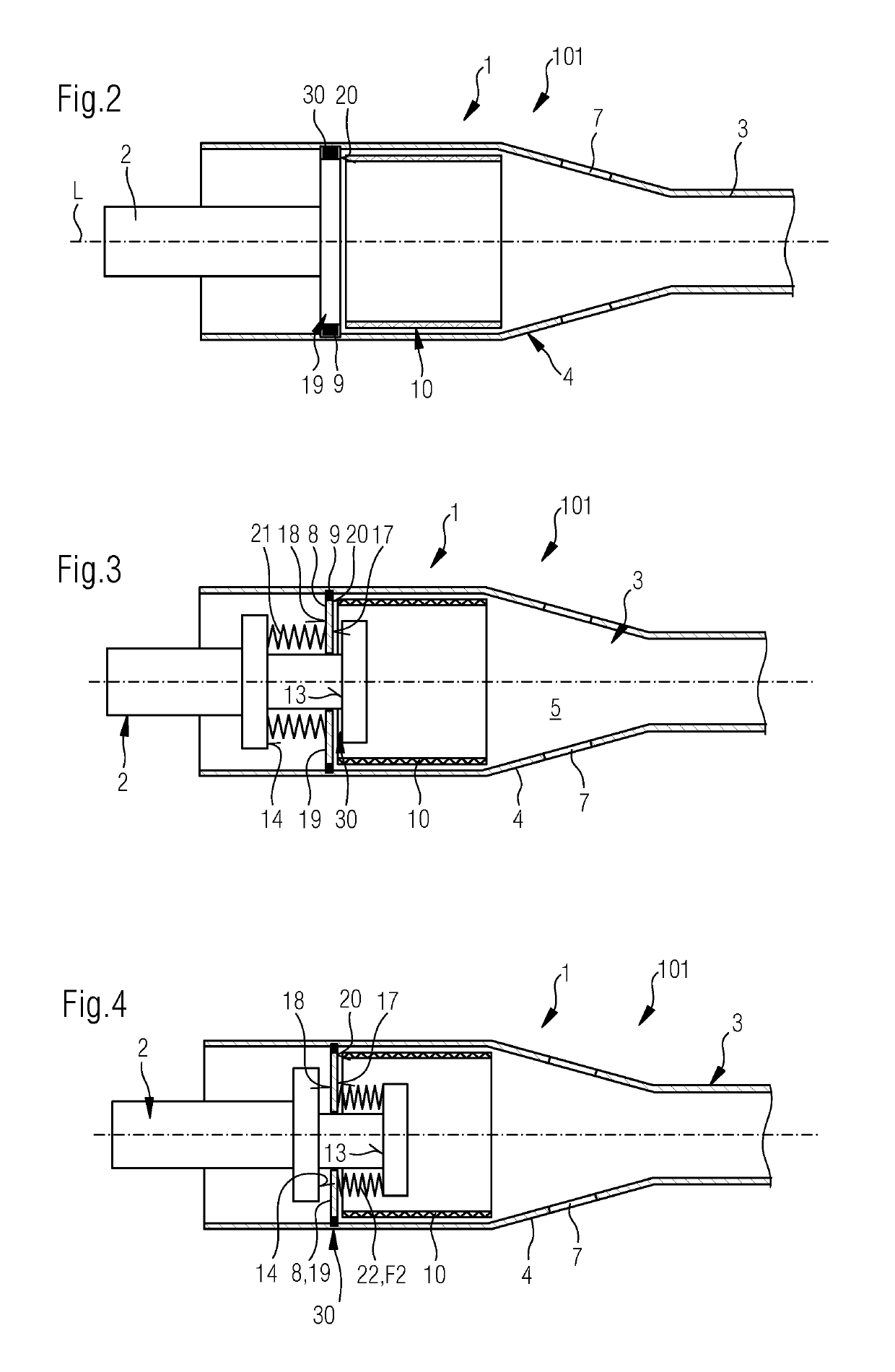
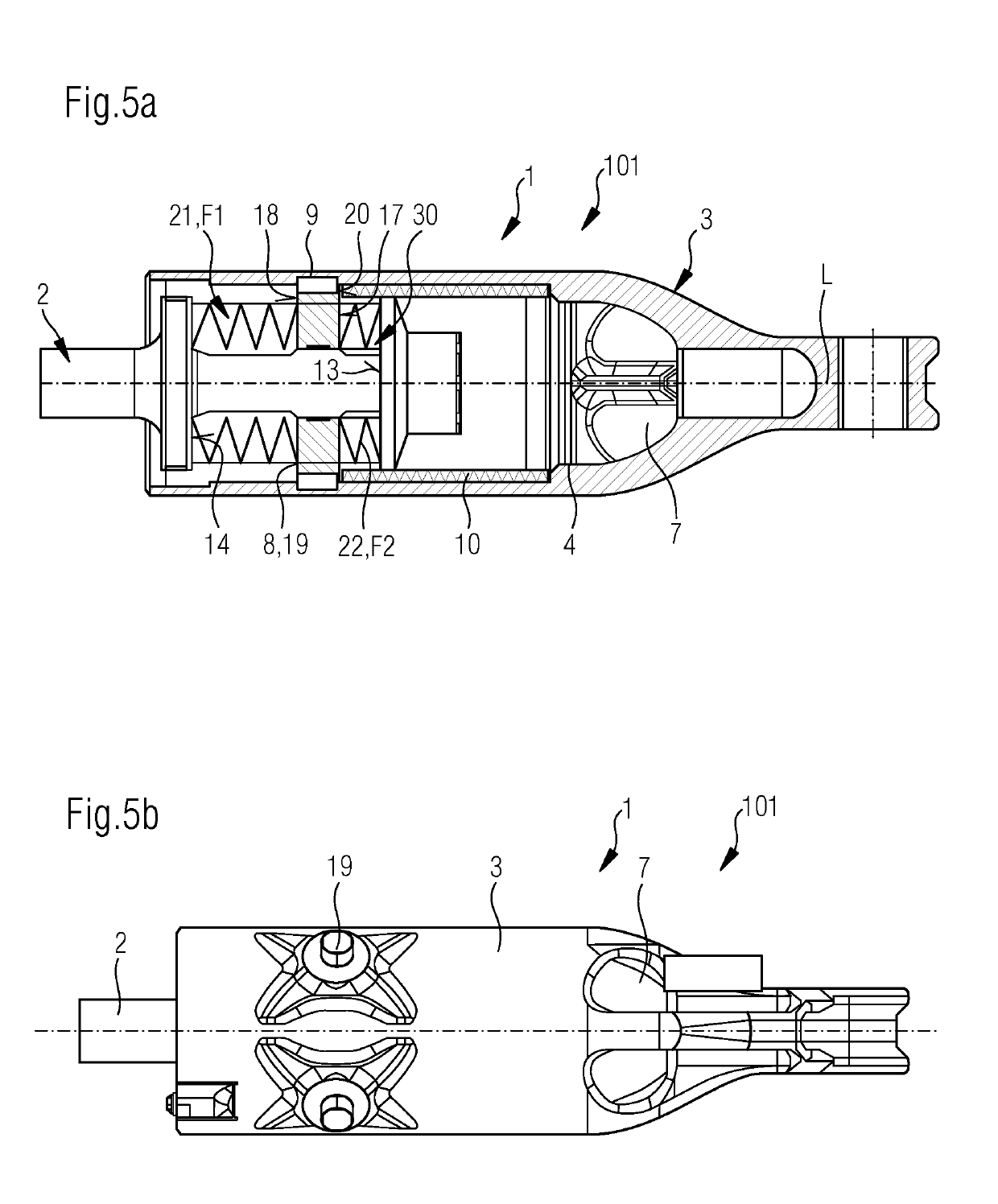
[0064]FIGS. 1a-5 show in a schematically simplified illustration the basic structure and the basic function of different embodiments of a traction-impact device 1 according to a The basic structure is identical, for which reason the same reference numerals are used for the same elements.
[0065]FIGS. 1a and 1b show in a schematically highly simplified illustration a first embodiment of a traction-impact device 1 according to the first embodiment in two functional positions. In this, the first force transmission element 2 is formed by a pull rod. The second force transmission element 3 is formed by a cylindrical element which extends along the longitudinal axis L with different cross-section regions. The cylindrical element surrounds in this instance an inner space when viewed in the peripheral direction about the longitudinal axis L. The nozzle portion 4 on the force transmission element 3 is formed either by the inner periphery 11 of the cylindrical element or by an additional compo...
second embodiment
[0079]FIG. 10 shows, in contrast, a second embodiment in which the irreversible energy absorption element 10 is arranged on the outer periphery of the force transmission element 3. The coupling 30 of the first force transmission element 2 which is constructed as a pull rod, the traction and pressure stops 13, 14 and the coupling of the pressure plate 8 to the second force transmission element 3 and the arrangement of the energy absorption between the pressure plate 8 and pull rod are carried out as described in FIG. 5. The nozzle portion 4 is, however, integrated in the first force transmission element 2. To this end, it has a sleeve-like portion 26, which surrounds the force transmission element 3 in a peripheral direction.
[0080]When a maximum permissible impact force is exceeded, the force-transmitting connection 30 between the force transmission element 2 and 3 is also cancelled by way of response of the desired breaking locations 9 between the pressure plate 8 and counter-elemen...
PUM
 Login to View More
 Abstract
Description
Claims
Application Information
 Login to View More