Method and device for controlling knocking in an internal combustion engine
- Summary
- Abstract
- Description
- Claims
- Application Information
AI Technical Summary
Benefits of technology
Problems solved by technology
Method used
Image

Examples
Embodiment Construction
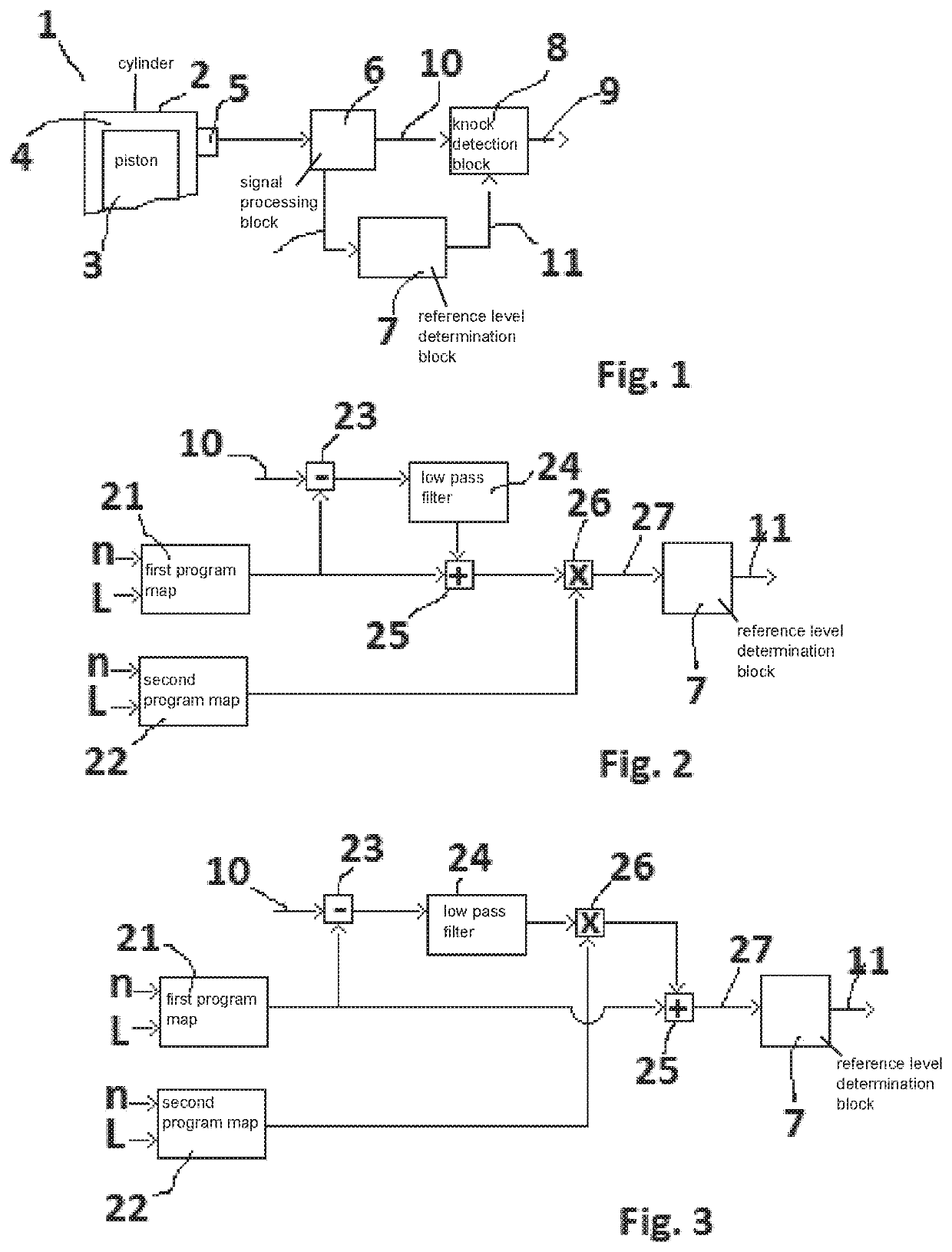
[0010]An internal combustion engine 1 is shown schematically in FIG. 1, in which a cylinder 2 with a piston 3 contained in it forms a combustion chamber 4. On the outer side of cylinder 2, knock sensor 5 is represented, which measures a knock signal of cylinder 2. Such a knock signal is a matter of a noise signal or vibrations of cylinder 2, which develop because of combustion processes in combustion chamber 4. The knock signals of knock sensor 5 are passed on to a signal-processing block 6, which from them, generates knock features 10 for each combustion. For each combustion process in cylinder 2, a knock feature 10 is generated for this combustion. Ascertained knock features 10 are then forwarded to a reference-level-determination block 7. The reference-level-determination block determines a reference level 11 from forwarded knock features 10, which is then passed on to knock detection block 8. In addition, knock detection block 8 receives knock feature 10 of the instantaneous com...
PUM
 Login to View More
 Abstract
Description
Claims
Application Information
 Login to View More
PatSnap Eureka turns technology decisions into work you can execute. Powered by our Innovation Knowledge Graph, it runs expert workflows across engineering, life sciences, materials and intellectual property. Get your review-ready output in minutes.


