Check patentability & draft patents in minutes with Patsnap Eureka AI!

System and method using local unique features to interpret transcript expression levels for RNA sequencing data

a technology of rna sequencing and transcript expression, applied in the field of methods and systems for characterizing gene transcript expression levels, can solve the problems of difficult allocation of sequencing reads to transcripts, increased transcriptome complexity, and difficulty in estimating gene and transcript expression from rna sequencing data, and achieves the effect of effective and efficient determination of gene transcript expression levels

Pending Publication Date: 2021-01-07
KONINKLJIJKE PHILIPS NV
View PDF0 Cites 0 Cited by
  • Summary
  • Abstract
  • Description
  • Claims
  • Application Information

AI Technical Summary

Benefits of technology

The patent text describes a method and system for characterizing gene transcript expression levels from RNA sequencing data. The system extracts unique features from gene transcripts and stores them in a database. It then compares the sequences to the unique features to identify the gene transcripts and compiles information about their expression levels. The unique features can include exons, exon junctions, introns, start locations, and stop locations. The system can also associate the unique features with annotation information. Overall, the method and system provide a efficient and effective way to characterize gene transcript expression levels.

Problems solved by technology

Protein diversity in eukaryotic organisms is largely increased by alternative splicing, which greatly increases transcriptome complexity.
However, estimating gene and transcript expressions from RNA sequencing data is challenging.
For example, since many genes express more than one transcript, allocating sequencing reads to the transcript from which they were derived is a major problem which any transcript expression estimation program must resolve.
Other challenges include, for example, non-uniform distribution of the read coverage, among many others.
However, these current tools do not solve all the challenges faced when analyzing RNA sequencing data.
For example, tools typically examine entire RNA sequencing reads from the transcript start site to the transcript stop site, which is time consuming and computationally inefficient.
Furthermore, as the complexity of resolving transcriptome structures increases, such as with small conditional RNA or low-quality RNA sequencing data, tools that rely on full RNA sequencing reads are less effective.

Method used

the structure of the environmentally friendly knitted fabric provided by the present invention; figure 2 Flow chart of the yarn wrapping machine for environmentally friendly knitted fabrics and storage devices; image 3 Is the parameter map of the yarn covering machine
View more

Image

Smart Image Click on the blue labels to locate them in the text.
Viewing Examples
Smart Image
  • System and method using local unique features to interpret transcript expression levels for RNA sequencing data
  • System and method using local unique features to interpret transcript expression levels for RNA sequencing data
  • System and method using local unique features to interpret transcript expression levels for RNA sequencing data

Examples

Experimental program
Comparison scheme
Effect test

Embodiment Construction

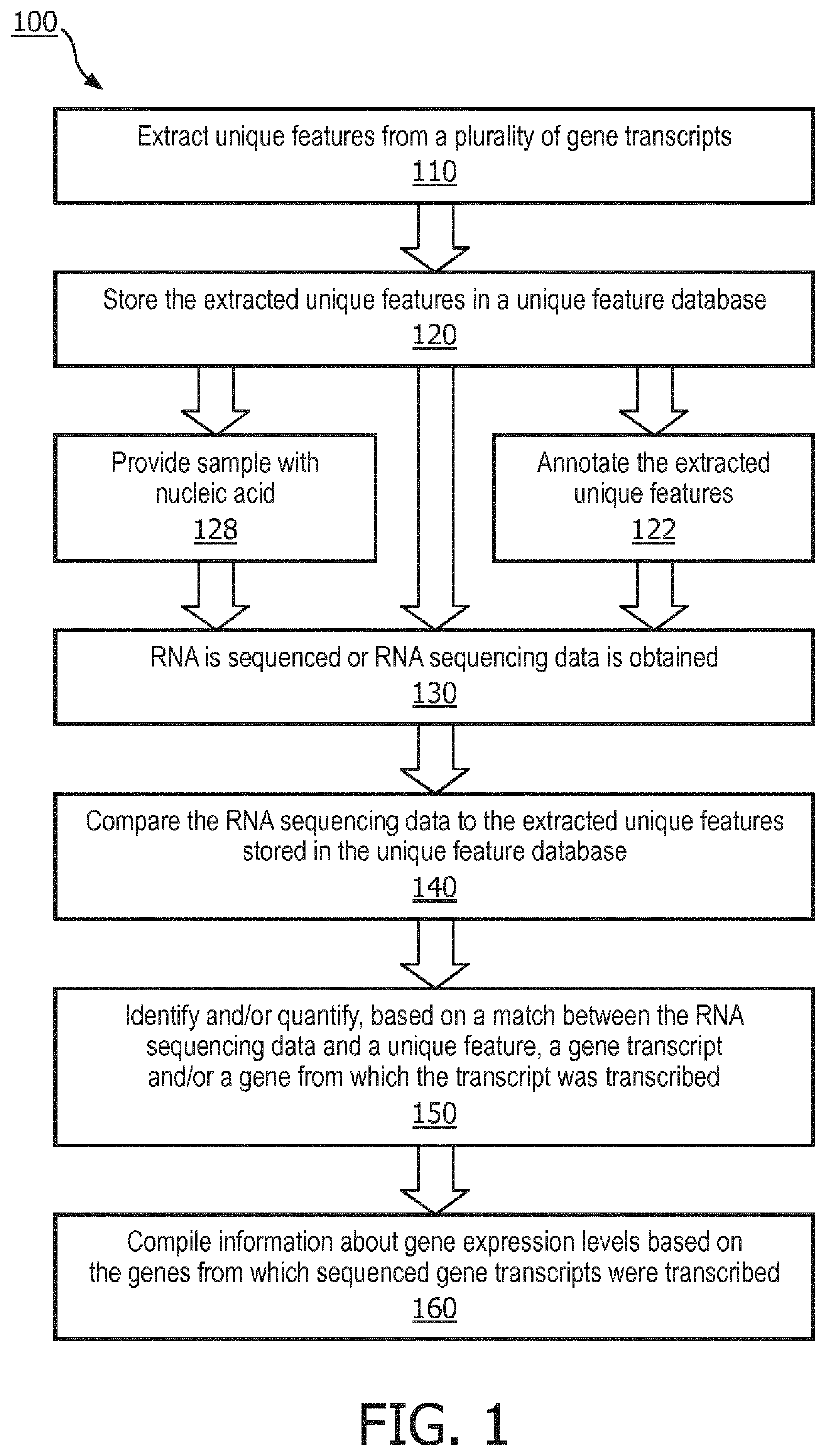
[0028]The present disclosure describes various embodiments of a system and method for compiling information about gene transcript expression levels using unique features extracted from gene transcripts. More generally, Applicant has recognized and appreciated that it would be beneficial to provide a system that enables rapid and efficient characterization of gene transcript expression levels using RNA sequencing data. The system comprises a unique feature database which stores unique features extracted from gene transcripts, including but not limited to unique exons, unique exon junctions, unique introns, unique start location, and / or unique stop locations, among many other unique features. The system receives or sequences gene transcripts and compares the sequences to the extracted unique features in the unique feature database. If at least a portion of a sequence matches one or more extracted unique features, the gene transcript from which the sequence was generated is identified....

the structure of the environmentally friendly knitted fabric provided by the present invention; figure 2 Flow chart of the yarn wrapping machine for environmentally friendly knitted fabrics and storage devices; image 3 Is the parameter map of the yarn covering machine
Login to View More

PUM

No PUM Login to View More

Abstract

A method (100) for characterizing gene transcript expression levels, comprising: (i) extracting (110) one or more unique features from each of a plurality of gene transcripts; (ii) storing (120) the extracted unique features in a unique feature database; (iii) receiving (130) a plurality of sequences sequenced from gene transcripts, wherein at least some of the sequences comprise one or more of the extracted unique features; (iv) comparing (140), by a processor, the plurality of sequences to the extracted unique features stored in the unique feature database; (v) identifying (150), based on a match between a sequence and an extracted unique feature, a gene transcript and / or gene from which the sequence was generated; and (vi) compiling (160) information about gene transcript expression levels based on said identified gene transcripts.

Description

FIELD OF THE DISCLOSURE[0001]The present disclosure is directed generally to methods and systems for characterizing gene transcript expression levels using unique features in gene transcripts.BACKGROUND[0002]RNA sequencing is an important tool for transcriptome study. This high-throughput technique offers several advantages compared to previous technologies, including the ability to detect novel and lowly expressed transcripts with broader dynamic ranges.[0003]Protein diversity in eukaryotic organisms is largely increased by alternative splicing, which greatly increases transcriptome complexity. For example, it is estimated that more than 90% of multi-exon human genes experience alternative splicing, many of which are revealed by RNA sequencing data. The expression of these transcript variants are highly regulated and are differentially expressed across different tissues or developmental stages, and in tumors or diseases. As a result, estimating gene and transcript expressions from ...

Claims

the structure of the environmentally friendly knitted fabric provided by the present invention; figure 2 Flow chart of the yarn wrapping machine for environmentally friendly knitted fabrics and storage devices; image 3 Is the parameter map of the yarn covering machine
Login to View More

Application Information

Patent Timeline
no application Login to View More
IPC IPC(8): G16B30/10G16B50/30G16B50/10G16B40/00G06F16/907G06F16/903
CPCG16B30/10G16B50/30G06F16/90344G16B40/00G06F16/907G16B50/10G16B25/10
Inventor WU, JIECHEUNG, YEE HIM
Owner KONINKLJIJKE PHILIPS NV
Features
  • R&D
  • Intellectual Property
  • Life Sciences
  • Materials
  • Tech Scout
Why Patsnap Eureka
  • Unparalleled Data Quality
  • Higher Quality Content
  • 60% Fewer Hallucinations
Social media
Patsnap Eureka Blog
Learn More