Check patentability & draft patents in minutes with Patsnap Eureka AI!

Computer system arrangement and methods for reducing communication and integration complexity for functions spanning across systems

Inactive Publication Date: 2021-06-03
TARIFFLEX
View PDF1 Cites 3 Cited by
  • Summary
  • Abstract
  • Description
  • Claims
  • Application Information

AI Technical Summary

Benefits of technology

The technology disclosed in this patent is a computer system arrangement that improves the effectiveness and reduces the complexity of integrating different computer systems. It also provides methods to execute the functions of the computer system arrangement. This technology can decrease the complexity when introducing new functions and minimize the effort and cost required to implement these functions. In simple terms, this technology enables a new function to be built without making significant changes to existing applications. It is particularly useful in enterprises where the functions of an artificial intelligence system may span across multiple systems. The technology disclosed can efficiently implement new functions even if entities are simple or connected to many other entities and / or legacy systems.

Problems solved by technology

Automating business processes, however, has posed challenges.
The diversity of languages, devices, applications, people skills, geographies, and cultures may pose a challenge to automating a homogeneous business process that delivers a quality product and / or service to a diverse set of customers.
The diversity of languages, devices, applications, people skills, geographies, and cultures has also led to an increasingly complexity when building new functions and functionality into existing systems.
This has led to increasing complexity for an operator to administrate the subscriptions, interaction with customers, accounting, activation / deactivation of services, troubleshooting, etc.
It is difficult to use a single all-in-one “standard” system to handle all of these interactions because all operators are different in that they often have different network equipment, different legislation, languages, and local practices.
The diversity of network equipment, different legislation, languages, and local practices has also led to an increasingly complexity when building new functions and functionality into existing systems.
Even more importantly, manual handling is very difficult due to the large number of pricing and product packaging combinations that are common.
This has led to an ever-increasing complexity and cost for operators to keep all support systems synchronized.
The result is that the operators are struggling with integrating the different business support system functions with each other, often with one system depending on many others.
Each integration takes time and costs money to implement, test, maintain and update.
Therefore, the costs and time of the integration, as well as possible sources of error increase rapidly with the number of systems.
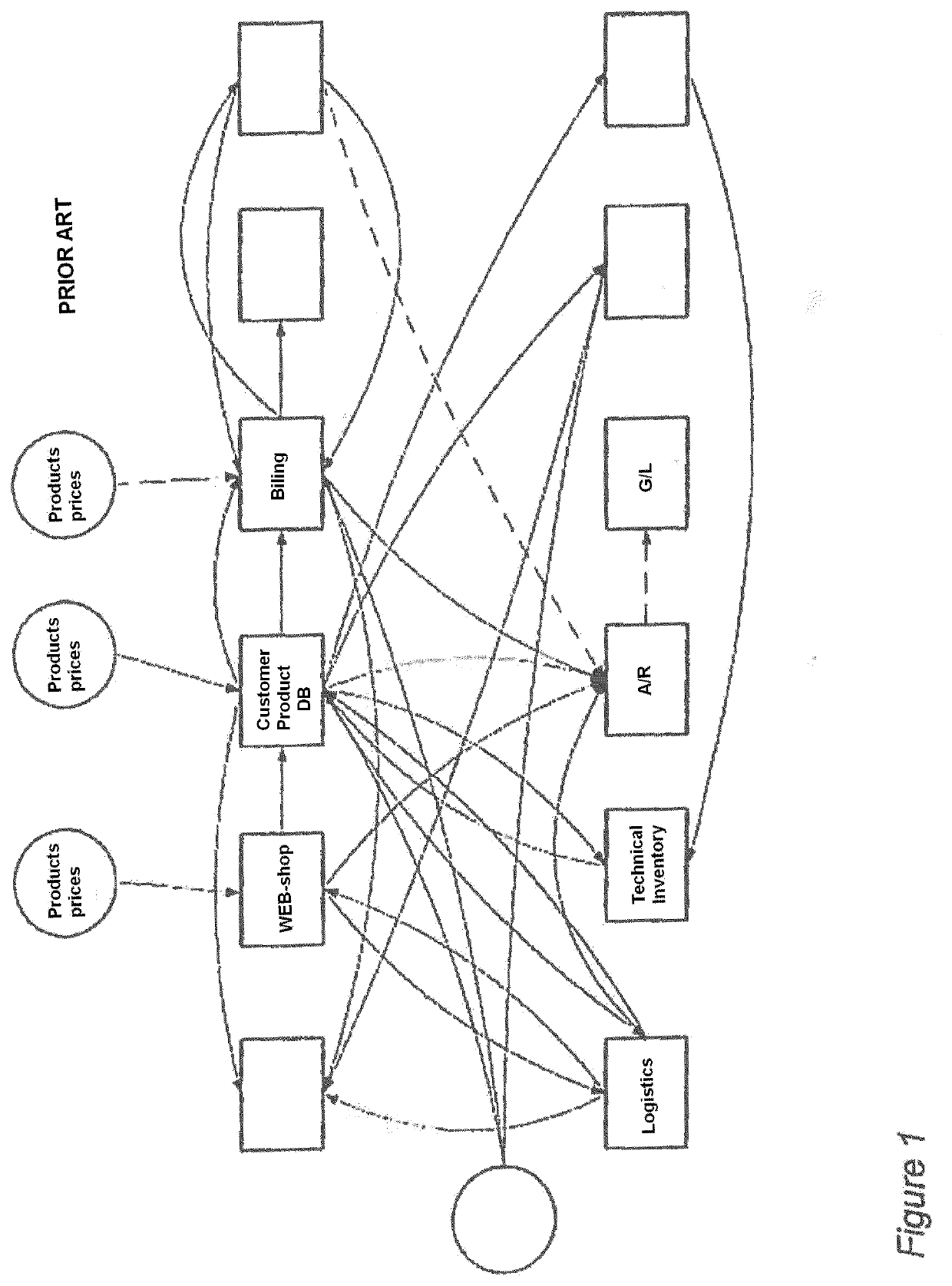
In summary, the architecture of the system in FIG. 1 has the following disadvantages:Large amount of integration and configuration to get the system operational.Due to the many interactions with many other systems, it is very difficult to replace one system if its supplier stops supporting it or it becomes unreliable or insufficient for some other reason.Difficult, slow, and costly to make any changes in the customer offering.The complexity increases rapidly with the number of systems (102), making it difficult to scale to large number of systems or to accommodate several operators needs in one system.Each system that integrates with another system needs to know the communication ability as well as the information definition and structure of that system.Data and rules are duplicated.
It is also a problem when it is extended and e.g. new information is added since these additions cannot be made in all systems simultaneously.
This means that to stay in the frontline of functional development, it is difficult to follow a standard and the implementation is in fact bound to diverge from the standard information model.
Such divergence from the standard is difficult to maintain in all affected subsystems simultaneously.The Information bus concept as typically implemented and as described in the example, only concentrates the problem of integration to the data mapping in the bus.
The basic problem with many-many relationship remains, just that each translation (or at least a part of it) takes place in the data mapping in the bus.
Therefore, the basic problem that each system is dependent on integration with many others is not mitigated.
Even if integrated, the different subsystems often use different names and concepts making it hard to follow and relate to the meaning of, say, an “account” when staff are working with the different systems and talk to each other.
Even if vaguely related, it is hard to intuitively understand how the concepts relate to each other since the translations and mapping is made between each pair of subsystems.
Prior art systems and methodologies, however, lack the ability to provide automated self-management based upon a real-time coordination of business rules, business metrics, and system resources.
Although some prior art systems provide a user-interface for manually defining or editing rule parameters, no system or methodology exists for managing electronic business processes with rules that are dynamically triggered and adapted in an automated fashion based on the critical value of business-critical metrics such as business transaction volume, response time, turn-around time, event priority, etc.
Another disadvantage of prior art electronic business control systems is their inability to adjust business rules “on-the-fly” without interfering with business process flow.
Such functionality, however, is critical in an on-line environment where clients continuously request system response and process performance.
Yet another drawback to prior art electronic business management systems is their failure to define business rule parameters and business metrics in a standard format such that they may be interchangeably used by rules for decisions, as well as updated by rules in response to internal or external events.
Additionally, business metrics defined by prior art systems lack the ability to independently generate event objects for triggering subsequent system control.
Other disadvantages of prior art systems include their inability to execute business rules in response to events generated externally or in response to a correlation of event objects generated over time.
A plurality of different mapping models must be handled and structured by means of the system, which leads to an undesired complexity.
Hence, the solutions mentioned in these documents do not describe any way how to practically implement a solution which can obtain the advantages provided by the technology disclosed and they therefore suffer from massive practical problems.

Method used

the structure of the environmentally friendly knitted fabric provided by the present invention; figure 2 Flow chart of the yarn wrapping machine for environmentally friendly knitted fabrics and storage devices; image 3 Is the parameter map of the yarn covering machine
View more

Image

Smart Image Click on the blue labels to locate them in the text.
Viewing Examples
Smart Image
  • Computer system arrangement and methods for reducing communication and integration complexity for functions spanning across systems
  • Computer system arrangement and methods for reducing communication and integration complexity for functions spanning across systems
  • Computer system arrangement and methods for reducing communication and integration complexity for functions spanning across systems

Examples

Experimental program
Comparison scheme
Effect test

first embodiment

[0325]FIG. 4a illustrates a computer system arrangement according to certain aspects of the technology disclosed, using an information model as an inherent part of the bus 20, and as an example using BPEL 22A (Business Process Execution Language) for the process execution and programming of the BPEE 22 (Business Process Execution Engine). Each subsystem 3a-o may have many external connections not passing through the bus (only a few examples are indicated in FIG. 4a). The data mapping is performed in each adapter 23a-o. This is the version mainly described in the text of this application as an example of implementation. Of course, the number of boxes 23a-o can be varied in accordance to the implementation as such.

[0326]In embodiments, the computer system arrangement according to the technology disclosed comprises a bus arrangement 20 having connections 24a-o to each one of the at least three applications 3a-o. The bus 20 is arranged to interpret between each of the at least three app...

second embodiment

[0329]FIG. 4b illustrates a computer system arrangement according to the technology disclosed, where the generic information model 21 is used in a separate system 27 through which all information will pass and be remodelled. In this case, the information bus 20 itself is a conventional implementation, but used in a new context since it adapts the information to the connected subsystems 3a-3o, by means of using a specific adapter 29, having a connection 28 to a separate, external subsystem 27 including the GTIM 21 (Generic Technical Information Model) performing the translation to / from the technical information model and communicating with the BPEE 22, within the bus 20. The subsystem 3i is a billing system including invoicing, CDR collection, etc. It should be noted, that the information passes the subsystem 27 twice, viz. the first time on the way in from the source before the business process takes over, and the second time on the way out to the target after the business process.

third embodiment

[0330]FIG. 4c shows a computer system arrangement according to the technology disclosed in which two different integration buses 20a, 20b, by means of one adapter each 32 and 33, respectively, are used to operate with one common external subsystem 27 that contains the technical information model 21. The buses 20a, 20b are connected to each application 3a-o for outputs and inputs, respectively. Hence, each subsystem 3a-o is connected to one bus 20a to send information for translation / execution, via adapters 23a-o and to the other bus 20b, via corresponding adapters 35 and / or adapters 32 and 33, to receive processed information.

the structure of the environmentally friendly knitted fabric provided by the present invention; figure 2 Flow chart of the yarn wrapping machine for environmentally friendly knitted fabrics and storage devices; image 3 Is the parameter map of the yarn covering machine
Login to View More

PUM

No PUM Login to View More

Abstract

A method and a computer system arrangement for minimizing communication and integration complexity between a plurality of external systems and / or software applications having each an individual data model defining an individual set of application parameters is disclosed. Specifically, the method and the computer system, or abstraction layer, have connections to each one of the plurality of external systems and / or software applications, where the computer system includes a plurality of adapters arranged to interpret between an external system and / or software application and to orchestrate incoming and outgoing requests from an external system and / or software application.

Description

TECHNICAL FIELD[0001]The technology disclosed relates to methods and a computer system arrangement for reducing communication and integration complexity between a plurality of external systems and / or software applications having each an individual data model defining an individual set of application parameters. In addition to integrating the different systems, the computer system arrangement and technology disclosed also relates to methods and a computer system arrangement for reducing the complexity when building new functions and functionality into a plurality of external systems and / or software applications. Specifically, the technology disclosed relates to methods and a computer system arrangement, e.g. an abstraction layer or bus arrangement, having connections to each one of plurality of external systems and / or software applications, where the computer system arrangement is comprising a plurality of adapters arranged to interpret between each system / software application and th...

Claims

the structure of the environmentally friendly knitted fabric provided by the present invention; figure 2 Flow chart of the yarn wrapping machine for environmentally friendly knitted fabrics and storage devices; image 3 Is the parameter map of the yarn covering machine
Login to View More

Application Information

Patent Timeline
no application Login to View More
IPC IPC(8): G06Q10/06G06F9/54G06N5/02H04L29/06
CPCG06Q10/0637G06Q10/067H04L69/08G06N5/025G06F9/541
Inventor JOBÉR, JOHANNORBERG, THOMAS
Owner TARIFFLEX
Features
  • R&D
  • Intellectual Property
  • Life Sciences
  • Materials
  • Tech Scout
Why Patsnap Eureka
  • Unparalleled Data Quality
  • Higher Quality Content
  • 60% Fewer Hallucinations
Social media
Patsnap Eureka Blog
Learn More