
Method for producing noble metal fine particle-supported catalyst, method for producing noble metal fine particles, noble metal fine particle-supported catalyst, and noble metal fine particles
- Summary
- Abstract
- Description
- Claims
- Application Information
AI Technical Summary
Benefits of technology
Problems solved by technology
Method used
Image

Examples
examples
[0087]The present invention will be described more specifically by way of Examples.
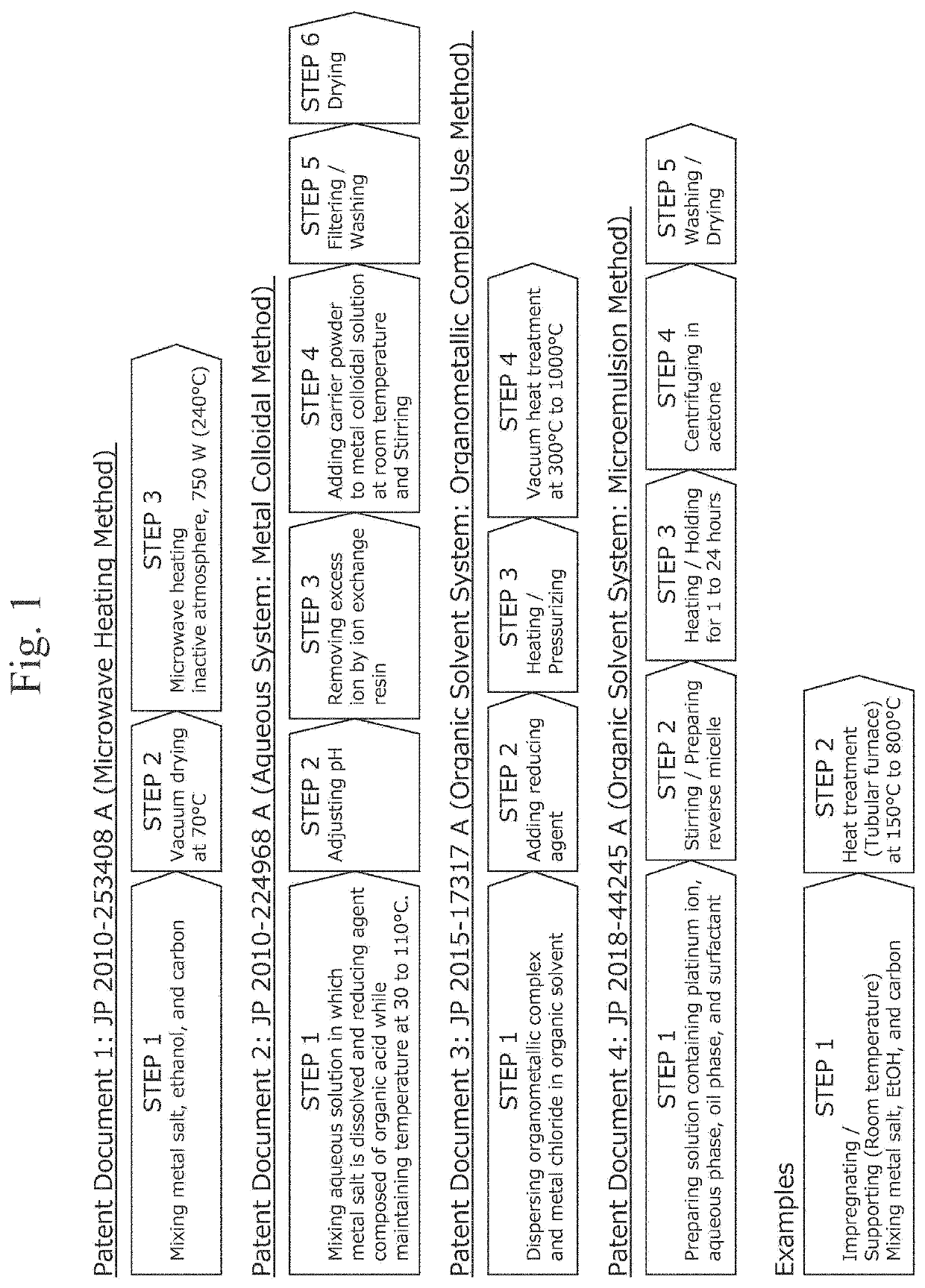
[0088]FIG. 1 shows a comparison between the number of steps in Examples and the number of steps in each of the patent documents. It can be seen that the Examples have the smallest number of steps. Another feature is that the production method of the Examples is an environment-friendly production method that does not generate any waste liquid because it does not use any organic substance or aqueous solution other than a volatile alcohol in the producing process.
1. Synthesis of Noble Metal Fine Particle-Supported Catalyst
[0089]Hexachloroplatinic (IV) acid hexahydrate (H2PtCl6.6H2O: Kanto Chemical Co., Inc., 98.5%) was collected in a beaker in an amount as shown in Table 1 below, and ethanol (C2H5OH) was added thereto in an amount as shown in Table 1 below to dissolve hexachloroplatinic (IV) acid hexahydrate. After collection of 85.6 g of graphitized carbon black (GCB, specific surface area of 150 m2g−1:...
PUM
| Property | Measurement | Unit |
|---|---|---|
| Temperature | aaaaa | aaaaa |
| Temperature | aaaaa | aaaaa |
| Particle diameter | aaaaa | aaaaa |
Abstract
Description
Claims
Application Information
 Login to View More