These sound modifiers in conventional gaming headsets are typically implemented with fixed signal modifiers and therefore suffer from several shortcomings, including the inability to easily modify the parameter settings of the sound modifiers or to easily recall such modifications.
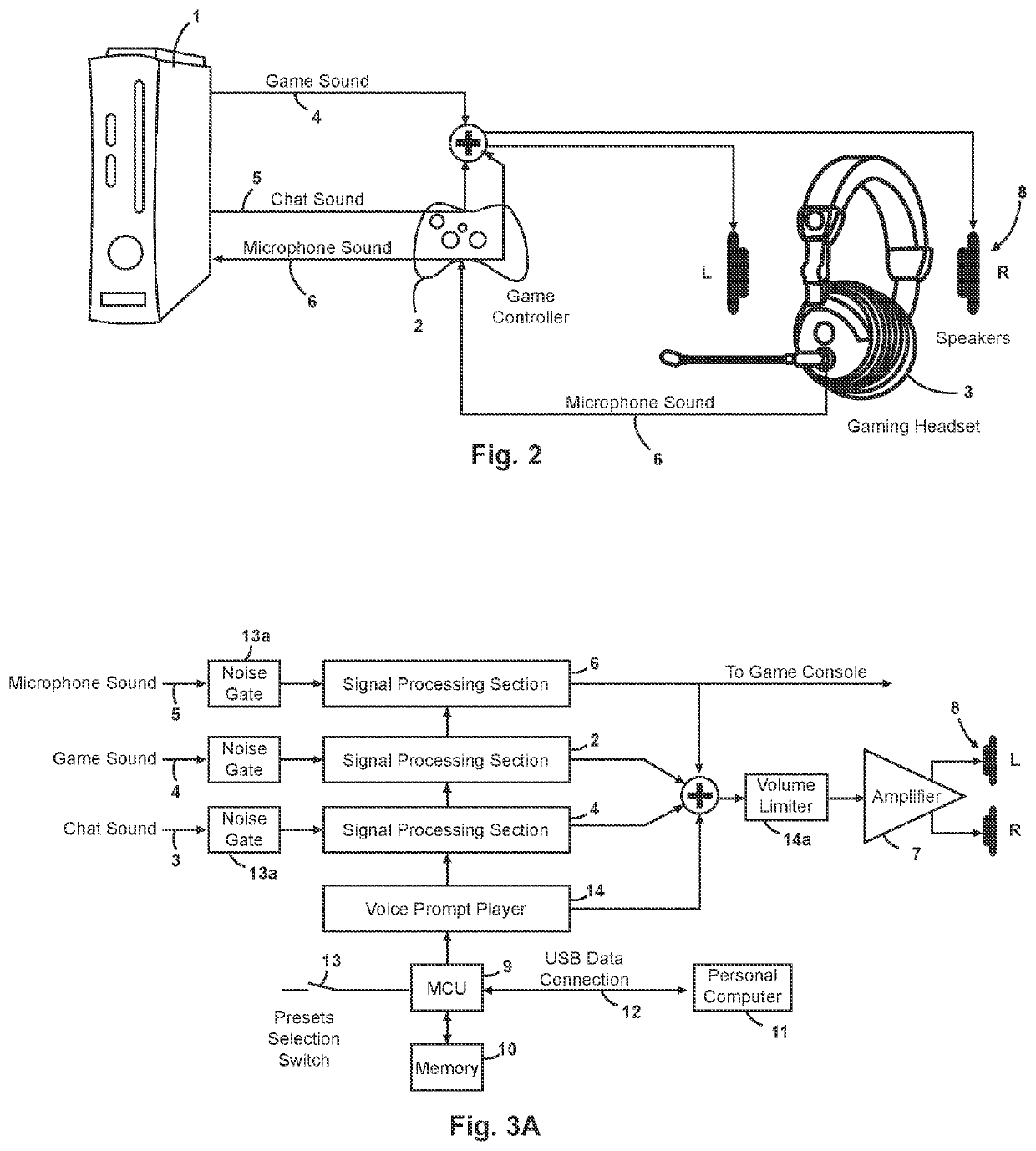
As an example, since the headset covers both ears, it is difficult for the user to hear his own voice when speaking into the microphone, thereby causing him to speak louder than normal.
Although it is desirable to adjust the level of microphone sound that is fed back to the speakers in this manner, it is cumbersome to do so because there is little room on the headset for a physical
volume control to set this level.
Therefore, this monitoring feature is typically implemented with a fixed volume level that may be either too soft or too loud for a particular user.
As a consequence of this
wide dynamic range, if the chat communication signals are set for a comfortable volume level during normal game passages, they cannot be heard over the loud game sound during louder game passages.
However there is little room on the headset for adding the required parameter controls, so this
gain boost parameter is often fixed and is not adjustable by the user.
The parameters for the signal modifiers are typically numerous and therefore cannot be adjusted with physical controls on the headset.
Consequently, these parameters are often fixed and cannot be modified, other than turning the fixed values on or off with a simple button.
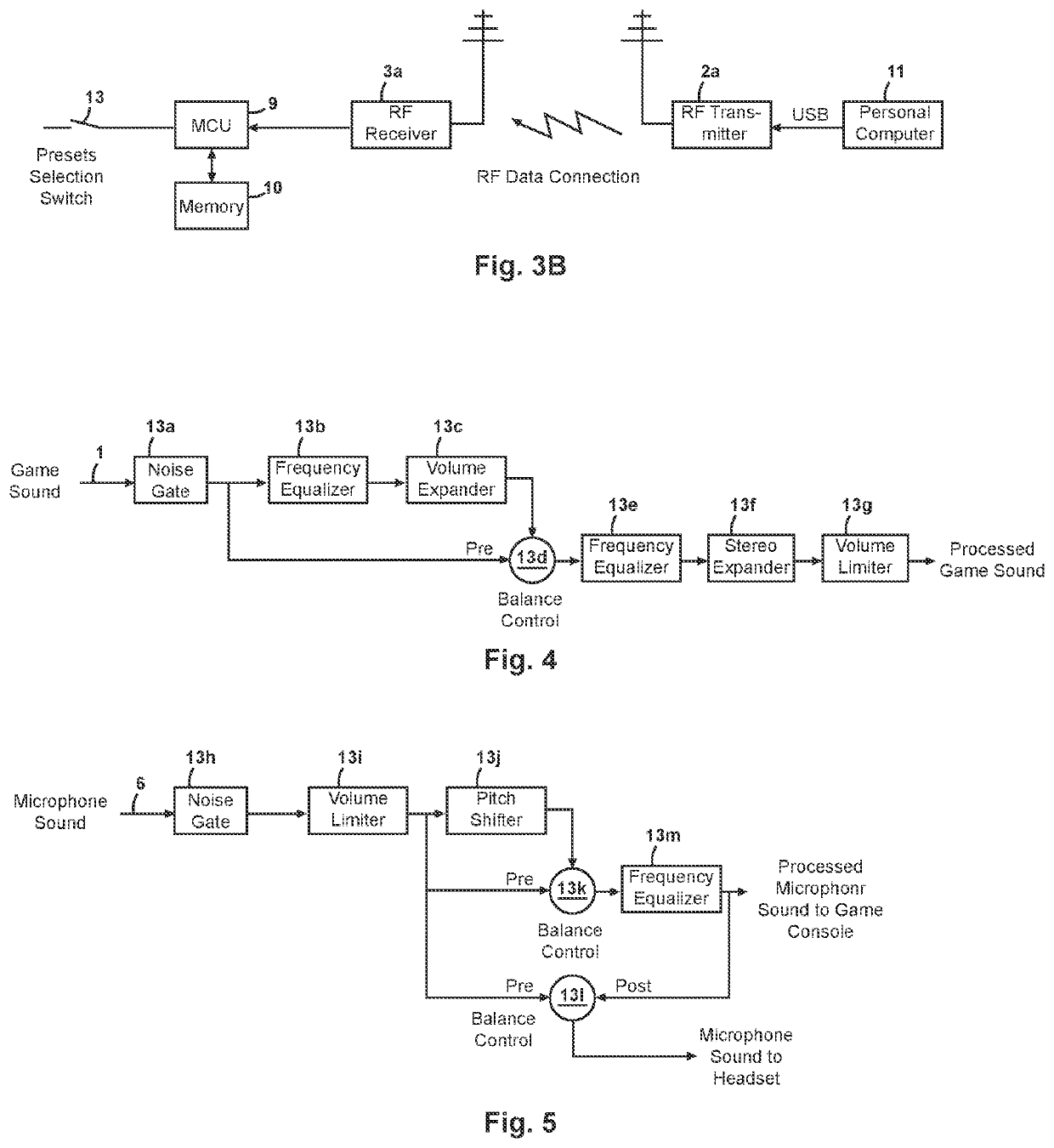
It is not possible to adjust a plurality of signal modifier parameters with an external
personal computer and save it in the headset's local memory for easy recall by the user, thereby allowing a large number of customized features to be implemented in the headset and easily controlled by the user.
As a fourth example, the game sound may sometimes reach unexpected loud crescendos that can potentially damage the hearing of the listener.
Turning down the volume to compensate for the louder sounds makes it more difficult to hear softer sounds, and is therefore rarely done by the user.
From these examples, it is apparent that many game sound parameters can be modified to improve the game experience, yet most gaming headsets do not allow the modification of parameters to adjust the sound.
This method of adjustment makes it difficult to set the parameters desired by each user and to exactly replicate specific settings desired by the user.
There are several problems with the modification of a plurality of parameters.
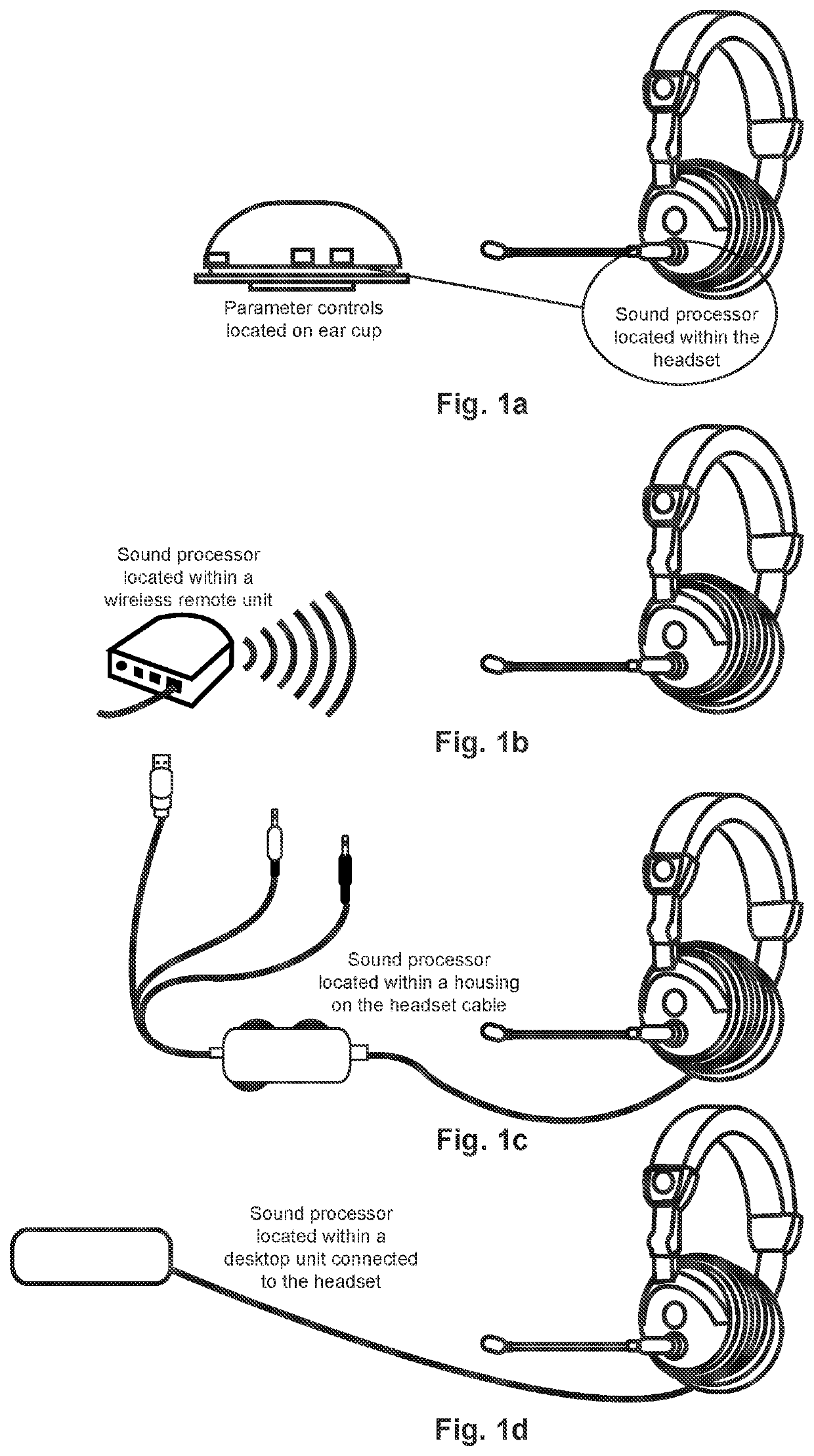
One problem is that it is cumbersome for the user to set and adjust multiple parameters if the controls are located on the headset because of the number of controls and the awkwardness of manipulating controls located on the ear cups or on the connecting cable.
Because of the limited space on a headset, the number and location of physical controls is very limited and therefore only a few parameters can be adjusted by the user.
Another problem is that the user cannot see the controls placed on the ear cups while wearing the headset, making it difficult to know which parameter is being changed when manipulating the controls.
Another problem is that it is difficult to adjust a plurality of parameter settings without a
visual interface that presents all of the controls in a logical manner so they may be adjusted and saved for easy recall.
The vast number of parameters that may be adjusted makes it impractical to provide hardware controls for setting the parameters.
Another problem is that fixed
hardware implementations of sound modification circuitry makes it difficult for the user to modify and replace the effects used for modifying the audio paths with custom variations that are desirable to the user.
Another problem of fixed
hardware implementations of sound modification circuitry is that it cannot be easily upgraded to new configurations.
The fixed nature of the design inherently limits the ability to change
signal routing and
processing paths for improvements or changes to the original design.
A problem with this implementation is that sound modification portion of the headset does not reside within the headset itself, but rather in the
personal computer software.



 Login to View More
  Login to View More