
Self-oscillating electronic discharge lamp ballast with dimming control
a technology of electronic discharge and ballast, which is applied in the direction of electric variable regulation, process and machine control, instruments, etc., can solve the problems of spectral content, complex electrical characteristics of gas-discharge lamps, and correspondingly complex and expensive known arrangements for controlling light output of gas-discharge lamps
- Summary
- Abstract
- Description
- Claims
- Application Information
AI Technical Summary
Benefits of technology
Problems solved by technology
Method used
Image

Examples
Embodiment Construction
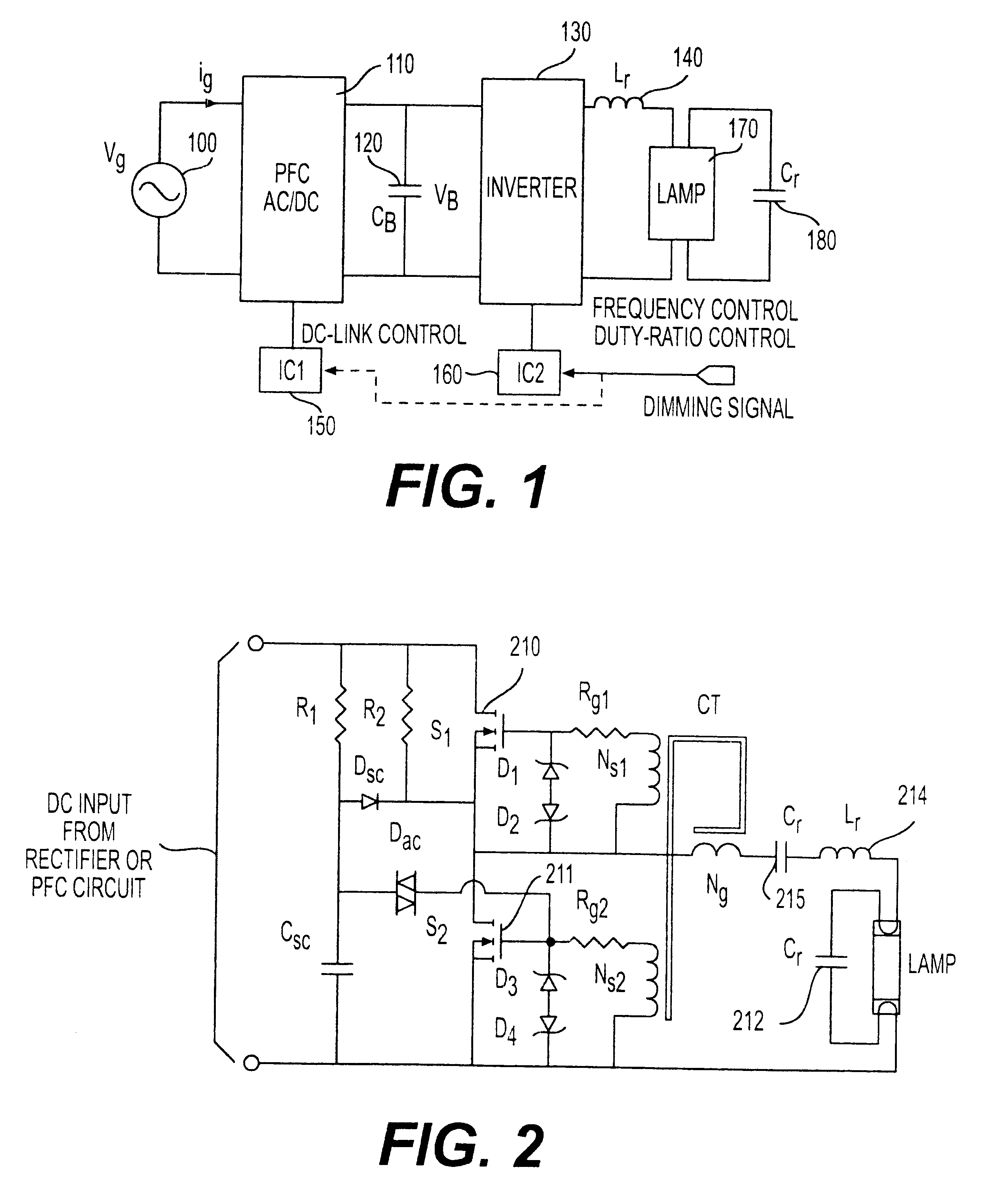
Referring now to the drawings, and more particularly to FIG. 1, there is schematically shown a generalized electronic ballast including a dimming system including functional blocks common to such arrangements known in the art and currently available. Since this depiction is generalized and arranged to facilitate an understanding of the invention, no portion of FIG. 1 (or any other Figure) is admitted to be prior art as to the present invention.
As shown in FIG. 1, it will often be desirable for the electronic ballast to be powered from an alternating utility line as depicted by alternating voltage source 100. However, the electronic ballast or power supply circuit is preferably powered by direct current. In such a case, it will also often be necessary (e.g. to comply with IEC-61000-3-2 class C regulations) to include power factor correction and AC / DC conversion 110. It is to be understood that such arrangements are generally well-understood in the art and, while omitted from some of ...
PUM
 Login to View More
 Abstract
Description
Claims
Application Information
 Login to View More