
pi-Type band pass filter
- Summary
- Abstract
- Description
- Claims
- Application Information
AI Technical Summary
Benefits of technology
Problems solved by technology
Method used
Image

Examples
Embodiment Construction
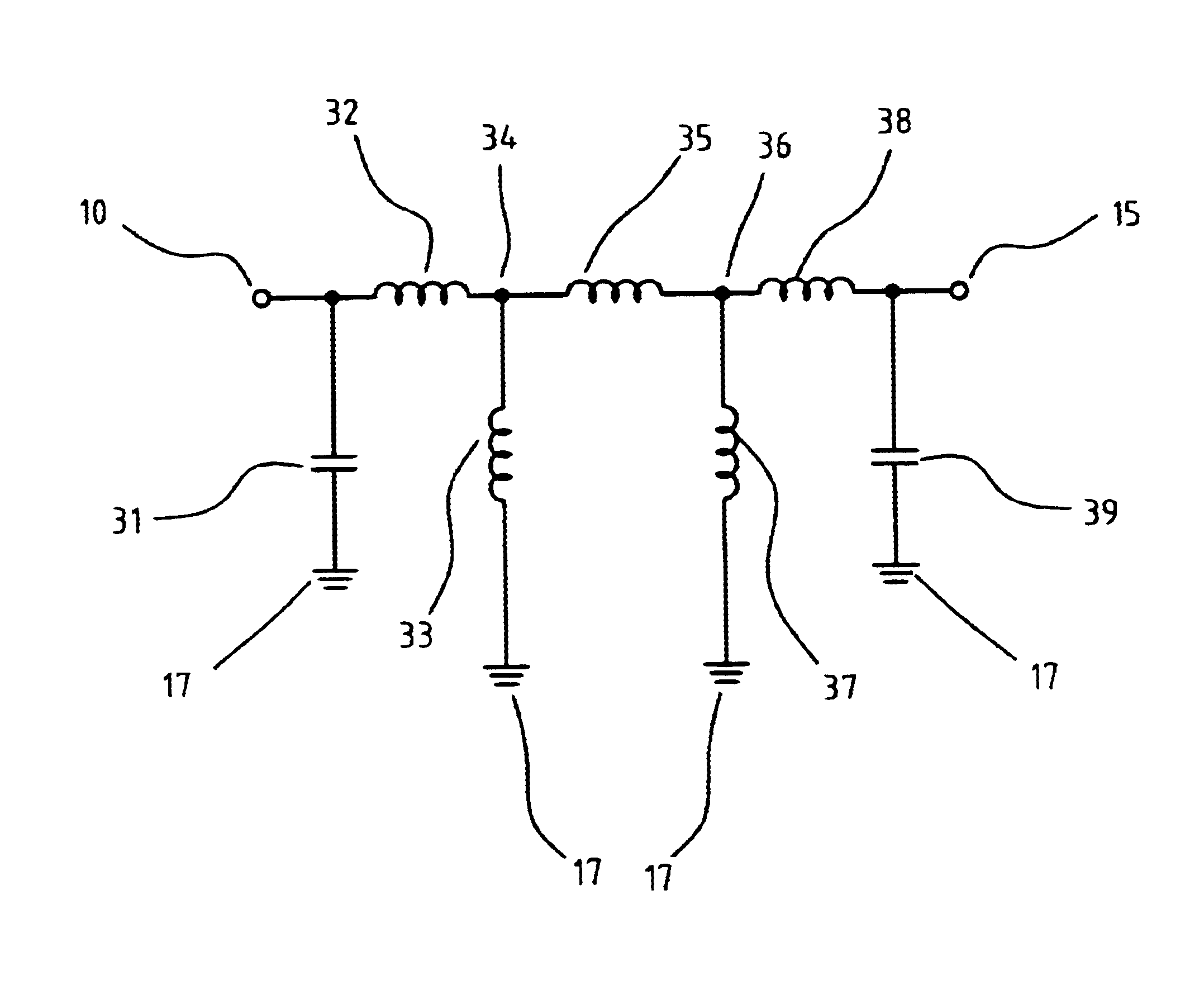
FIG. 3 shows a π-type band pass filter of the present invention. Input signals enter the filter from the input signal end 10. A first resonant capacitor 31 is placed between input signal end 10 and ground 17, and a first serial inductor 32 is placed between input signal end 10 and a first junction 34. A first parallel inductor 33 is placed between first junction 34 and ground 17. A compensating inductor 35 is placed between first junction 34 and a second junction 36. A second parallel inductor 37 is placed between second junction 36 and ground 17. A second serial inductor 38 is placed between second junction 36 and a signal output end 10. A second resonant capacitor 39 is placed between signal output end 15 and ground 17. The signal output end 15 outputs signals. First and second resonant capacitors 31, 39 have the same capacitance, first and second serial inductors 32, 38 have the same inductance, and first and second parallel inductors 33, 37 have the same inductance.
When signals ...
PUM
 Login to View More
 Abstract
Description
Claims
Application Information
 Login to View More