Semiconductor memory device
a memory device and semiconductor technology, applied in the field of semiconductor memory devices, can solve the problems of long manufacturing term and high manufacturing cost, and achieve the effect of high integration degr
- Summary
- Abstract
- Description
- Claims
- Application Information
AI Technical Summary
Benefits of technology
Problems solved by technology
Method used
Image



Examples
first embodiment
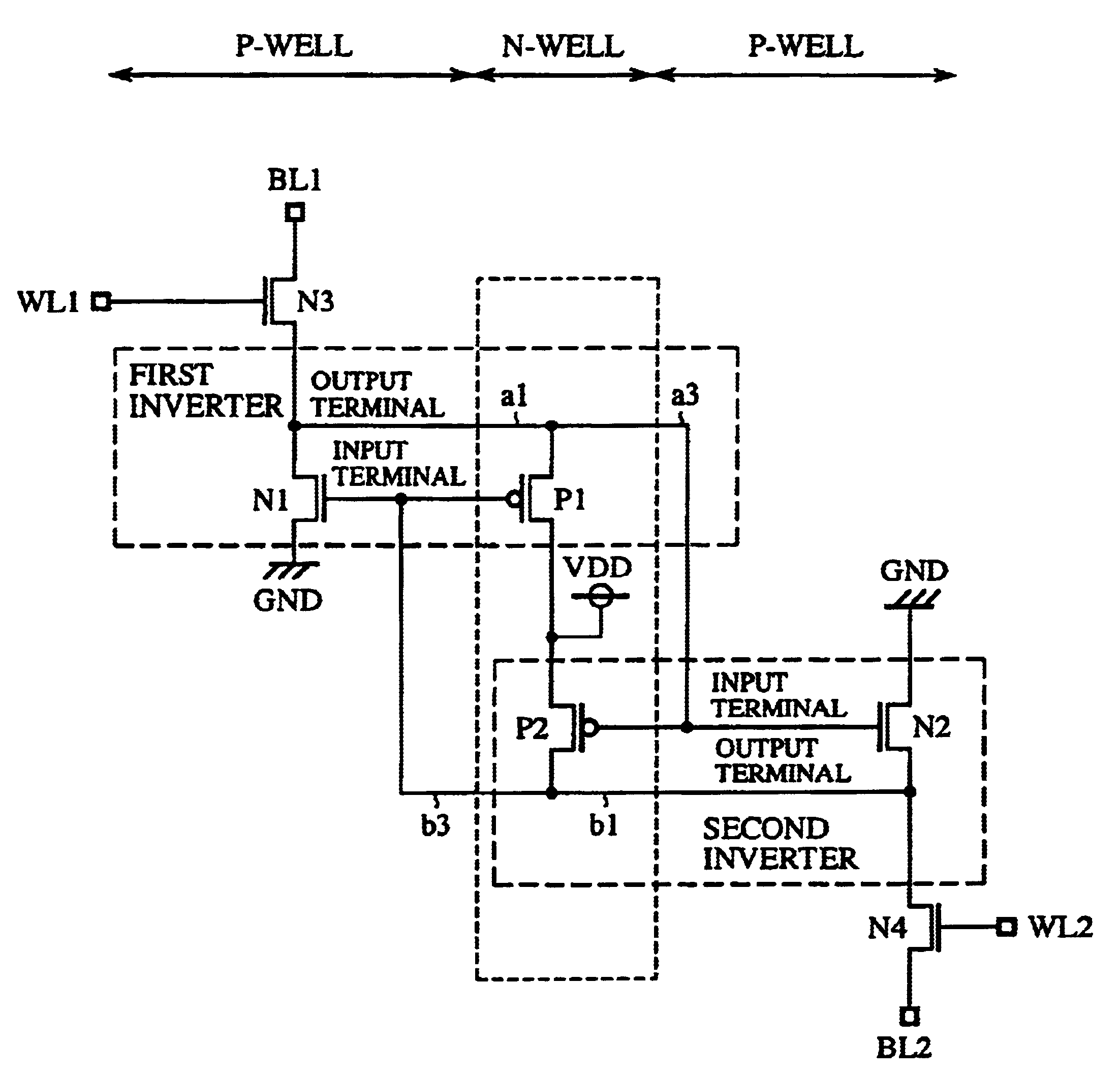
FIG. 1 is a layout configuration diagram showing a semiconductor memory device according to the first embodiment of the present invention. FIG. 2 is a circuit diagram showing the semiconductor memory device shown in FIG. 1.
Referring to FIGS. 1 and 2, reference numeral 1 denotes an one-bit SRAM, reference numeral N1 denotes an NMOS transistor (a first NMOS transistor) formed in a first P well region, reference numeral N2 denotes an NMOS transistor (a second NMOS transistor)formed in a second P well region, reference numeral N3 denotes an NMOS transistor (a third NMOS transistor) formed in the first P well region. Reference numeral N4 denotes an NMOS transistor (a fourth NMOS transistor) formed in the second P well region. Reference numeral P1 denotes a PMOS transistor (a first PMOS transistor) formed in a N well region, and reference numeral P2 denotes a PMOS transistor (a second PMOS transistor) formed in the N well region. The NMOS transistor N1 and PMOS transistor P1 make up a fir...
second embodiment
In the first embodiment, the semiconductor memory device made up of the one-bit SRAM is shown. In the case where the semiconductor memory device is a plural-bits SRAM, the semiconductor memory device should be formed into the layout configuration such as shown in FIG. 3. FIG. 4 is a circuit diagram showing the semiconductor memory device shown in FIG. 3.
In the second embodiment, the source of the NMOS transistor N2 of a memory cell m1 is connected to the N+ diffused region (corresponding to the N+ diffused region located in the lower of the first P well region in FIG. 1) to which the source of the NMOS transistor N1 of a memory cell m0 is connected to share the N+ diffused region.
Similarly, the source of the NMOS transistor N1 of a memory cell m2 is connected to the N+ diffused region (corresponding to the N+ diffused region located in the upper of the second P well region in FIG. 1) to which the source of the NMOS transistor N2 of the memory cell m0 is connected to share the N+ dif...
third embodiment
While in the first embodiment, the NMOS transistors N1 and N3 are formed in the first P well region, and the NMOS transistors N2 and N4 are formed in the second P well region by dividing a P well region, the PMOS transistor P1 may be formed in the first N well region, and PMOS transistor P2 may be formed in the second N well region by dividing a N well region as in FIGS. 5 and 6. In this event, the same effect as the first embodiment can be obtained.
The arrangement of the other parts can be easily inferred from the description in the first embodiment, so more detailed description thereof is omitted. The NMOS transistors N1, N2, N3, and N4 are formed in a P well region. At that time, the NMOS transistors N1, N2, N3, and N4 are formed such that the sources and drains thereof align in a direction orthogonal to the word lines WL1 and WL2.
The sources of NMOS transistors N1 and N2 are connected with the ground potential of a N+ diffused region formed in P well region.
PUM
 Login to View More
 Abstract
Description
Claims
Application Information
 Login to View More