Method for reconstructing the topology of a polygonal soup

a topology and polygonal soup technology, applied in the field of interactive simulation visualization tools, can solve the problems of most of the limitations inherent in the data structure of these tools

a topology and polygonal soup technology, applied in the field of interactive simulation visualization tools, can solve the problems of most of the limitations inherent in the data structure of these tools

US6889176B1Inactive Publication Date: 2005-05-03FORD GLOBAL TECH LLC

Image

Smart Image Click on the blue labels to locate them in the text.
Viewing Examples
Smart Image
  • Method for reconstructing the topology of a polygonal soup
  • Method for reconstructing the topology of a polygonal soup
  • Method for reconstructing the topology of a polygonal soup

Examples

Experimental program
Comparison scheme
Effect test

Embodiment Construction

)

[0023]As indicated, there is a need for interactive simulation with complex systems, such as airplanes and cars, and in fact visualization tools have been developed which are capable of rendering large models in real-time. However, in developing the 3-D rendering tools, insufficient attention has been paid to architecting systems capable of evolving into effective modeling tools. One of the critical limitations is inherent in the data structure. Almost all visualization tools have adopted polygonal soups as their standard data representation. However, a variety of existing applications, ranging from CFD, FEA and assembling simulations, require more than a cloud of points or triangles.

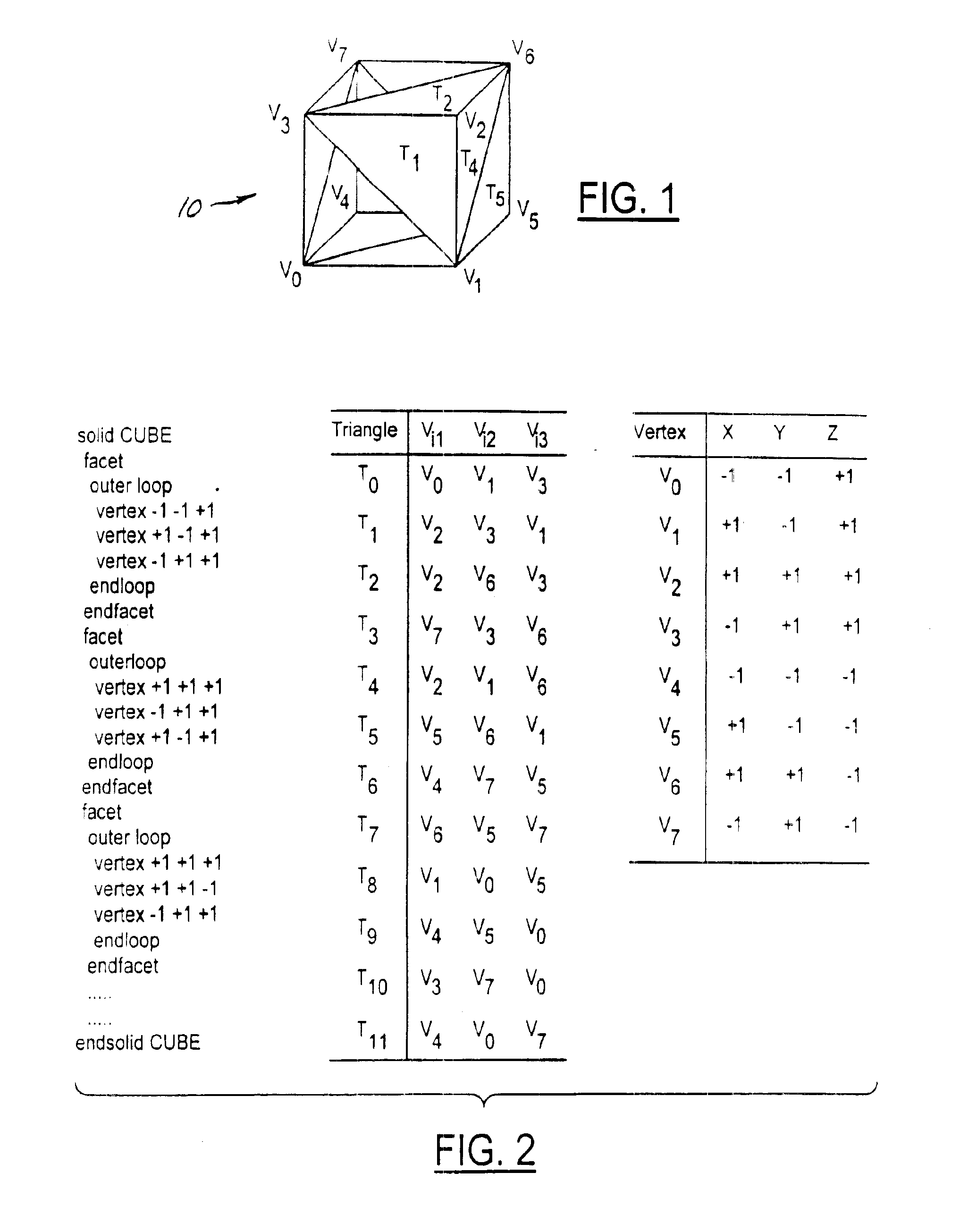
[0024]Currently, different data representations are used to model tessellated meshes. FIG. 1 illustrates one example represented by a cube 10. The cube is modeled as a set of eight triangles, two per side, and eight vertices, V0 through V7.

[0025]In the STL (stereo lithography) format, the model is desc...

the structure of the environmentally friendly knitted fabric provided by the present invention; figure 2 Flow chart of the yarn wrapping machine for environmentally friendly knitted fabrics and storage devices; image 3 Is the parameter map of the yarn covering machine
Login to View More

PUM

No PUM Login to View More

Abstract

A method for automatically reconstructing topographical information for a given mesh, altering the mesh by introducing, deleting, or splitting existing polygons when needed. An OctTree space decomposition is used to achieve a log2-complexity search method to find the closest vertex in the polygonal soup to a given point in space. Linear complexities are used to find triangles connected to a given vertex and all triangles connected to a given triangle. The triangles are split to enforce conductivity.

Description

TECHNICAL FIELD[0001]The present invention relates to visualization tools for interactive simulations with complex vehicle models.BACKGROUND OF THE INVENTION[0002]To meet the need for interactive simulations with complex vehicle models, a generation of visualization tools have been developed. However, most of these tools have limitations inherent in their data structure. In this regard, most visualization tools have adopted a polygonal soup, that is, an unstructured collection of polygons, as their standard data representation. However, a variety of existing applications, such as CFD (Computational Fluid Dynamics), FEA (Finite Element Analysis), and assembly simulation, require more than a cloud of points or triangles.[0003]Thus, a need exists for a method of reconstructing the topographical information (relationships between polygons) of a polygonal soup in order to overcome the known problems with visualization tools.SUMMARY OF THE INVENTION[0004]The object of the present inventio...

Claims

the structure of the environmentally friendly knitted fabric provided by the present invention; figure 2 Flow chart of the yarn wrapping machine for environmentally friendly knitted fabrics and storage devices; image 3 Is the parameter map of the yarn covering machine
Login to View More

Application Information

Patent Timeline
03 May 2005
Publication
US6889176B1
IPC
G06F17/50; G06T17/20
CPC
G06T17/205; G06T17/20; G06F30/00
Inventors
BUTTOLO, PIETRO; STEWART, PAUL JOSEPH