Method of using transient faults to verify the security of a cryptosystem

US6965673B1Inactive Publication Date: 2005-11-15HANGER SOLUTIONS LLC

Image

Smart Image Click on the blue labels to locate them in the text.
Viewing Examples
Smart Image
  • Method of using transient faults to verify the security of a cryptosystem
  • Method of using transient faults to verify the security of a cryptosystem
  • Method of using transient faults to verify the security of a cryptosystem

Examples

Experimental program
Comparison scheme
Effect test

Embodiment Construction

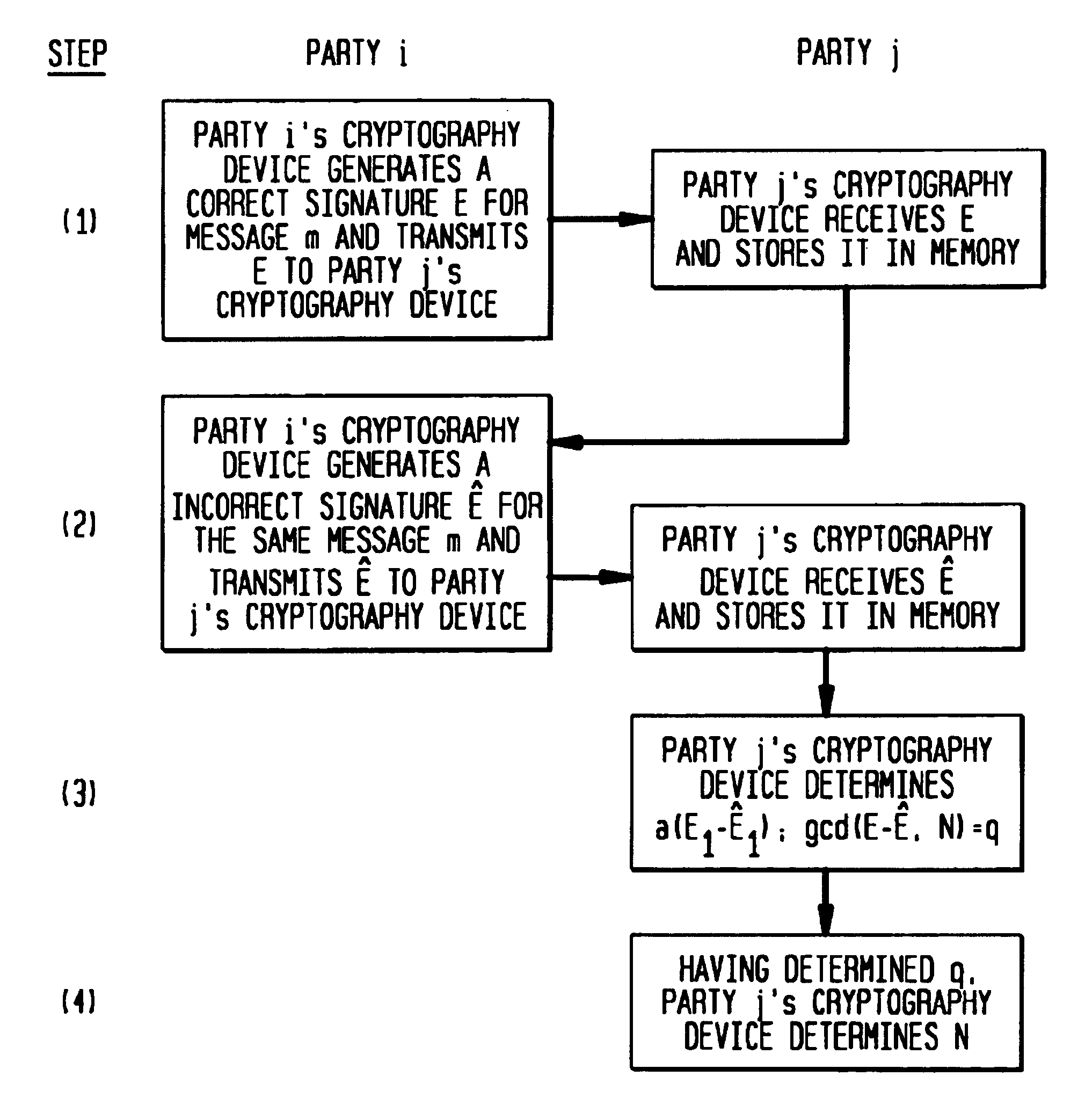
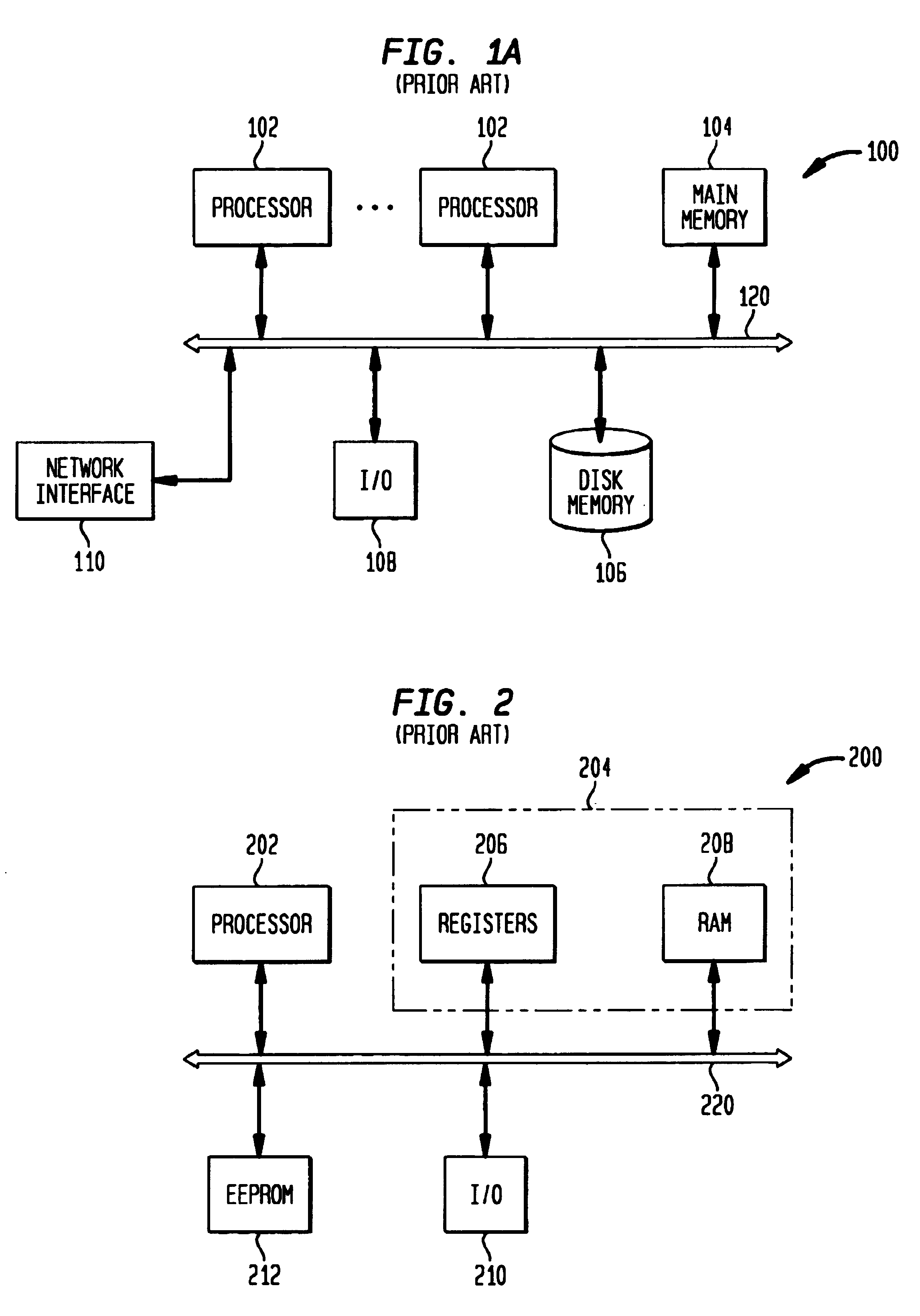
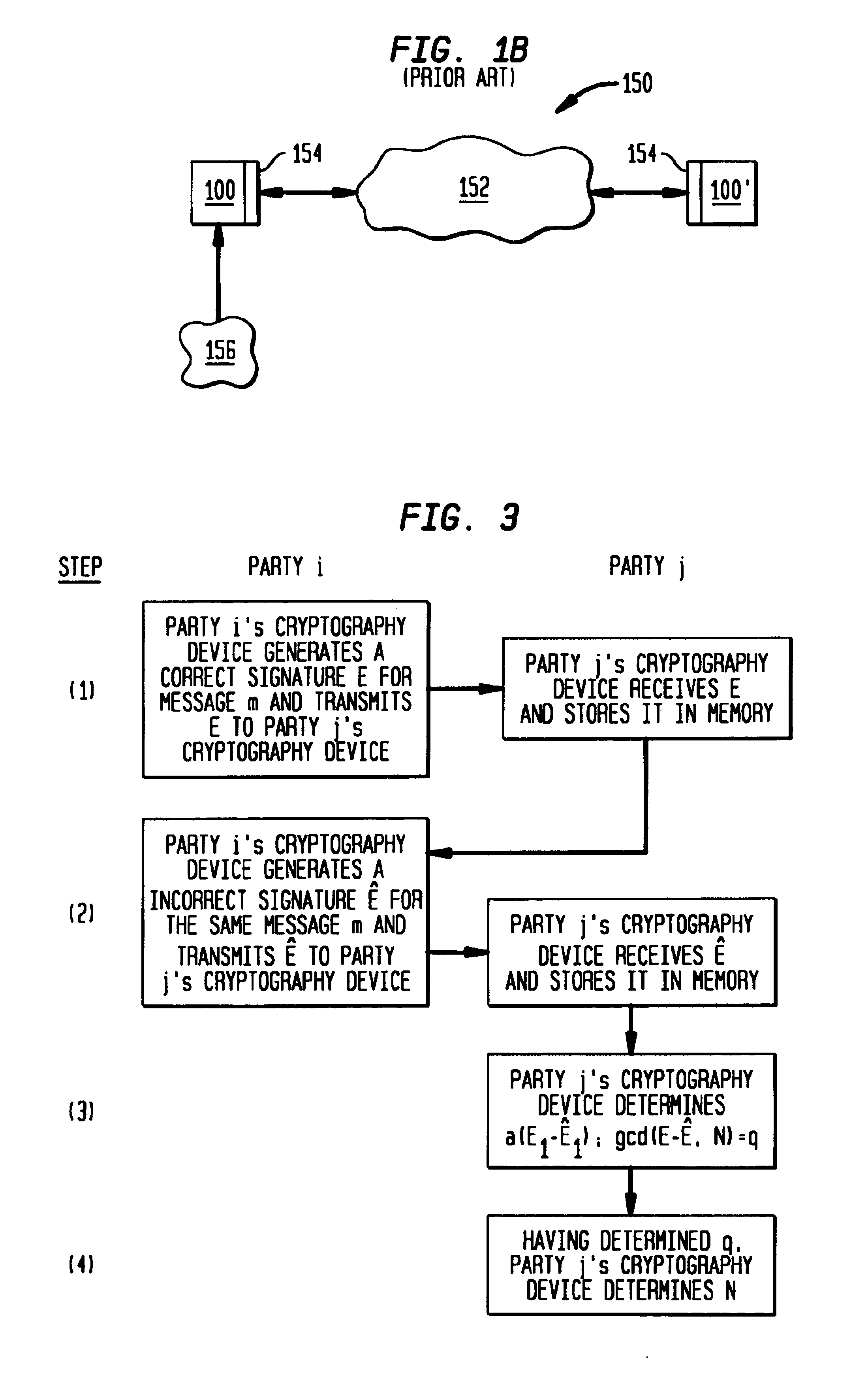
[0053]The present invention is described in the following sections:[0054]I. Types of Faults which may occur which permit certain cryptosystems to be cracked are described with reference to FIG. 2.[0055]II. Cracking Cryptographic Signature Implementations that Use the Chinese Remainder Theorem is described with reference to FIGS. 3 and 4, including discussion of the RSA Signature Scheme and the Chinese Remainder Theorem, Cracking the RSA Signature Scheme, and Cracking the Rabin Signature Scheme.[0056]III. Using Register Faults To Break Cryptosystems is described with reference to FIGS. 5, 6A, 6B, and 7, including discussion of Using Register Faults to Attack the Fiat-Shamir Authentication Scheme, Using Register Faults to Crack Schnorr's Authentication Scheme, and Using Register Faults to Crack Other RSA Implementations.[0057]IV. Providing Cryptosystems and Cryptography Devices which Resist Tampering Due to Hardware Faults is described.[0058]V. A Conclusion is provided.

I. Types of Fau...

the structure of the environmentally friendly knitted fabric provided by the present invention; figure 2 Flow chart of the yarn wrapping machine for environmentally friendly knitted fabrics and storage devices; image 3 Is the parameter map of the yarn covering machine
Login to View More

PUM

No PUM Login to View More

Abstract

A useful method of verifying the integrity of a cryptosystem involves using erroneous outputs to obtain secret information. In certain signature schemes which use the Chinese Remainder Theorem, a correct signature of a message and an erroneous signature of the same message permit the modulus to be easily obtained. If the content of the message is known, such cryptosystems may be cracked with only an erroneous signature of the message. Certain other authorization schemes may be cracked by analyzing a number of erroneous outputs caused by a particular type of error called a “register fault.” A security expert or cryptosystem designer may intentionally induce a tamper proof device generate a faulty computation by subjecting the device, such as a smart card, to physical stress, such as certain types of radiation, atypical voltage levels, or a higher clock rate than the device was designed to accommodate. Cryptosystems should be impervious to the attacks described herein. If not, the system should be modified or discarded.

Description

RELATED APPLICATION[0001]This patent application is a continuation of U.S. patent application Ser. No. 08 / 933,541 filed Sep. 19, 1997.BACKGROUND OF THE INVENTION[0002]1. Field of the Invention[0003]The present invention relates to cryptanalysis and, more particularly, relates to methods for “cracking”, or deciphering, cryptosystems, by analyzing one or more erroneous outputs to infer information ordinarily difficult or impossible for a party not privy to secret information. Knowing how a cryptosystem may be cracked suggests methods for avoiding attacks on the cryptosystem, thus further improving the integrity of the cryptosystem. A security expert or cryptosystem designer may use the inventive methods in the design of cryptography devices to verify that an existing or proposed device is impervious to such attacks.[0004]2. Discussion of Related Art[0005]Cryptography has become essential to the acceptance of electronic commerce and sensitive electronic communications. For example, sec...

Claims

the structure of the environmentally friendly knitted fabric provided by the present invention; figure 2 Flow chart of the yarn wrapping machine for environmentally friendly knitted fabrics and storage devices; image 3 Is the parameter map of the yarn covering machine
Login to View More

Application Information

Patent Timeline
15 Nov 2005
Publication
US6965673B1
IPC
H04K1/00; G06F7/72; H04L9/30; H04L9/32
CPC
G06F7/723; H04L9/004; H04L9/302; H04L9/3218; H04L9/3249; G06F2207/7219
Inventors
BONEH, DAN; LIPTON, RICHARD