Small molecular weight TNF receptor multimeric molecule
Inactive Publication Date: 2006-07-04
THE KENNEDY INST OF RHEUMATOLOGY HAMMERSMITH
View PDF16 Cites 6 Cited by
Summary
Abstract
Description
Claims
Application Information
AI Technical Summary
This helps you quickly interpret patents by identifying the three key elements:
Problems solved by technology
Method used
Benefits of technology
Benefits of technology
[0012]The present invention also relates to protein or receptor molecules which bind cytokines that bind to receptor molecules comprising more than one subunit (e.g., IL-2 and IL-6 bind to an α or β receptor protein). The ECD of such receptors linked by a polypeptide linker have higher affinity for the cytokine, and, are effective inhibitors of the biological activity of the cytokine. Thus, the receptor comprises all or a functional portion of the ECD of two or more cytokine receptors linked via one or more polypeptide linkers. Furthermore, the receptor is less immunogenic, allows faster clearance and greater tissue penetration in the host upon administration than recombinant immunoglobulin molecules.
Problems solved by technology
However, these molecules are large in size, immunogenic and include the Fc portion of the IgG which may interfere with clearance by binding to Fc receptors.
Method used
the structure of the environmentally friendly knitted fabric provided by the present invention; figure 2 Flow chart of the yarn wrapping machine for environmentally friendly knitted fabrics and storage devices; image 3 Is the parameter map of the yarn covering machine
View more
Image
Smart Image Click on the blue labels to locate them in the text.
Viewing Examples
Smart Image
Click on the blue label to locate the original text in one second.
Reading with bidirectional positioning of images and text.
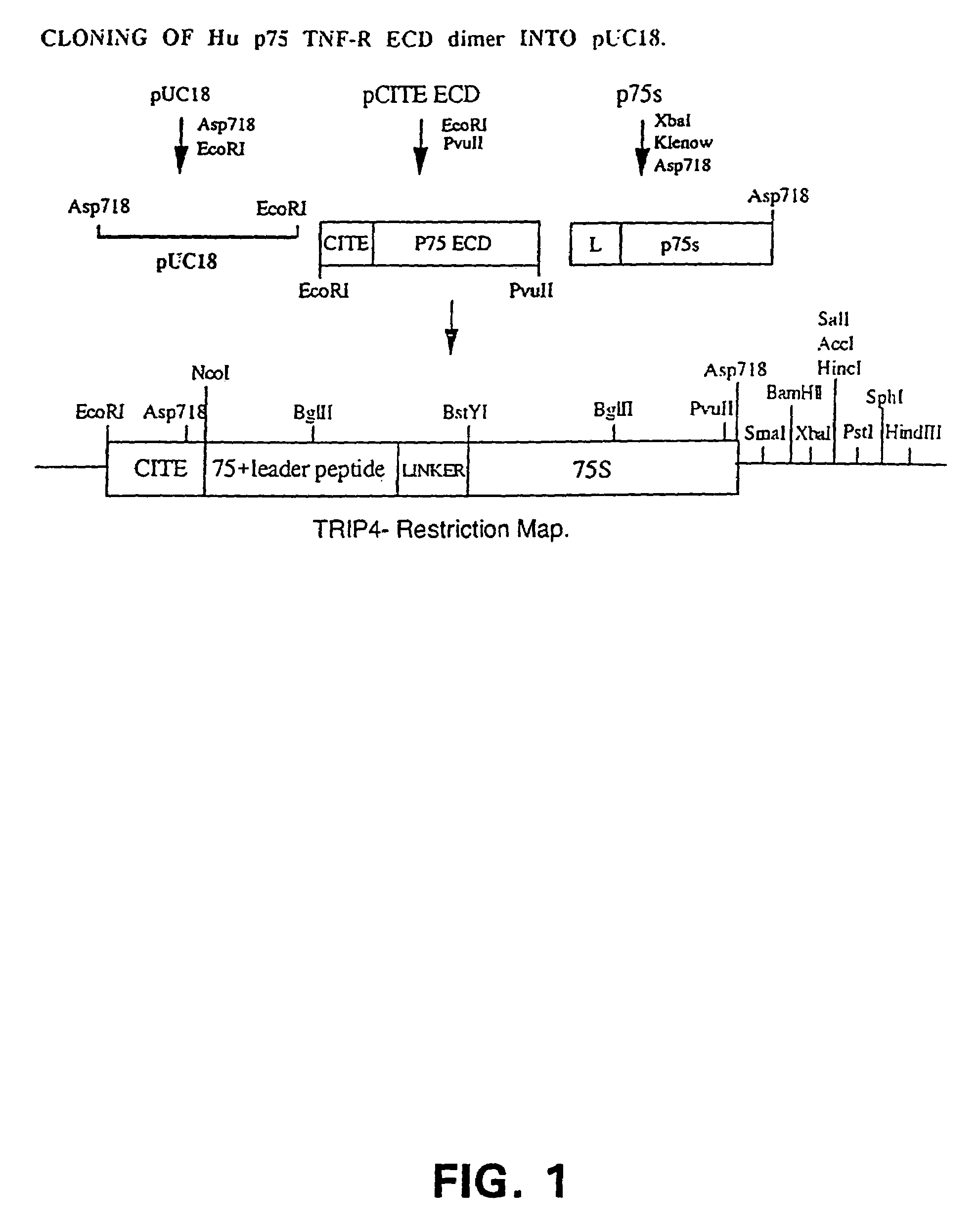
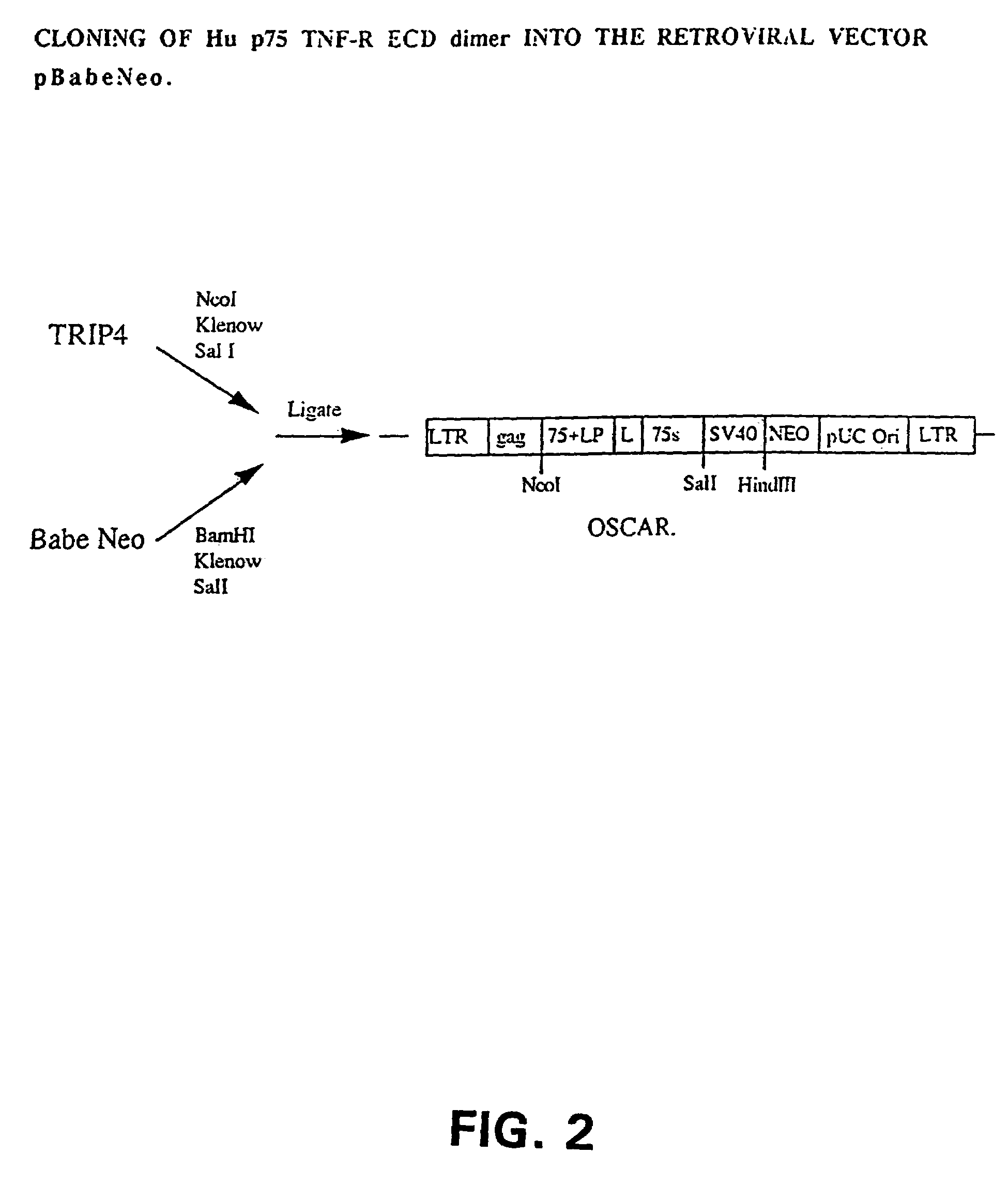
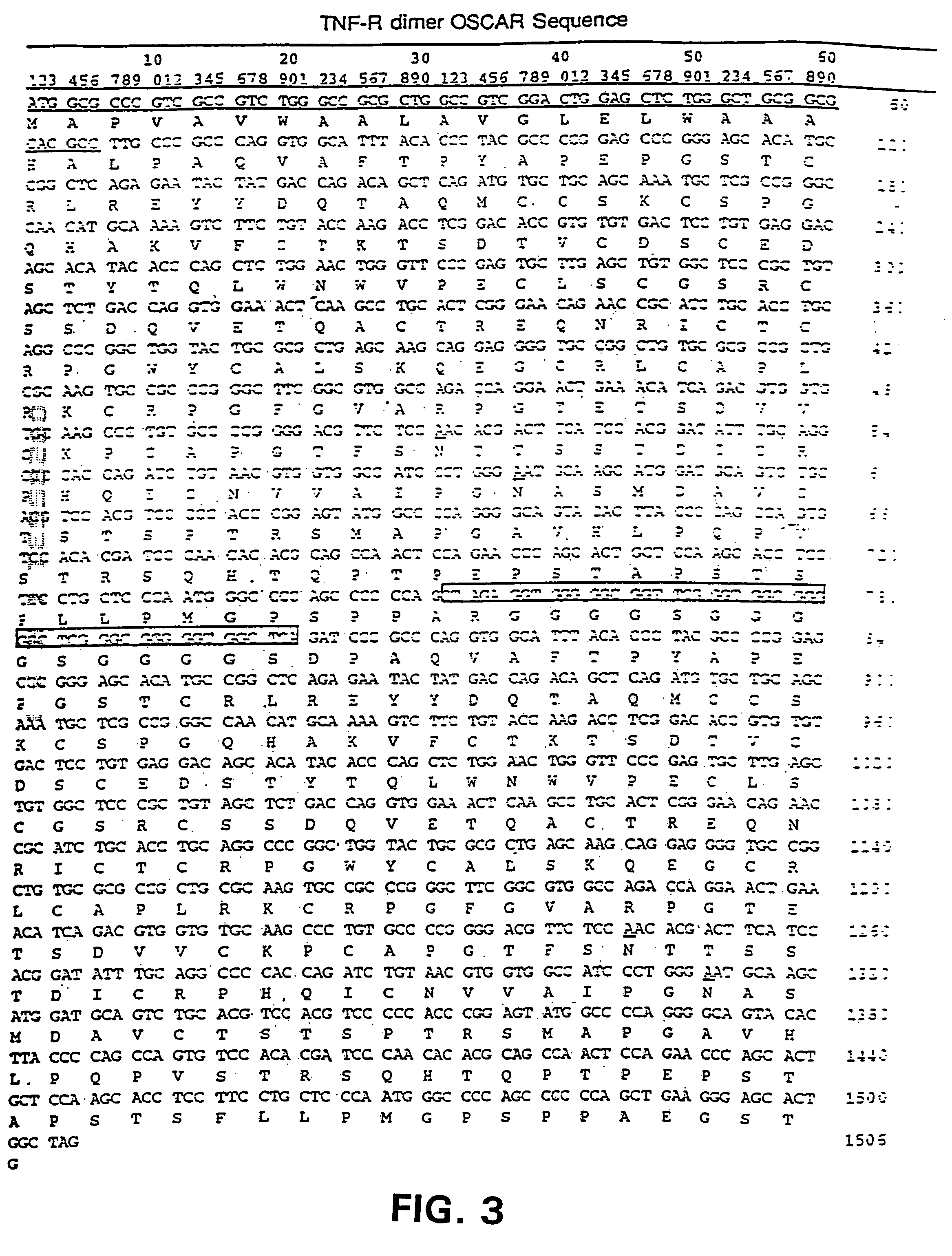
[0043]In order to express a small molecular weight Hu p75 TNF-R ECD dimer, we constructed the retroviral expression vector, Oscar, that was built in a multiple-step cloning procedure described below. Plasmids were grown using DH5α competent cells [supE44 DlacU169 f80 lacZDM15) hsdR17 recA1 endA1 gyrA96 thi-1 relA1].
[0044]The Hu p75 TNF-R ECD was amplified by PCR from the pVL1393-Hu p75 TNF-R ECD plasmid using primers (1) and (2) shown below. pVL1393-Hu p75 TNF-R ECD (derived from pVL1393, In-Vitrogen) contained the Hu p75 TNF-R ECD from amino acid 1 to 205 with a 3′ stop codon. The 5′ primer (1) contained a BamHIrestriction site. Bases 7 to 30 of primer (1) annealed to bases 70 to 93 of the mature Hu p75 TNF-R ECD. The 3′ primer which anneals to the multiple cloning site of the pVL1393, downstream of the ECD insert, contained an Asp718 restriction site.[0045](1) 5′ TCGGATCCCGCCCAGGTGGCATTTACACCC 3′(SEQ ...
example 2
Transfection of GPenvAM12 Cells with the Dimeric Hu p75 TNR-R ECD Retroviral Vector
[0057]Permanent transfections were done in GPenvAM12 cells (Markowitz, D., et al., Virology, 167:400 (1988)). Stable transfectants expressing the Hu p75 TNF-R ECD dimer were made in the cell line GPenvAm12 and G418 was used to select for permanent transfectants. These cells constitutively express the protein which is secreted into the media.
[0058]The GPenv AM12 cells were grown and maintained in DMEM medium supplemented with 10% new-born calf serum, 2.5 units / ml penicillin, 2.5 μg / ml streptomycin and 2 mM glutamine.
[0059]For stable expression of Oscar from GPenvAM12 cells (Markowitz, D., et al., Virology, 167:400 (1988)), 20 μg of vector DNA were transfected into the cell line using the calcium-phosphateprecipitation method. Transfected cells were selected and maintained in medium with 1 mg / ml G418. G418 resistant cell clones were pooled and tested for expression of Hu p75 TNF-R ECD dimer by ELISA, W...
example 3
Protection from TNF Cytotoxicity on WEHI Cells by Hu p75 TNF-R ECD Construct
[0067]WEHI Assay. The concentrated supernatants were tested for protection against TNF cytotoxicity in the WEHI cell assay. To measure the inhibitory effect of the expressed Hu p75 TNF-R ECD dimer on TNF cytotoxic activity, WHEI 164 clone 13 mouse fibrosarcoma cells were used (Espevic, T., and Nissen-Meyer, J., J. Immunol. Methods, 95:99 (1986)).
[0068]FIG. 5 shows the protective effect obtained in this assay when TNF was preincubated with dilutions of various Hu p75 TNF-R ECD proteins. However, the two dimeric Hu p75 TNF-R ECD constructs namely p75 sf2 and Oscar efficiently protected WEHI cells from TNF cytotoxicity. Table 1 shows that 20 pg dimeric Hu TNF-R75 ECD were sufficient to inhibit by 50% the killing activity of 63.5 pg of human TNF. In comparison, 57 pg of the dimeric Hu p75 TNF-R ECD in an Ig backbone (p75 sf2) (Butler, D., et al., Cytokine, 6:616 (1994)) were needed to obtain the same level of pr...
the structure of the environmentally friendly knitted fabric provided by the present invention; figure 2 Flow chart of the yarn wrapping machine for environmentally friendly knitted fabrics and storage devices; image 3 Is the parameter map of the yarn covering machine
Login to View More
PUM
Property
Measurement
Unit
Ratio
aaaaa
aaaaa
Biological properties
aaaaa
aaaaa
Nucleic acid sequence
aaaaa
aaaaa
Login to View More
Abstract
The present invention relates to a receptor molecule which binds to TNF comprising all or a functional portion of the extracellular domain (ECD) of two or more TNF-Rs linked via one or more polypeptide linkers. The receptor can further comprise a signalpeptide of a secreted protein, such as the signalpeptide of the extracellular domain of the TNF-R or the signalpeptide of a cytokine. The invention also relates to isolated DNA encoding a receptor molecule which binds to TNF, comprising two or more sequences encoding all or a functional portion of the ECD of TNF-Rs linked via one or more sequences encoding a polypeptide linker. The invention further relates to a method of making a construct which expresses all or a functional portion of the ECD of two or more TNF-Rs linked via one or more polypeptide linkers and cells which express the construct. The invention also relates to a method of inhibiting the biological activity of TNF in a host comprising administering to the host an effective amount of a receptor molecule of the present invention. The invention further relates to receptor molecules which bind cytokines that bind to receptor molecules comprising more than one subunit.
Description
RELATED APPLICATION(S)[0001]This application is a Continuation of Ser. No. 08 / 437,533 filed May 9, 1995 now abandoned, the entire teachings of which are incorporated herein by reference.BACKGROUND OF THE INVENTION[0002]Tumor Necrosis Factor, a pleiotropic cytokine released by activated T cells and macrophages, is expressed as a mature 17 kDa protein that is active as a trimer (Smith, R. A. and Baglioni, C., J. Biol. Chem., 262:6951 (1986). Trimeric cytokines such as Tumor Necrosis Factor (TNFα) and the closely related proteinlymphotoxin (TNFβ), exert their biological activity by aggregating their cell surface receptors. The TNF trimer binds the receptors on the cell surface causing localized crosslinking of TNF receptors into clusters necessary for signal transduction.[0003]The action of TNFα and TNFβ are mediated through two cell surface receptors, the 55 kDa (p55 TNF-R) and the 75 kDa (p75 TNF-R) receptors. Truncated forms of these receptors, comprising the extracellular domains ...
Claims
the structure of the environmentally friendly knitted fabric provided by the present invention; figure 2 Flow chart of the yarn wrapping machine for environmentally friendly knitted fabrics and storage devices; image 3 Is the parameter map of the yarn covering machine
Login to View More
Application Information
Patent Timeline
Application Date:The date an application was filed.
Publication Date:The date a patent or application was officially published.
First Publication Date:The earliest publication date of a patent with the same application number.
Issue Date:Publication date of the patent grant document.
PCT Entry Date:The Entry date of PCT National Phase.
Estimated Expiry Date:The statutory expiry date of a patent right according to the Patent Law, and it is the longest term of protection that the patent right can achieve without the termination of the patent right due to other reasons(Term extension factor has been taken into account ).
Invalid Date:Actual expiry date is based on effective date or publication date of legal transaction data of invalid patent.


 Login to View More