
Method and apparatus for performing fixed blocksize compression for texture mapping
a texture mapping and compression technology, applied in the field of methods and apparatus for performing fixed blocksize compression for texture mapping, can solve the problems of loss of color precision and impact on the quality of displayed images, and achieve the effect of reducing computational demands and reducing texel bandwidth
- Summary
- Abstract
- Description
- Claims
- Application Information
AI Technical Summary
Benefits of technology
Problems solved by technology
Method used
Image

Examples
Embodiment Construction
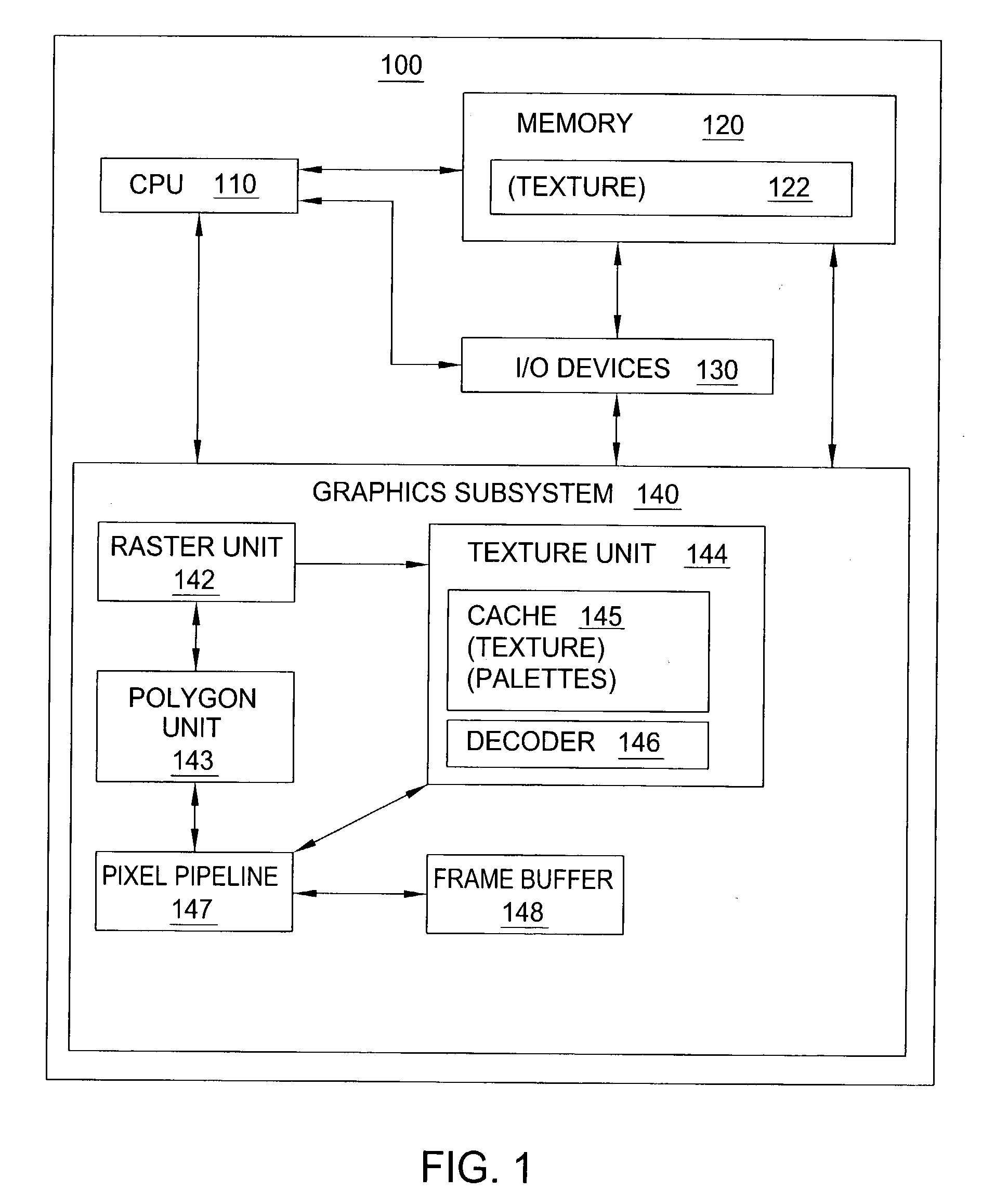
[0028]FIG. 1 illustrates a block diagram of a general purpose computer system 100 implementing the present invention. The computer system 100 comprises a central processing unit (CPU) 110, a system memory 120, a plurality of Input / Output (I / O) devices 130, and a graphics subsystem or a graphics accelerator 140.
[0029]In one embodiment, the graphics subsystem 140 or parts thereof can be physical devices that are coupled to the CPU 110 through a communication channel. Alternatively, the various modules or components within the graphics subsystem 140 can be represented by one or more software applications (or even a combination of software and hardware, e.g., using application specific integrated circuits (ASIC)), where the software is loaded from a storage medium, (e.g., a magnetic or optical drive or diskette) and operated by the CPU in the memory 120 of the computer. As such, the graphics subsystem 140 or parts thereof (including associated data structures as discussed below) of the ...
PUM
 Login to View More
 Abstract
Description
Claims
Application Information
 Login to View More