Determining data signal jitter via asynchronous sampling
a data signal and jitter technology, applied in the direction of noise figure or signal-to-noise ratio measurement, instruments, transmission monitoring, etc., can solve the problems of significant high-impedance data signal, compensation model may not be accurate, significant circuit area can be consumed in impedance-matched and isolated output pads
- Summary
- Abstract
- Description
- Claims
- Application Information
AI Technical Summary
Benefits of technology
Problems solved by technology
Method used
Image



Examples
Embodiment Construction
[0027]The present invention concerns the measurement of jitter of data signals, and in particular, the measurement of jitter in interface data signals. In order to produce accurate results, the capture of measurement data is generally performed by a sampling circuit within the interface (or other data-receiving circuit) rather than a separate test probe. However, the techniques of the present invention can be applied to and within test equipment, as well.
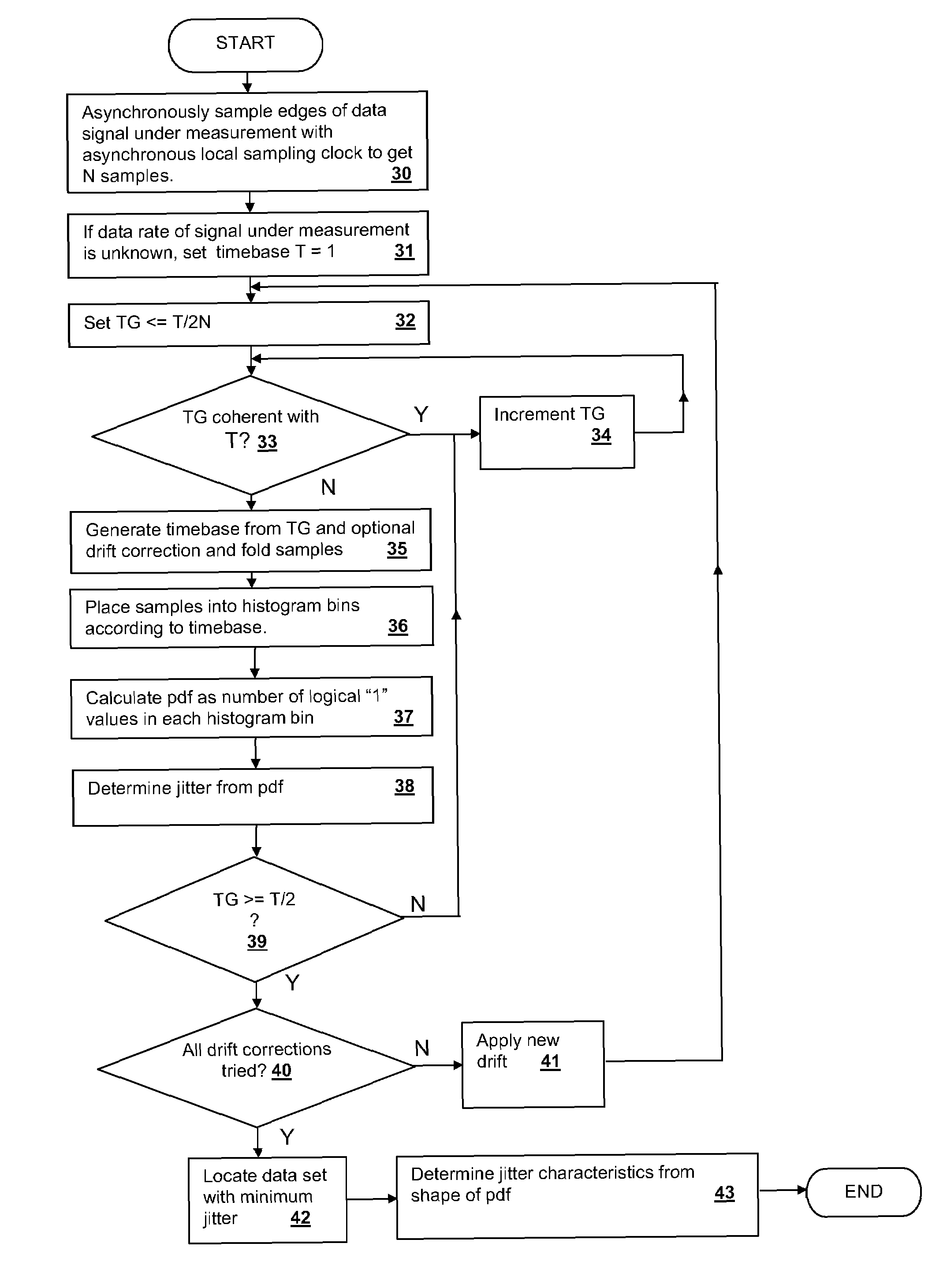
[0028]Primarily, the present invention provides new methods for analyzing data obtained by sampling a data signal under measurement with an asynchronous sampling clock. Rather than filtering the sampled data, as is done within a phase-lock loop (PLL) loop filter, the present invention resolves the sampled data to identify a relationship between the measured locations of data signal edges relative to the sampling clock and then determines the jitter of the measured data signal from the distribution of samples after folding the sample...
PUM
 Login to View More
 Abstract
Description
Claims
Application Information
 Login to View More