Unlock instant, AI-driven research and patent intelligence for your innovation.

System and method for recognition and cyclic service of partial sequences of communication requests

a technology of partial sequences and service methods, applied in the field of accelerating the service of telecommunications requests, can solve the problems of affecting the quality of service, the inability to cope at this increased level, and the excessive cost of coping with a given increase in traffic or size, so as to reduce the delay after dialing

Active Publication Date: 2009-12-29
UNIFY PATENTE GMBH & CO KG
View PDF7 Cites 5 Cited by
  • Summary
  • Abstract
  • Description
  • Claims
  • Application Information

AI Technical Summary

Benefits of technology

This approach reduces post-dial delays, ensures fairness in message processing, and improves system throughput by allowing unbroken message sequences to be processed quickly, reducing the risk of deadlocks and maximizing resource utilization.

Problems solved by technology

An unscalable system is one in which the additional cost of coping with a given increase in traffic or size is excessive, or one that cannot cope at this increased level at all.
A system that does not scale well adds to labor costs or harms the quality of service.
It can delay or deprive the user of revenue opportunities.
At the same time, the concept of scalability and the understanding of the factors that improve or diminish it are vague and even subjective.
The scalability of a system may be impaired by inherent wastefulness in frequently repeated actions.
It may also be impaired by the presence of access algorithms that lead to deadlock or that result in suboptimal scheduling of resources.
Such systems may function well when the load is light, but suffer substantial performance degradation as the load increases.
Classical examples of poor load scalability include Ethernet bus contention and busy waiting on locks in multiprocessor systems.
Systems with poor load scalability can be hard to model, because they may migrate from a state of graceful function to overload, and perhaps from there into deadlock.
Some of the factors that can undermine load scalability include (1) the scheduling of a shared resource, (2) the scheduling of a class of resources in a manner that increases its own usage (self-expansion), and (3) inadequate exploitation of parallelism.
A system may also have poor load scalability because one of the resources it contains has a performance measure that is self-expanding, i.e., its expectation is an increasing function of itself.
This is because the holding time of a resource is increased by contention for a like resource, whose holding time is increased by the delay incurred by the customer wishing to free it.
In some cases, the presence self-expansion may make the performance of the system unpredictable when the system is heavily loaded.
Despite this, the operating region in which self-expansion is likely to have the biggest impact may be readily identifiable: it is likely to be close to the point at which the loading of an active or passive resource begins to steeply increase delays.
By an unproductive cycle, we mean a repeated sequence of states in which a process spends an undesirable amount of time using resources without actually accomplishing the goals of the user or programmer.
Some systems or procedures that are perceived as scaling poorly use resources inefficiently.
Such systems may hold one or more resources while being in an idle or waiting state, or they may incur overheads or delays that are tolerable at low volumes of activity but not at high volumes.

Method used

the structure of the environmentally friendly knitted fabric provided by the present invention; figure 2 Flow chart of the yarn wrapping machine for environmentally friendly knitted fabrics and storage devices; image 3 Is the parameter map of the yarn covering machine
View more

Image

Smart Image Click on the blue labels to locate them in the text.
Viewing Examples
Smart Image
  • System and method for recognition and cyclic service of partial sequences of communication requests
  • System and method for recognition and cyclic service of partial sequences of communication requests
  • System and method for recognition and cyclic service of partial sequences of communication requests

Examples

Experimental program
Comparison scheme
Effect test

Embodiment Construction

[0035]Exemplary embodiments of the invention as described herein generally include systems and methods for recognizing and cyclically servicing partial sequences of communication requests. Accordingly, while the invention is susceptible to various modifications and alternative forms, specific embodiments thereof are shown by way of example in the drawings and will herein be described in detail. It should be understood, however, that there is no intent to limit the invention to the particular forms disclosed, but on the contrary, the invention is to cover all modifications, equivalents, and alternatives falling within the spirit and scope of the invention.

[0036]An exemplary system lacking load scalability is a museum checkroom. This is a simplification of a problem occurring in replicated database systems. At a museum checkroom, visitors are required to join a common FCFS queue to deposit and collect their coats. The scarce resources are coat hangers (passive) and attendants (active)...

the structure of the environmentally friendly knitted fabric provided by the present invention; figure 2 Flow chart of the yarn wrapping machine for environmentally friendly knitted fabrics and storage devices; image 3 Is the parameter map of the yarn covering machine
Login to View More

PUM

No PUM Login to View More

Abstract

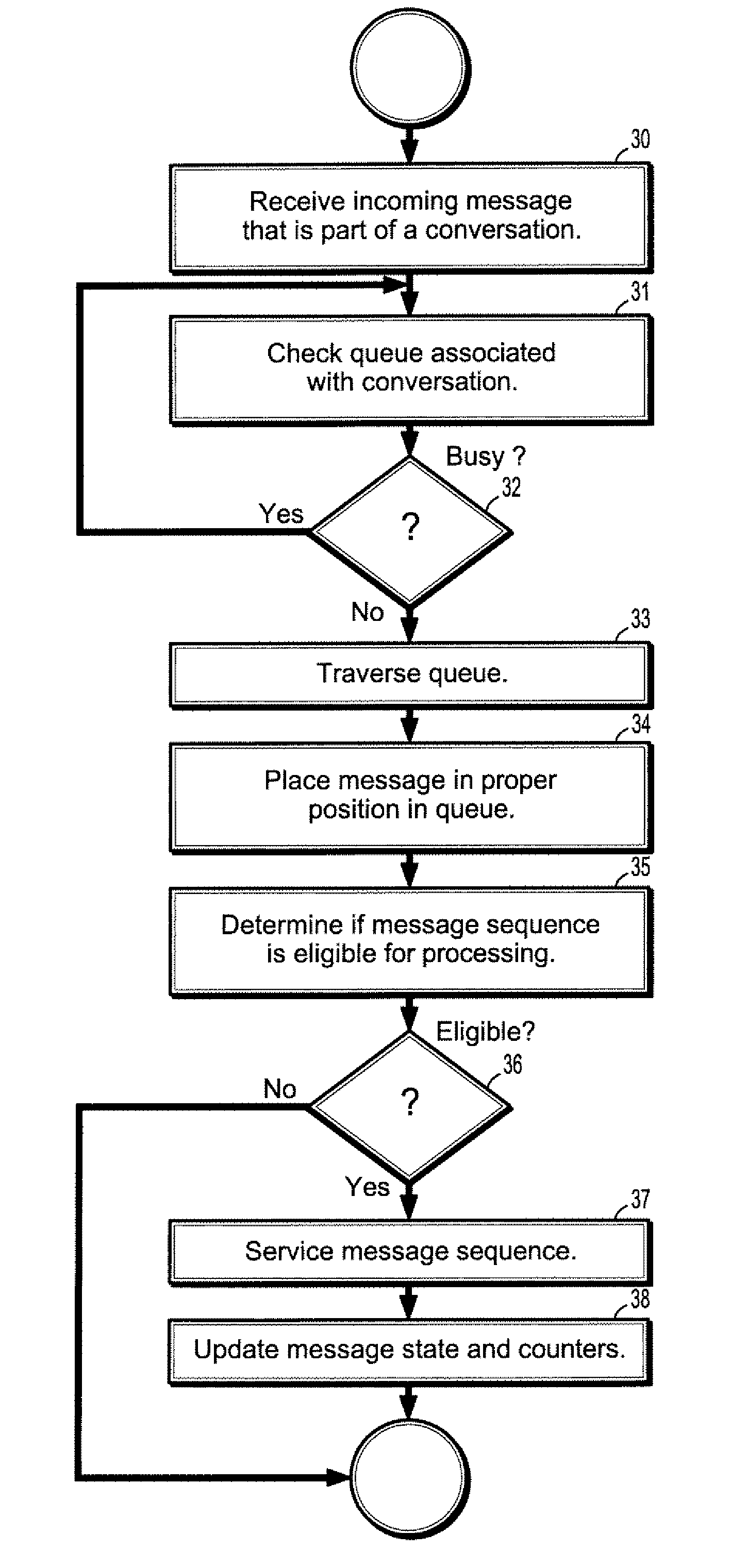
A system for servicing a telecommunications conversation comprising one or more messages includes a sequence recognition engine for processing an incoming message, a queue for storing a sequence of messages of said conversation, a length indicator for a message subsequence eligible for processing, a state indicator of said message sequence, and an indicator of a most recently transmitted message of said message sequence. When a new message arrives the sequence recognition engine is invoked to place the message in a correct position in the queue and to determine a next state for the message sequence.

Description

TECHNICAL FIELD[0001]This invention is directed to expediting the servicing of telecommunications requests in computer networksDISCUSSION OF THE RELATED ART[0002]Scalability is a desirable attribute of a network, system, or process. The concept connotes the ability of a system to accommodate an increasing number of elements or objects, to process growing volumes of work gracefully, and / or to be susceptible to enlargement. When procuring or designing a system, it is often required that it be scalable. The requirement may even be mentioned in a contract with a vendor.[0003]An unscalable system is one in which the additional cost of coping with a given increase in traffic or size is excessive, or one that cannot cope at this increased level at all. Cost may be quantified in many ways, including but not limited to response time, processing overhead, space, memory, or even money. A system that does not scale well adds to labor costs or harms the quality of service. It can delay or depriv...

Claims

the structure of the environmentally friendly knitted fabric provided by the present invention; figure 2 Flow chart of the yarn wrapping machine for environmentally friendly knitted fabrics and storage devices; image 3 Is the parameter map of the yarn covering machine
Login to View More

Application Information

Patent Timeline
no application Login to View More
Patent Type & Authority Patents(United States)
IPC IPC(8): H04L12/26H04J3/24H04L12/56
CPCG06F9/546G06F2209/548
Inventor BONDI, ANDRE B.
Owner UNIFY PATENTE GMBH & CO KG