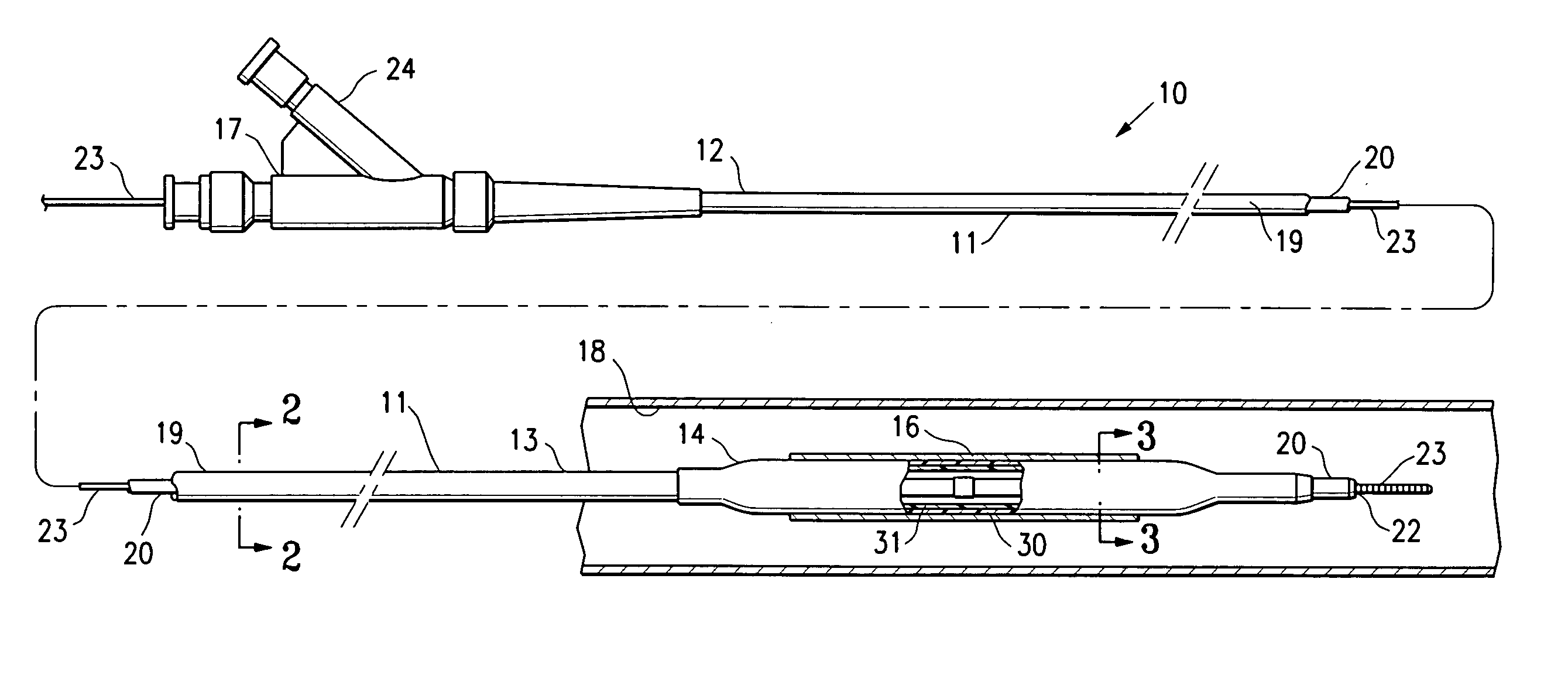
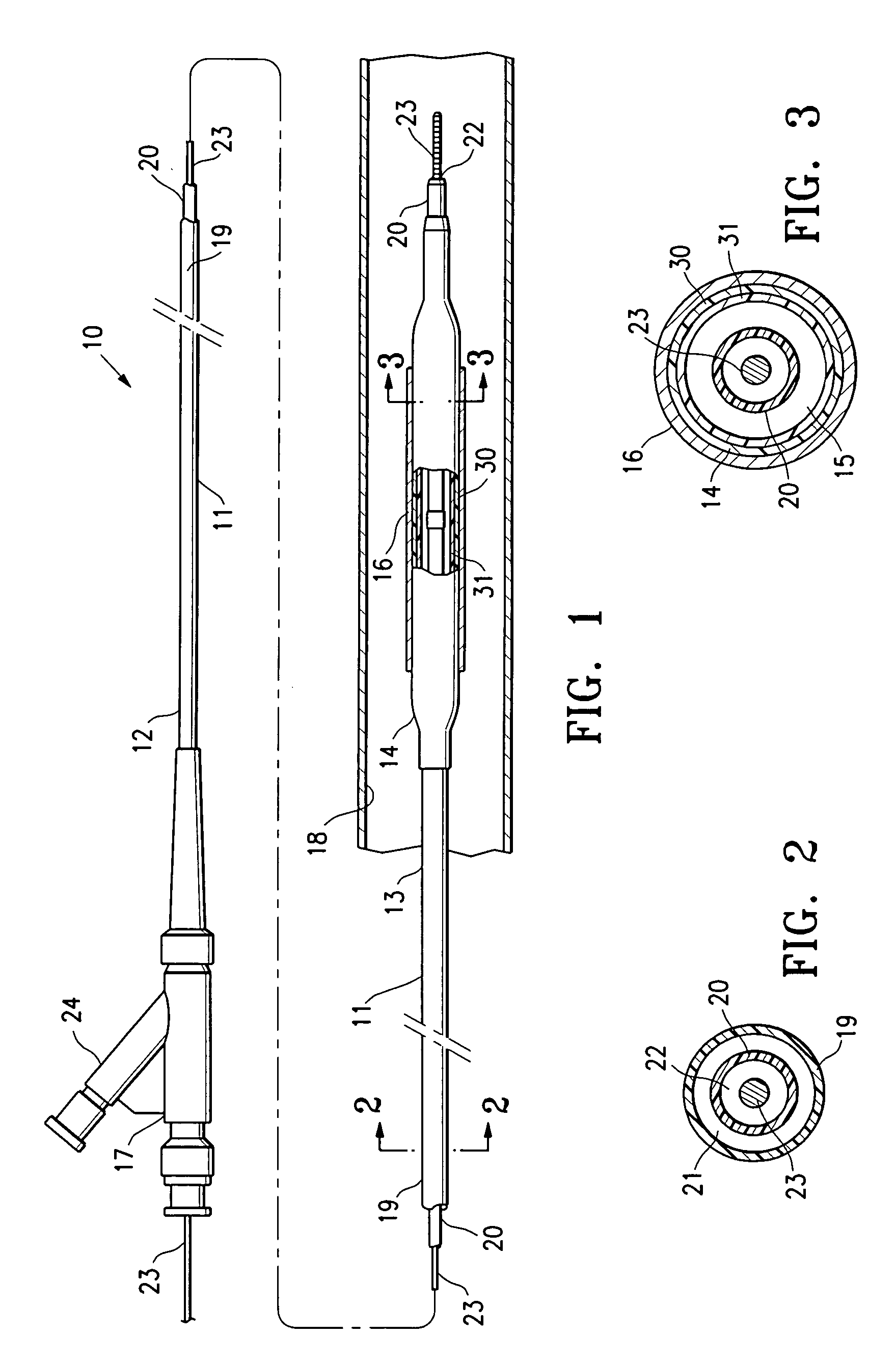
[0008]The invention is directed to a balloon catheter having a multilayered balloon which has a first layer and at least a second layer, and which has noncompliant limited radial expansion beyond the nominal diameter of the balloon. By selecting the polymeric materials forming the balloon layers, and arranging and radially expanding the multiple layers of the balloon in accordance with the invention, a balloon is provided having an improved low compliance, preferably in combination with high flexibility and softness.
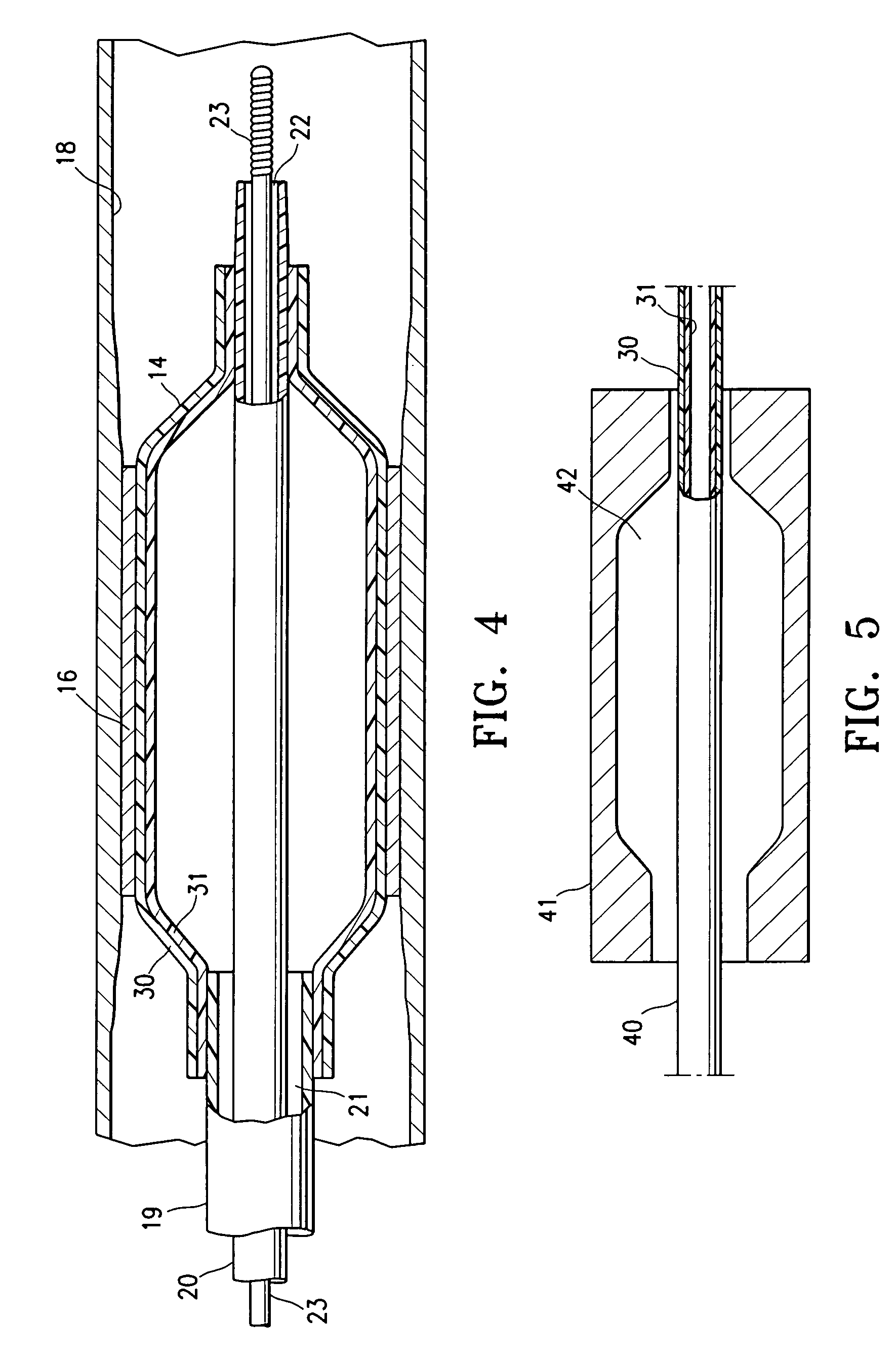
[0009]A multilayered balloon of the invention is preferably formed in whole or in part of coextruded polymeric tubular layers, and provides for ease of manufacture of the balloon and balloon catheter formed therefrom. The multilayered balloon is typically formed by conventional blow-molding in which a multilayered polymeric tube is radially expanded within a balloon mold. The resulting multilayered balloon has an inflated shape which corresponds to the inner surface of the mold and which has a diameter about equal to the inner diameter of the balloon mold, commonly referred to as the balloon's nominal working diameter. The nominal pressure is the inflation pressure required to fill the balloon to the nominal working diameter. In accordance with the invention, the balloon expands a very small amount (i.e., noncompliantly) at pressures above the nominal pressure. As a result, the balloon minimizes injury to a patient's blood vessel, which can otherwise occur if the balloon continues to expand a substantial uncontrolled amount at increasing inflation pressures above nominal.
[0013]Additionally, the invention can alternatively provide for a balloon with a low compliance but with very thin walls. For example, one embodiment is directed to a multilayered balloon having a first (outer) layer of a first durometer material and one or more inner layer(s) of successively lower durometer materials which has a compliance not substantially greater than (e.g., not more than about 10% to about 20% greater than), and preferably about equal to a balloon which is formed of 100% of the highest durometer material but which has a larger wall thickness than the multilayered balloon of the invention. The embodiment of the balloon having a very thin total wall thickness provides an improved low profile and flexibility due to the thinner walls of the balloon, but, in accordance with the invention, nonetheless continues to provide a low compliance despite the thin wall.
[0015]The presence of the lower durometer material inner layer(s) does provide layers of increased softness, and therefore preferably provides a balloon that is softer and more flexible than a balloon formed of 100% of the highest durometer material.
[0016]Prior multilayered balloons with layers of polymers having different strengths / softnesses typically arrange the layers so that the durometer hardnesses decreased from the inner to the outer layer, for various balloon design considerations. For example, lower durometer (softer) materials are typically preferred as outer layers for design considerations such as pinhole resistance, stent retention, and the like. In contrast, a balloon of the invention arranges layers so that the highest durometer material has on an inner surface thereof a layer of a lower durometer material, and configures the layers to provide for a maximized BUR which produces an improved combination of characteristics including a very low compliance. However, with the inner layer(s) of the balloon of the invention optimized for compliance purposes as discussed above, one embodiment of a balloon of the invention has an outer-most layer of a relatively soft material, to, for example, enhance stent retention.
[0018]In a presently preferred embodiment, the polymeric material of the first layer and the polymeric material of the second layer of the multilayered balloon are elastomers, which typically have a lower flexural modulus than nonelastomers. Elastomeric polymers suitable for forming the first and / or second layer of the multilayered balloon typically have a flexural modulus of about 40 kpsi to about 110 kpsi. Thus, unlike nonelastomeric materials such as PET which have been used in the past to provide relatively low compliance catheter balloons, the multilayered noncompliant balloon of the invention is preferably formed of one or more elastomers which provide for improved balloon flexibility.


 Login to View More