Plastic frame for an intrauterine device

a technology for intrauterine devices and frames, which is applied in the direction of contraceptive devices, female contraceptives, etc., can solve the problems of displacement and expulsion of iud, abnormal uterine bleeding and cramping pain, and insufficient resilience, so as to facilitate upward rotation of arms and assembly.

US8430101B2Inactive Publication Date: 2013-04-30PAT
7 Cites 0 Cited by

Patent Information

Authority / Receiving Office
US · United States
Patent Type
Patents(United States)
Current Assignee / Owner
Publication Date
2013-04-30
Estimated Expiration
Not applicable · inactive patent

Smart Images

  • Figure 1
    Figure 1
  • Figure 2
    Figure 2
  • Figure 3
    Figure 3
Patent Text Reader

Abstract

An intrauterine device (IUD) for delivering bioactive substances in the uterine cavity includes a plastic frame affixed to a drug delivery compartment. The frame retains the IUD in the uterine cavity and prevents displacement and expulsion. The frame is shaped like the letter “omega” having two resilient arms which possess latero-lateral memory. The extremities of the arms are provided by a short side-arm which forms an angle with the rest of the arm. These prominent plastic parts facilitate the upward rotation of the arms during removal of the intrauterine device. The drug delivery compartment has an element at its upper extremity to determine the exact location of the IUD in the uterine cavity by ultrasound. The drug delivery compartment contains one or more drugs which are gradually released in the uterine cavity over extended periods of time.
Need to check novelty before this filing date? Find Prior Art

Description

FIELD AND BACKGROUND OF THE INVENTION

[0001] Intrauterine drug delivery is becoming increasingly important in gynecological practice. Intrauterine drug delivery can be used for contraception and treatment of various gynecological conditions. However, with existing intrauterine systems, delivering hormones in the uterus, there are several drawbacks which can be improved such as the ease of insertion in the uterine cavity, adaptation of the plastic frame to different sizes and shapes of uterine cavities to minimize side effects, retention of the IUD in the uterus, retrieval of the intrauterine foreign body from the uterus and visibility of the body on ultrasound examination.

[0002] The plastic frame of intrauterine devices (IUD) often creates dimensional incompatibility with the uterine cavity which could give rise to complaints such as abnormal uterine bleeding and cramping pain. Incompatibility also leads to displacement and expulsion of the IUD.

[0003] In an attempt to improve compatibil...

Examples

Embodiment Construction

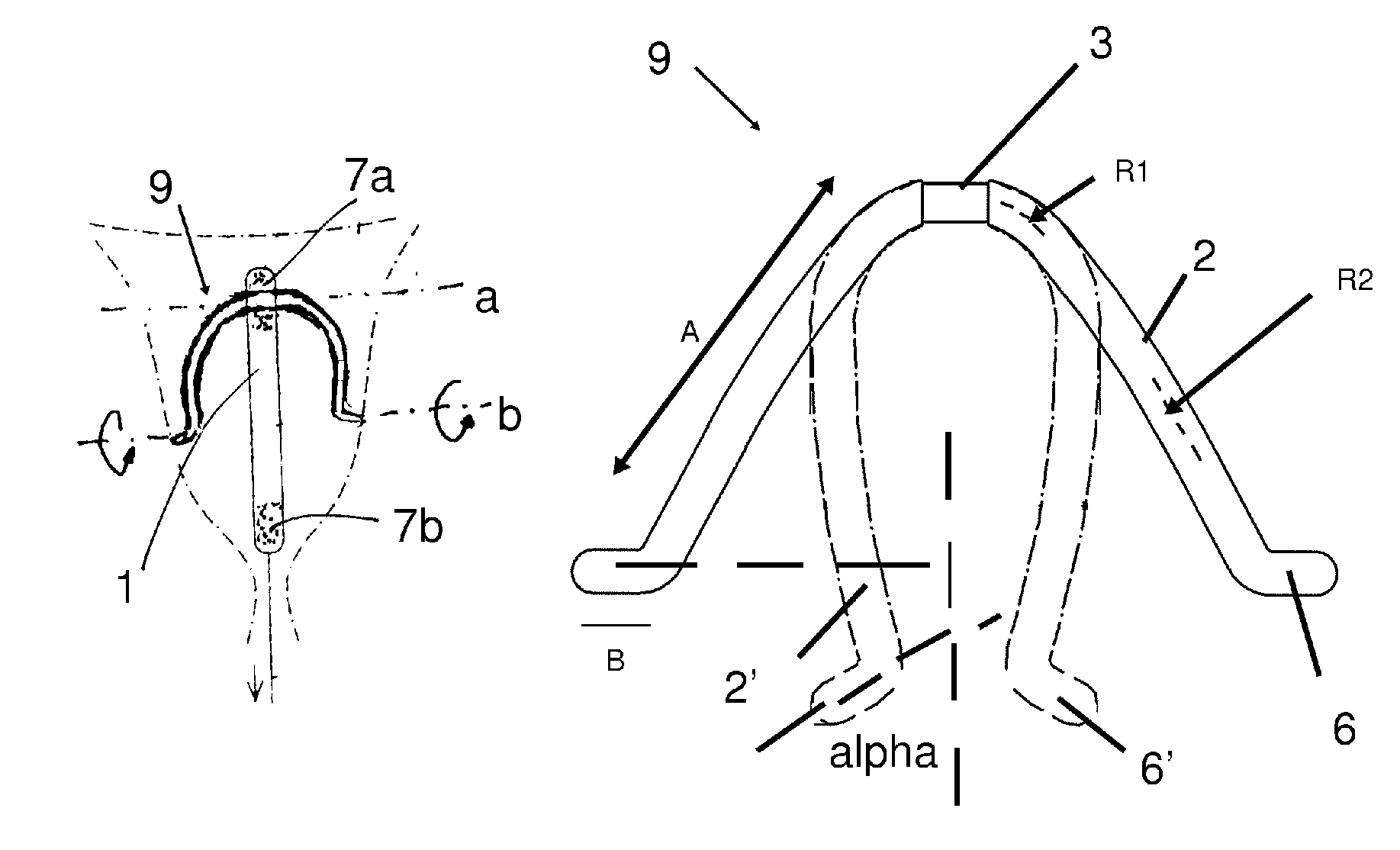
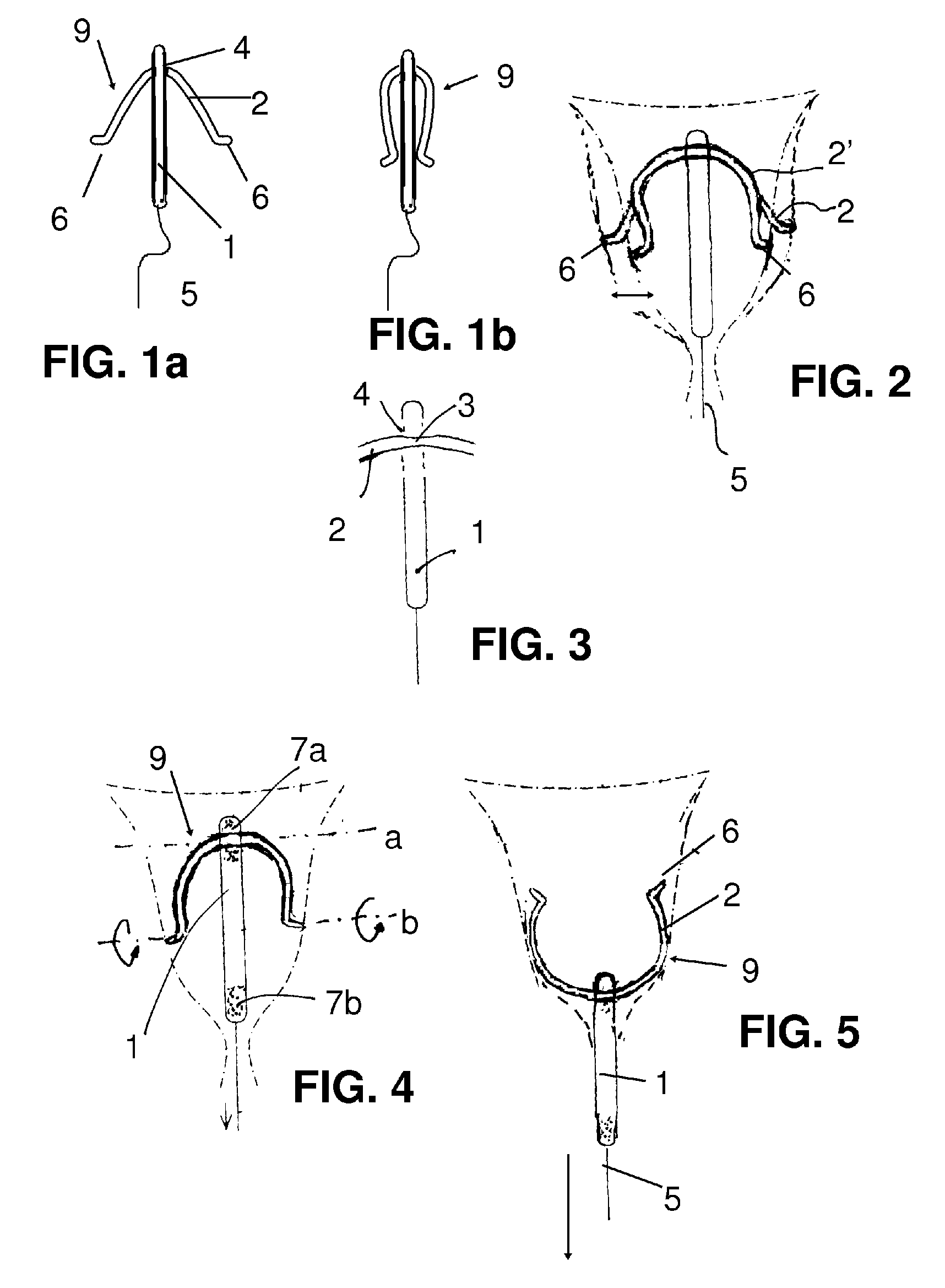
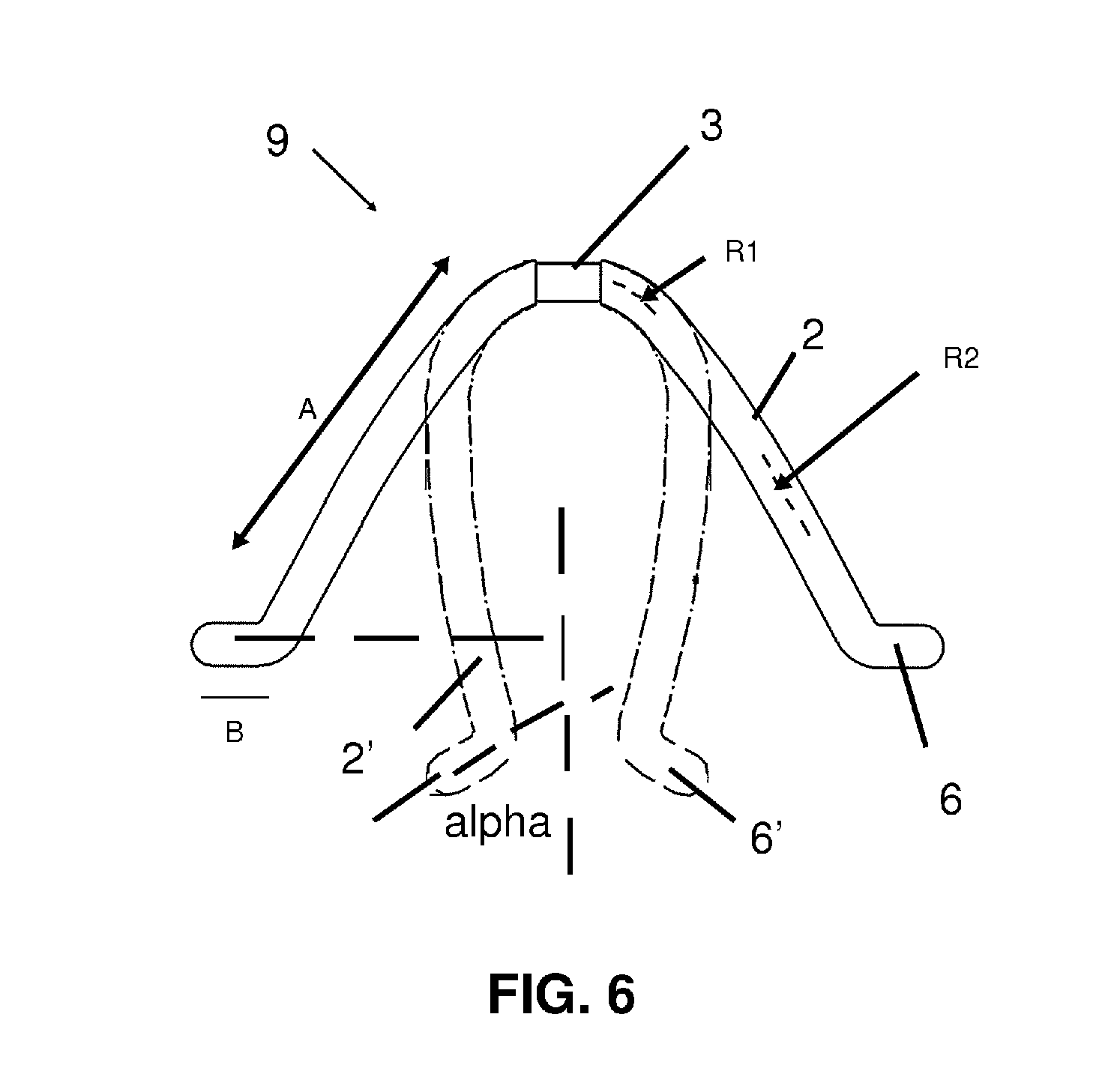
[0028]Referring now particularly to FIGS. 1a and 1b, the IUD according to a embodiment of the invention is illustrated respectively in the relaxed state and in the folded state. The IUD consists essentially of a plastic frame 2 made in a material which is resilient, and a drug delivery compartment 1 also made in a material which is resilient and flexible. The mid-section of the plastic frame is connected with the drug delivery rod 1 through a hole 4 in the its upper part forming an assembly which is easily inserted in the uterus with a hollow tube (e) when the drug delivery rod is inserted in the tube. Also illustrated are small ends 6 of the arms of the plastic frame, extending outwardly. These elements due to the resilience of the arms are in contact of the wall of the uterus.

[0029]According to the representation in FIG. 2, the plastic frame 2 allows approximation of the arms of the frame to adapt to different widths of uterine cavities. If the uterus is wider, the plastic frame 2...