
Radiation therapy agent
a radiation therapy and agent technology, applied in the field of radiation therapy agents, can solve the problems of no photocatalytic material which can be put into practical use, side effects, etc., and achieve the effects of high therapeutic effect, reduced side effects of radiation on normal tissue other than tumors, and effective damag
- Summary
- Abstract
- Description
- Claims
- Application Information
AI Technical Summary
Benefits of technology
Problems solved by technology
Method used
Image

Examples
example 1
Production of Composite Particle
(1) Production of Substrate Particle as Titanium Peroxide-Titanium Dioxide Fine Particle
[0065]A substrate particle as a titanium peroxide-titanium dioxide fine particle was prepared as described below.
[0066]To 0.02 mol of titanium tetrachloride (TiCl4) (manufactured by Wako Pure Chemical Industries, Ltd.) were added 10 ml of water and 30 ml of 25% (percent by weight) tetramethylammonium hydroxide (TMAH) (manufactured by TAMA CHEMICALS CO., LTD.), and the total volume was adjusted to 50 ml with water. The resultant was subjected to a heating treatment at 125° C. for 1 hour and cooled to room temperature. After that, 5 ml of a 30% (percent by weight) hydrogen peroxide solution were added. The resultant was washed five times by filtration with an ultrafiltration membrane (Amicon; manufactured by Millipore Corporation; molecular weight cut-off: 100 kDa) to produce a dispersion liquid of a substrate particle as a titanium peroxide-titanium dioxide fine par...
experimental example 1
Confirmation of Radical Generation from Substrate Particle Through Radiation Irradiation
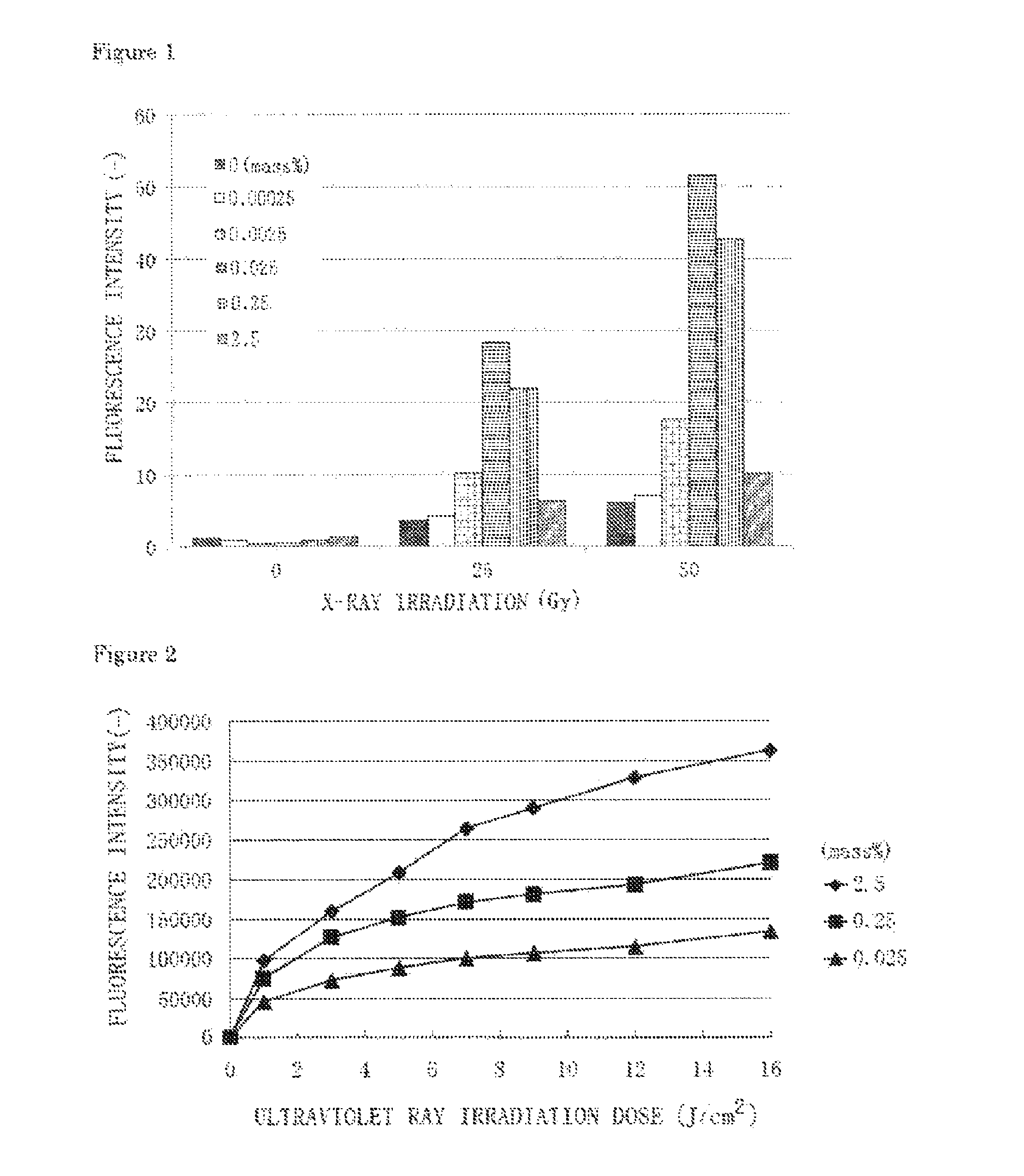
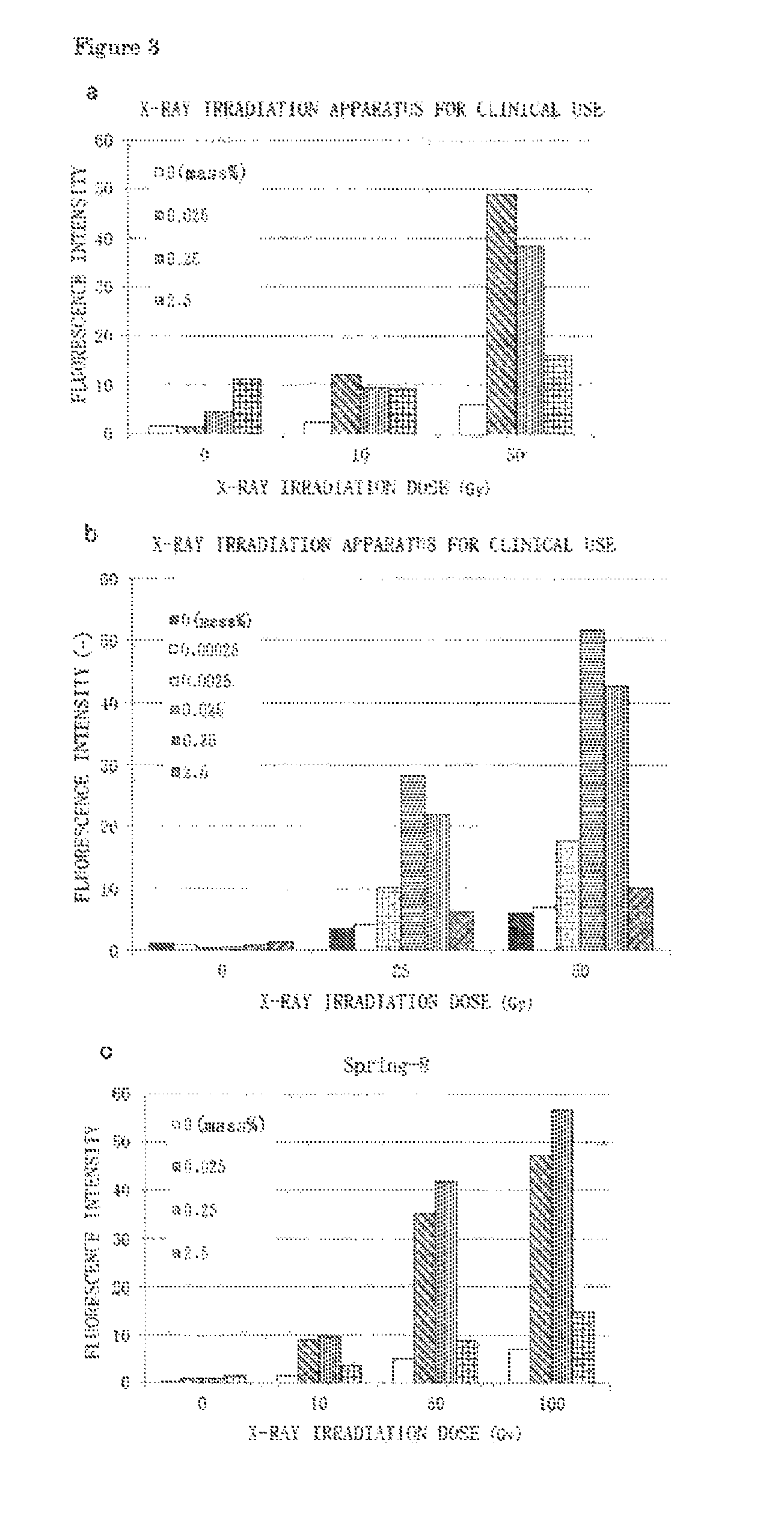
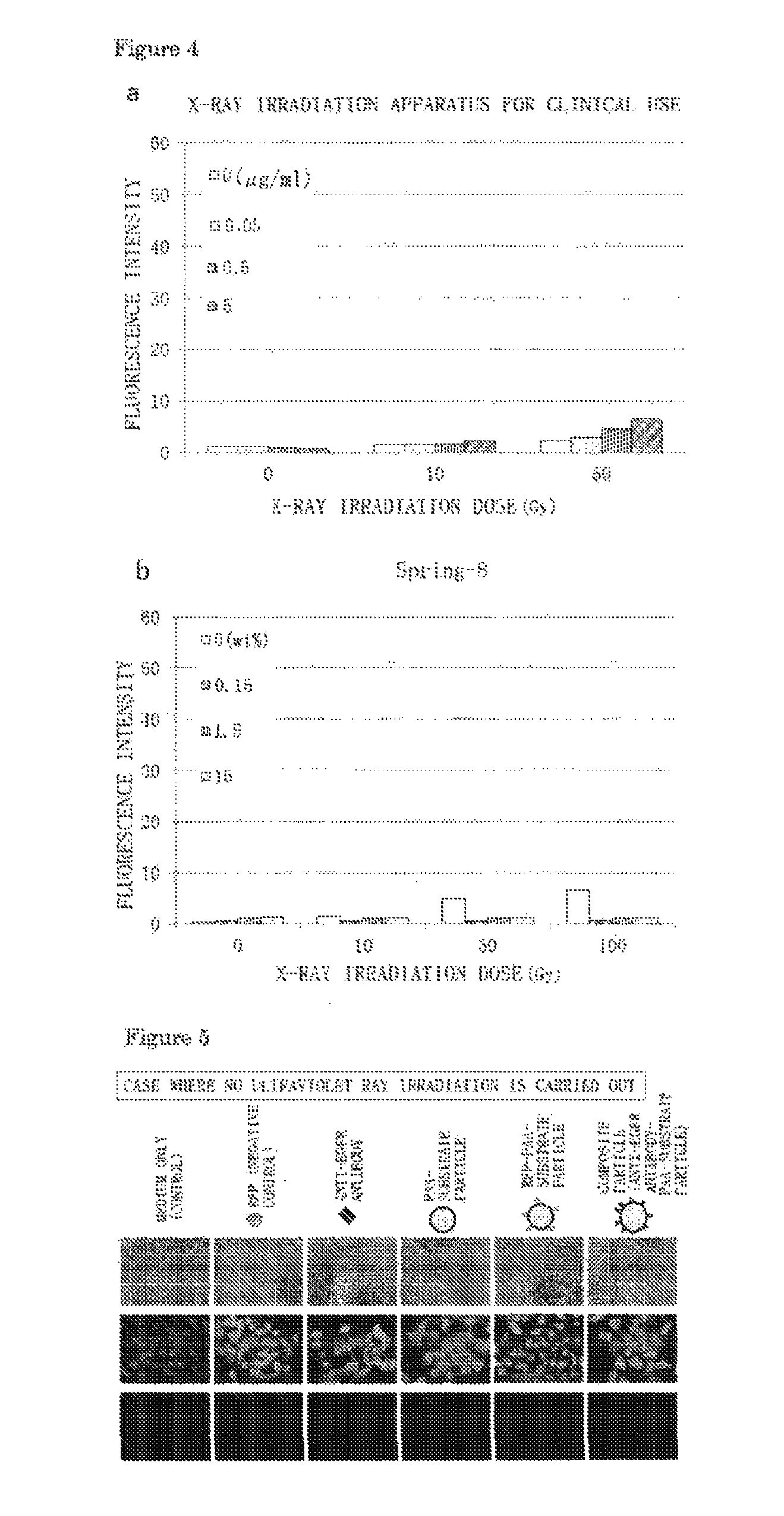
[0072]Aminophenyl fluoroscein (APF) has substantially no fluorescence in a neutral aqueous solution. However, when APF reacts with a reactive oxygen species (in particular, .OH or .O2−) having a strong activity, fluorescein as a strong fluorescent compound is generated. As a result, an increase in fluorescence intensity is observed. This reaction was utilized to confirm a change in the amount of a radical generated from the substrate particle (0, 0.00025, 0.0025, 0.025, 0.25, or 2.5 mass % (percent by mass)) obtained in the section (1) of Example 1 through radiation irradiation. The radiation irradiation was carried out with a high-energy X-ray irradiation apparatus for clinical use Linac: Mitsubishi EXL-15DP (hereinafter, also referred to as “X-ray irradiation apparatus for clinical use”) or a Spring-8 apparatus at an irradiation dose with a uniform gray (Gy) number (0 to 100 Gy) in accordance w...
experimental example 2
Confirmation of Cytotoxic Effect of Composite Particle
[0074]Investigations were made on cancer cell specificity of the composite particle produced in Example 1 and cancer cell-killing / damaging effects of the composite particle. In Experimental Example 1, it was confirmed that the substrate particle containing titanium peroxide generated a radical through radiation irradiation. Hence, in this experimental example, for the sake of convenience, an experiment was carried out through the use of ultraviolet ray irradiation in place of radiation irradiation.
[0075]2 ml each of a cancer cell (Hela cell) suspension were added to a 3.5 cm dish at 2×10⁵ cells / dish. A DMEM medium (manufactured by NACALAI TESQUE, INC.) was used as a medium. Incubation was carried out in 5% CO2 at 37° C. for 24 hours. The medium was discarded, 2 ml of a fresh medium were added, and 0.15 ml of a 1% (percent by weight) composite particle (anti-EGFR antibody-PAA-substrate particle) was added. Next, ultraviolet ray ir...
PUM
| Property | Measurement | Unit |
|---|---|---|
| particle diameter | aaaaa | aaaaa |
| surface potential | aaaaa | aaaaa |
| particle diameter | aaaaa | aaaaa |
Abstract
Description
Claims
Application Information
 Login to View More