It is possible for an application program, a user, a
system operator, or some other entity to apply erroneous operations to a database, thus corrupting it.
Once corrupted, the database is useless to applications since the data stored in the database that is used by the applications to make decisions and to provide services cannot be trusted.
Erroneous information in the database can wreak havoc on the recipients of the application's services.
Incorrect banking account balances can cause unintended overdrafts or credit denials.
Erroneous medical records can cause improper treatment of patients and, in extreme cases, even death.
Errors can be introduced into a database from several sources, including a faulty application, a
user error, the faulty action of a
system administrator, a hardware fault, or even employee malfeasance.
Unfortunately, the magnetic-tape
backup copies of the database intended to correct such an error were unreadable.
The company was unable to reconstruct the database and went out of business.
These are examples of major disruptions of application services caused by database corruption.
This process can take hours or days.
Sometimes, it cannot be completed if one of the many
backup tapes is unreadable.
Even if the database restoration is successful, all of the data updates since the last
backup are lost and have to be recreated through some other means, such as reentering them manually from hard-copy reports.
However, all data updates since the last backup are still lost.
However, if the
recovery of the database is due to the database being corrupted, the replay of transactions can only be made up to the point of corruption.
Further replay will simply re-corrupt the database.
All changes made after the database corruption began will be lost.
Advantage can be taken of the mirrored pair if an application change that could potentially damage the database is attempted.
Unfortunately, all changes made to the database during the trial operation of the new application are lost.
The change log is generally unusable with an earlier version of the database and cannot be used to roll forward the changes since the unmirroring.
If a failure occurs at the
source system, and if
asynchronous data replication is used, in which a data change is sent to the target system after it has been applied to the production database, the amount of data lost is the data still in the replication pipeline.
However, data replication does not solve the database-corruption problem.
Usually, if a problem such as an
application error,
user error, or operations-staff error has corrupted the source database, the errors will be replicated to the
target database so that it also becomes corrupted.
However, any database changes made since the backup was taken were typically lost.
The application of random changes to a database is a lengthy process.
Therefore, it is typically the
Consumer that limits the replication capacity of the Shadowbase replication engine.
Often, only a portion of the database has been corrupted by an application or by an
end user.
Applying random updates to a database is a lengthy process, whereas reading a sequential file as the Collector does with the Audit Trail is a relatively rapid process.
This technique presents some significant challenges.
One challenge is the amount of data that needs to be processed to perform the restore operation.
This can involve the
recovery of massive amounts of data from the backup medium and can require access to hundreds of tapes or disk packs.
Yet another challenge is the time it takes to copy and to restore a large database from
magnetic tape or disk.
Many application databases today are massive, often measuring several terabytes in size.
Even backing up and restoring from high-speed disk rather than from
magnetic tape can take hours if not days.
During this
recovery time, the application is typically down.
Attempting to restore the database using a prior art approach such as the
Oracle Flashback capability that recovers to a previous point-in-time from just the change blocks can take a very long time to complete if there has been a lot of update activity against the database since the restore point was taken (see the section entitled “
Oracle Flashback”).
Worse, the application is often unavailable during the process since the database typically must be taken offline during the operation.
Another problem is that the roll-forward capability provided by many transaction managers does not allow selective roll forward.
This can result in the transaction manager rolling thru the corrupting changes and reapplying them, causing the newly restored database to also become corrupted.
It is also possible that roll forward will be unsuccessful, as many of the database changes made during the aborted
processing may have depended upon a new infrastructure and hence cannot be applied to the database copy.
If this is the case, the result is that the roll-forward operation is aborted by the transaction manager.
It cannot be completed.
Thus, the time to save the initial version of the database and then to restore it to the application in the event of a problem is very small.
However, the saved mirror typically cannot be rolled forward because the change log is on the mirror that has been abandoned and is not generally accessible by the transaction manager.
Even if the transaction manager could access the change log, the replay of the changes may not be possible because the state of the database may not be what the transaction manager or change log expects.
Even if the change log is accessible, the transaction manager typically cannot selectively roll forward the change log changes, and the resulting database will match the corrupted database.
Thus, the application database cannot be rolled forward to its current, correct state using this method.
As can be seen from the various discussions of prior art
recovery techniques, they have several limitations.
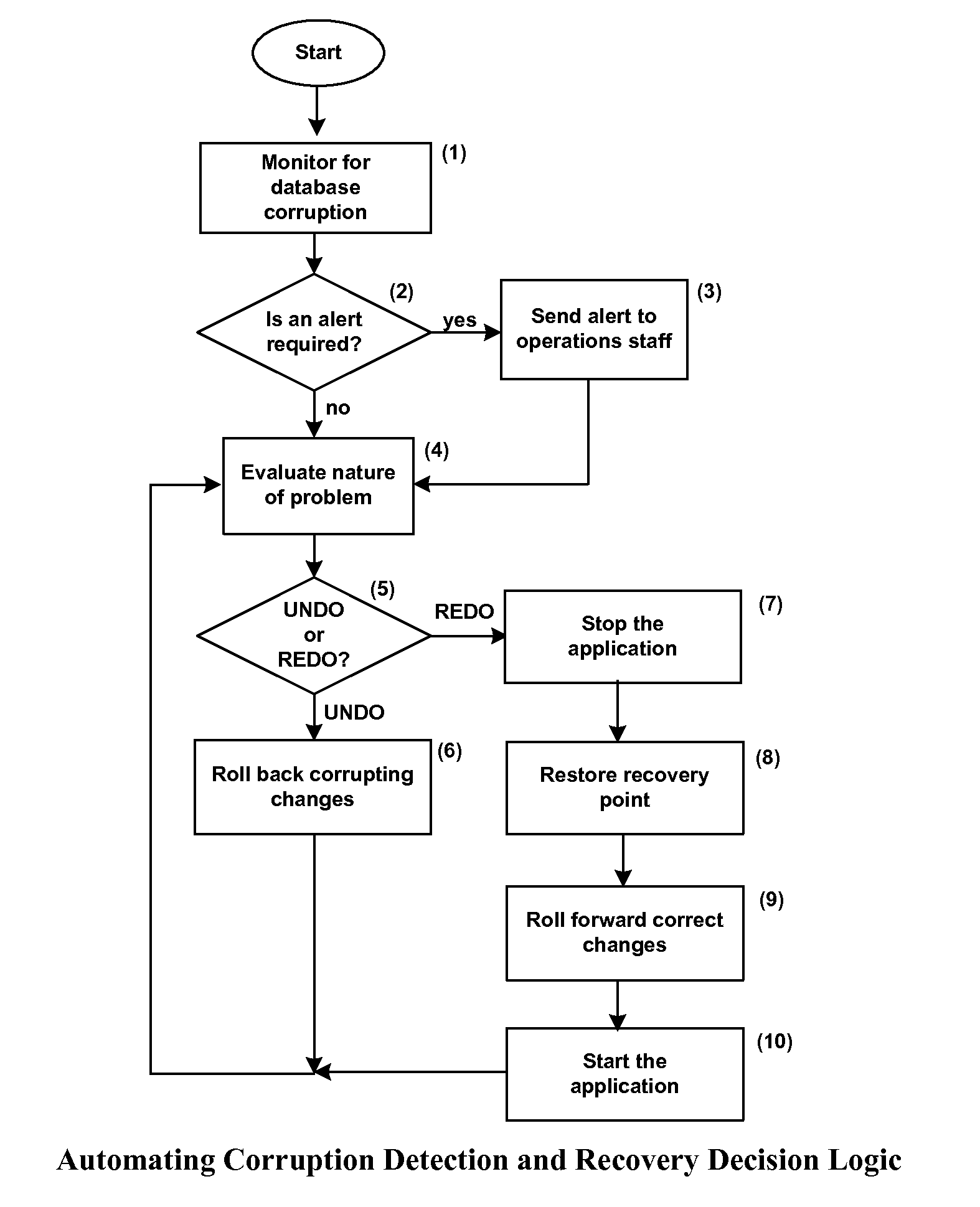
In the prior art, the fact that the database has become corrupted may not even be detected until an
end user notices the problem and calls the IT department's help
desk.10.
This is a complex function, and in the prior art the decision is made manually after exhaustive analysis.
In the prior art, many techniques for roll-forward and roll-back may violate
referential integrity for short periods of time.12.
In the prior art, the change log is not available to the recovery point mirror.
In the prior art, the change log is often stored on the
source system and is unavailable to the target-system roll-forward utility if the source system is unavailable or if the replication network is down.



 Login to View More
  Login to View More