Protecting websites from cross-site scripting

a website and scripting technology, applied in the direction of digital transmission, unauthorized memory use protection, instruments, etc., can solve the problems of cross-site scripting, theft and/or misuse of sensitive information, complex internet infrastructure,

US9032519B1Active Publication Date: 2015-05-12AMAZON TECH INC
5 Cites 16 Cited by

Patent Information

Authority / Receiving Office
US · United States
Current Assignee / Owner
Publication Date
2015-05-12

Smart Images

  • Figure 1
    Figure 1
  • Figure 2
    Figure 2
  • Figure 3
    Figure 3
Patent Text Reader

Abstract

Methods and systems for protecting websites from cross-site scripting are disclosed. A request for a web page comprising a web page element is received from a client. It is determined if the web page comprises a data integrity token for the web page element. It is also determined if a value of the data integrity token matches an expected value. If the web page comprises the data integrity token and if the value matches the expected value, the web page comprising the web page element is sent to the client. If the web page does not comprise the data integrity token or if the value does not match the expected value, a protective operation is performed.
Need to check novelty before this filing date? Find Prior Art

Description

BACKGROUND

[0001] Website operators such as online merchants are engaged in an ongoing battle to maintain information security. The complexity of the internet's infrastructure is accompanied by numerous security vulnerabilities. One such vulnerability is known as cross-site scripting. A cross-site scripting exploit may be used by an attacker to breach the security of a web browser or other web-based application. By breaching a browser's security, the attacker may gain access to a user's session at a particular website. For a user engaged in a session at the website of an online merchant, for example, a cross-site scripting exploit may permit an attacker to gain access to private information associated with the user's session, such as financial information, authentication credentials, and / or elements of the user's personal identity (e.g., a real name, an e-mail address, etc.).

[0002] In particular, a cross-site scripting flaw may be exploited to enable an attacker to inject a client-side...

Examples

Embodiment Construction

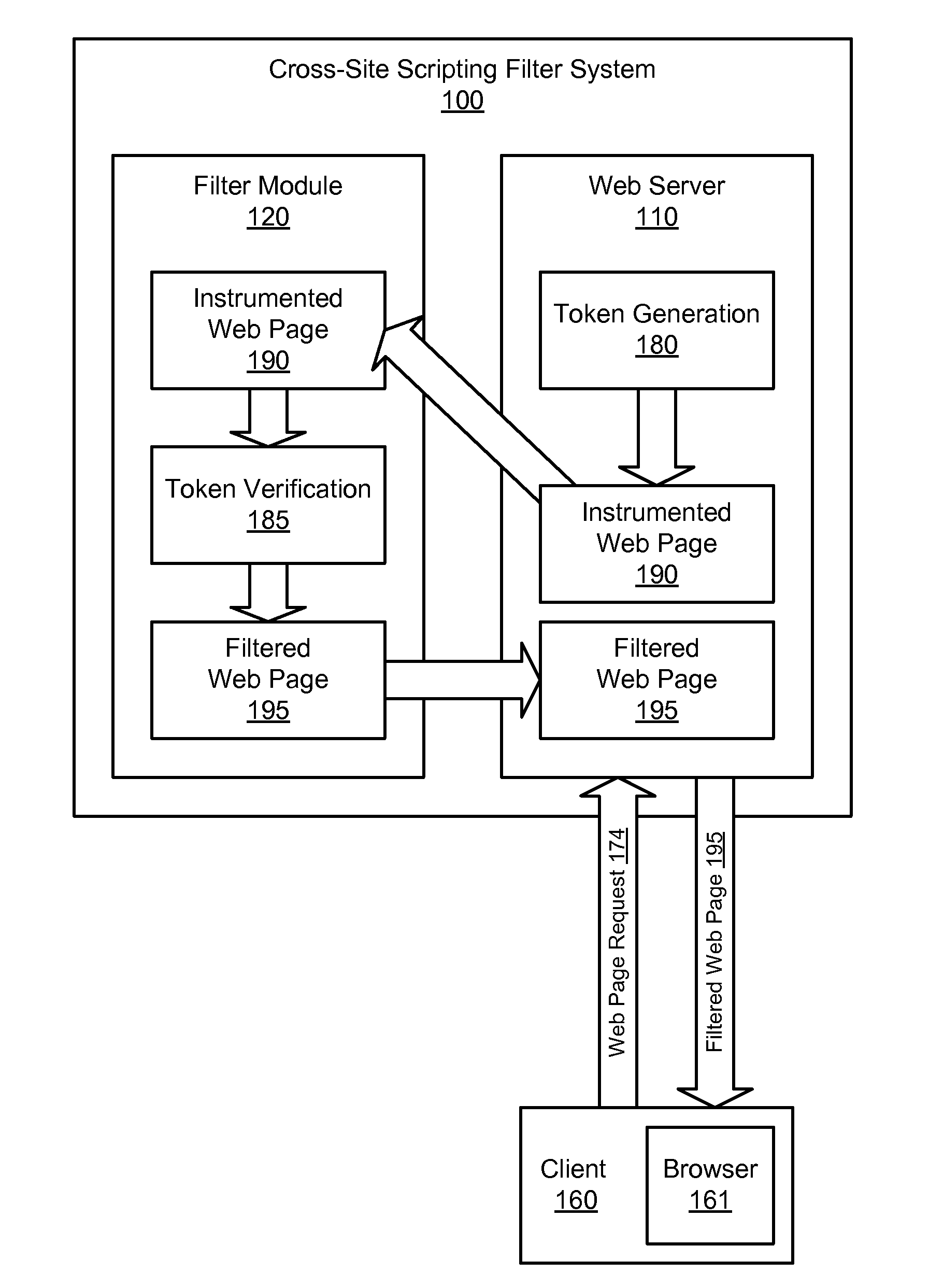
[0014]Various embodiments of methods and systems for protecting websites from cross-site scripting are described. Using the systems and methods described herein, a data integrity token having a checksum as its value may be added to particular web page elements (e.g., tags and / or attributes) when web pages are generated. Before a page is sent to a client, any web page element that lacks the data integrity token or the correct checksum may be subjected to protective or remedial action. For example, a web page element that fails the integrity check may be negated or made ineffective (e.g., by escaping it, removing it, or replacing it with a comment), or the sending of the page may be blocked. In this manner, the use of both persistent and non-persistent cross-site scripting exploits may be prevented.

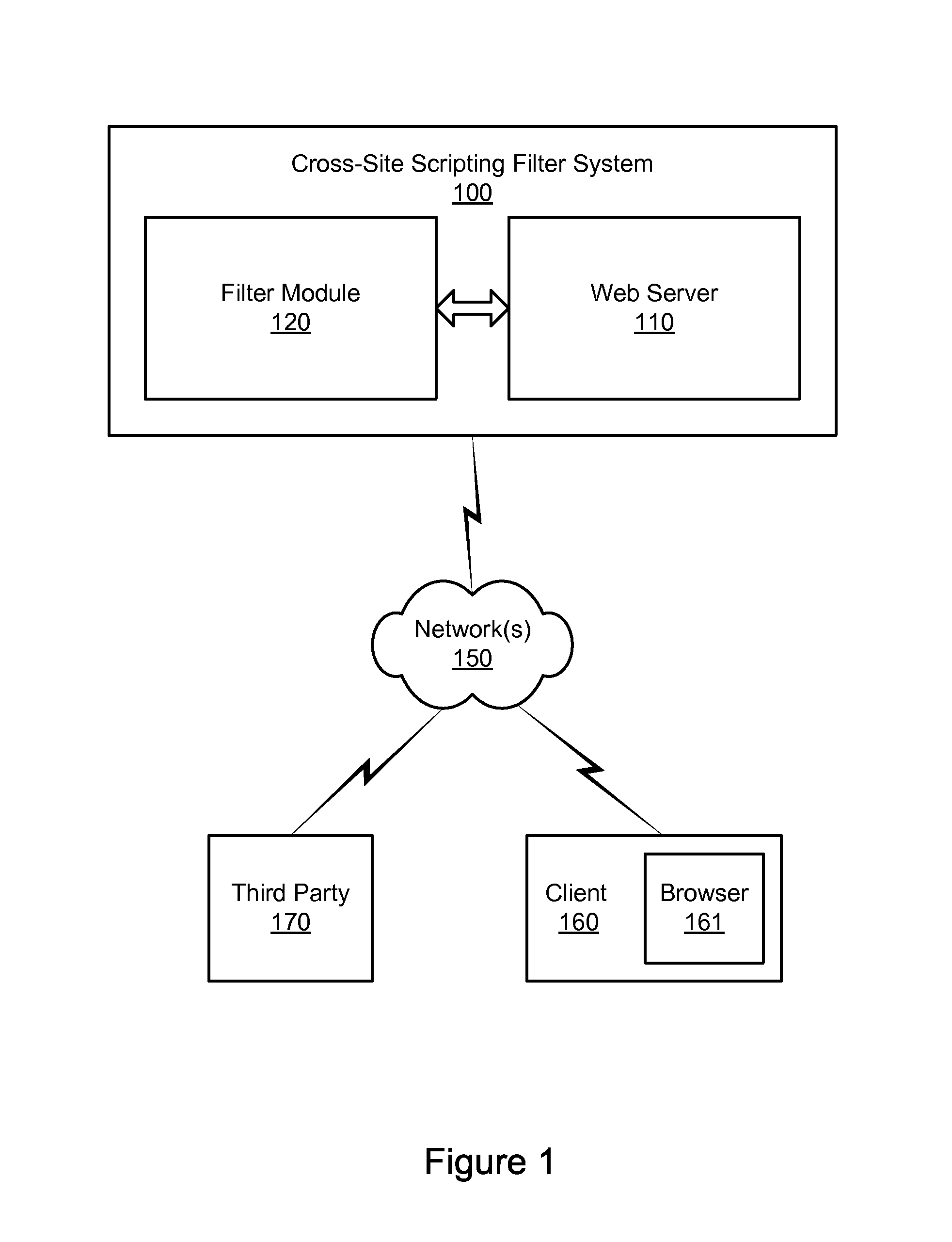
[0015]FIG. 1 illustrates an example system environment for protecting websites from cross-site scripting, according to one embodiment. The example system environment may comprise a cross-si...