Supercharge Your Innovation With Domain-Expert AI Agents!

Short detection in battery cells

a battery cell and short detection technology, applied in secondary cell servicing/maintenance, instruments, electrochemical generators, etc., can solve problems such as unbalanced battery pack system modules or battery cells, battery cells and battery pack system modules may experience different wear and use patterns, and battery system may not behave as desired

Active Publication Date: 2015-08-04
SOUTHWEST ELECTRONICS ENERGY CORP
View PDF16 Cites 9 Cited by
  • Summary
  • Abstract
  • Description
  • Claims
  • Application Information

AI Technical Summary

Benefits of technology

This approach allows for early detection of potentially faulty battery cells, preventing thermal runaway events and ensuring safer operation by identifying internal shorts and imbalances through monitoring balancing cycles, thereby enhancing the reliability and safety of battery systems.

Problems solved by technology

The battery system may not behave as desired when battery pack system modules are out of balance with each other or battery cells within a battery pack system module are out of balance with each other.
For example, an output voltage from and / or capacity in a battery system with unbalanced battery pack system modules or battery cells may be outside a desired range.
Battery cells and battery pack system modules may experience different wear and use patterns.
When battery cells and battery pack system modules experience different wear and use patterns they become more out of balance with other battery cells and battery pack system modules.
One cause may be differences in the age of the cells or modules.
This results because older cells or modules typically have lower capacity.
Another cause may be difference in the capacity of the cells or modules when they are manufactured.
Even when modules or cells are manufactured by the same supplier, the cells or modules used in a system may not be obtained from the same manufacturing lot of the supplier.
Cells or modules that experience different temperatures throughout operation may suffer different reductions in capacity.
Another cause may be differential power drain internal to a module.
A battery management system may have component variations or a normal current leakage paths resulting in balancing of a module due to internal power drain of the module.
A fifth cause may be differential physical damage to a cell or module.
Physical damage may reduce capacity or create internal shorts.
Another cause may be differential leakage of current internal or external to a cell or cells within a module.
Pack manufacturing defects are one cause for external differential leakage current.
Cell defects or damage are another cause for external differential leakage current.
For example, internal cell shorts may occur as a result of anode dendrites, separator dendrites, manufacture metal flake defects, weld splash defects, cell crush damage, excessive cell vibration, and / or shock.
These internal shorts may generate localized heat within the interior of a cell.
Even small intermittent shorts may cause lasting damage to a battery cell.
Although small intermittent shorts may burn themselves out, their occurrence may weaken the interior of the cell, which leads to more frequent and more severe internal shorts.
Over time, and with stresses of charging and discharging, multiple instances of internal shorts may eventually result in an internal short severe enough to cause a thermal run away event.
A thermal run away event is the release of a dangerous amount of energy that may destroy the cell within a very short time.
The released energy may damage equipment or injure operators.
However, internal shorts often occur without causing a detectable temperature increase around the battery cell.
Even though the temperature does not immediately rise, a thermal runaway event may nonetheless be building in the battery cell.
During a future charge cycle of the battery cells, battery cells coupled to the internally shorted battery cell may overcharge, increasing the likelihood of a thermal runaway event due to the additional stress on the otherwise-healthy battery cells.
The combination of the stressed healthy battery cells and the heat from the internally shorted battery cell may result in a thermal runaway event occurring that was originally undetectable by an external temperature sensor.

Method used

the structure of the environmentally friendly knitted fabric provided by the present invention; figure 2 Flow chart of the yarn wrapping machine for environmentally friendly knitted fabrics and storage devices; image 3 Is the parameter map of the yarn covering machine
View more

Image

Smart Image Click on the blue labels to locate them in the text.
Viewing Examples
Smart Image
  • Short detection in battery cells
  • Short detection in battery cells
  • Short detection in battery cells

Examples

Experimental program
Comparison scheme
Effect test

Embodiment Construction

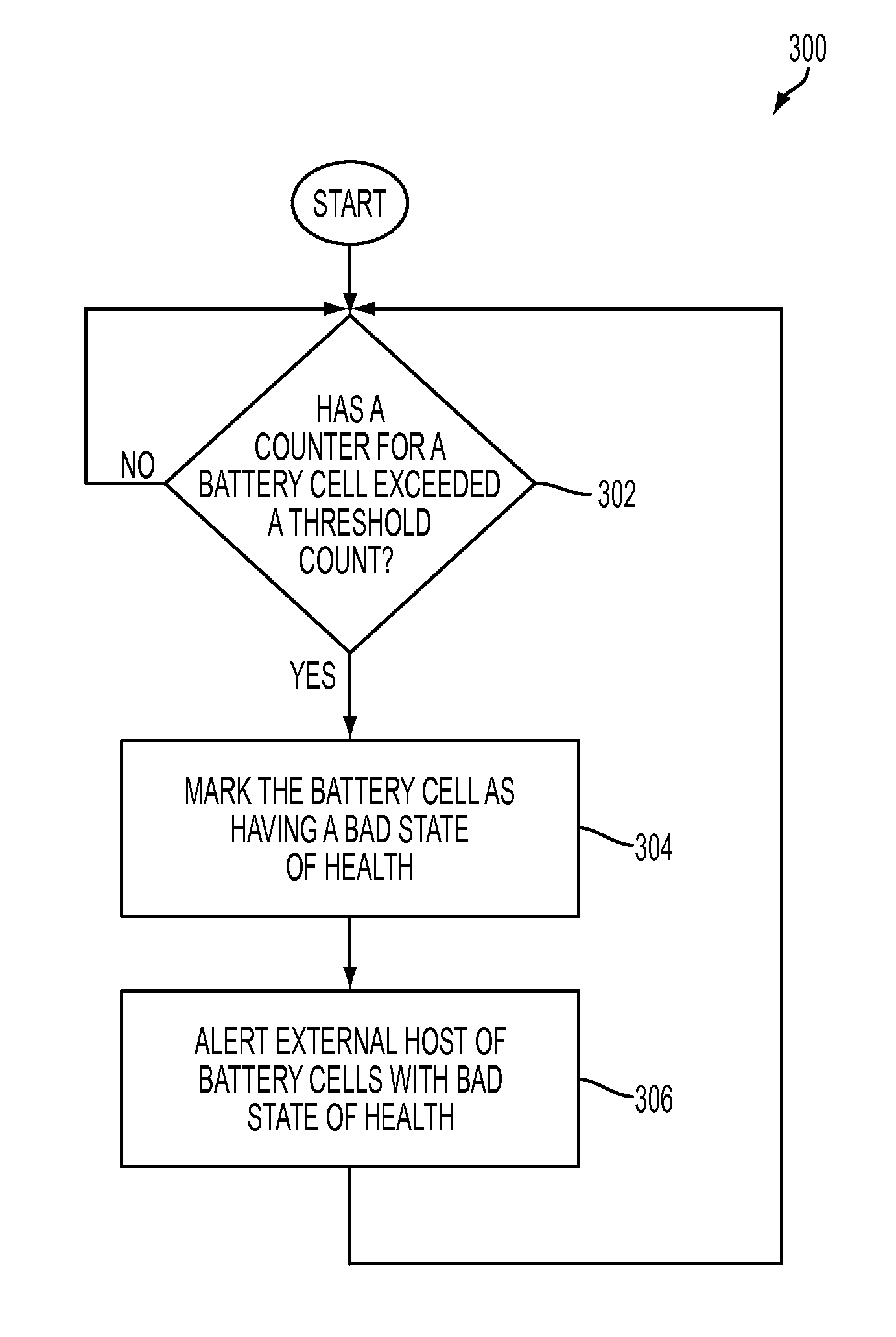
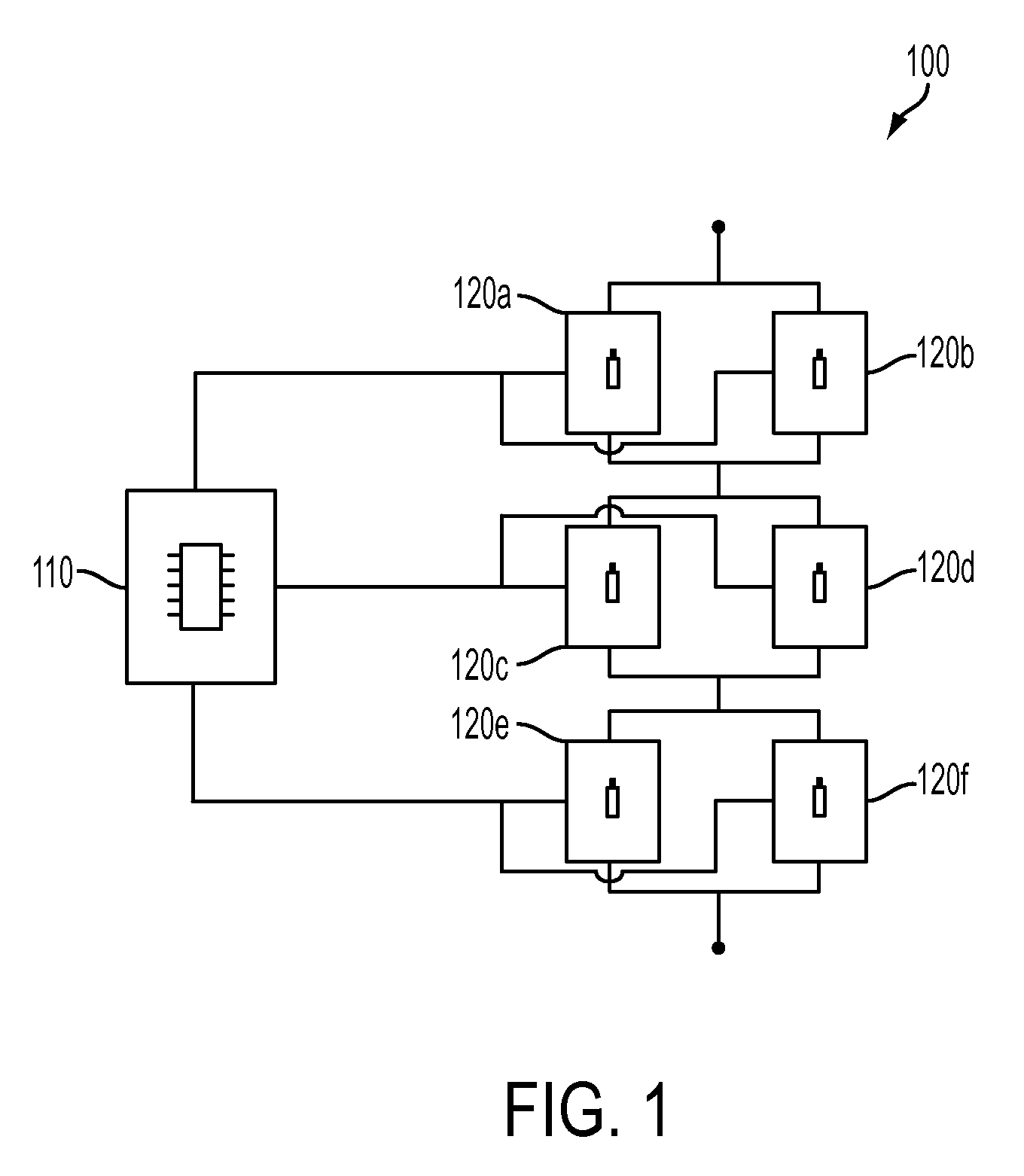
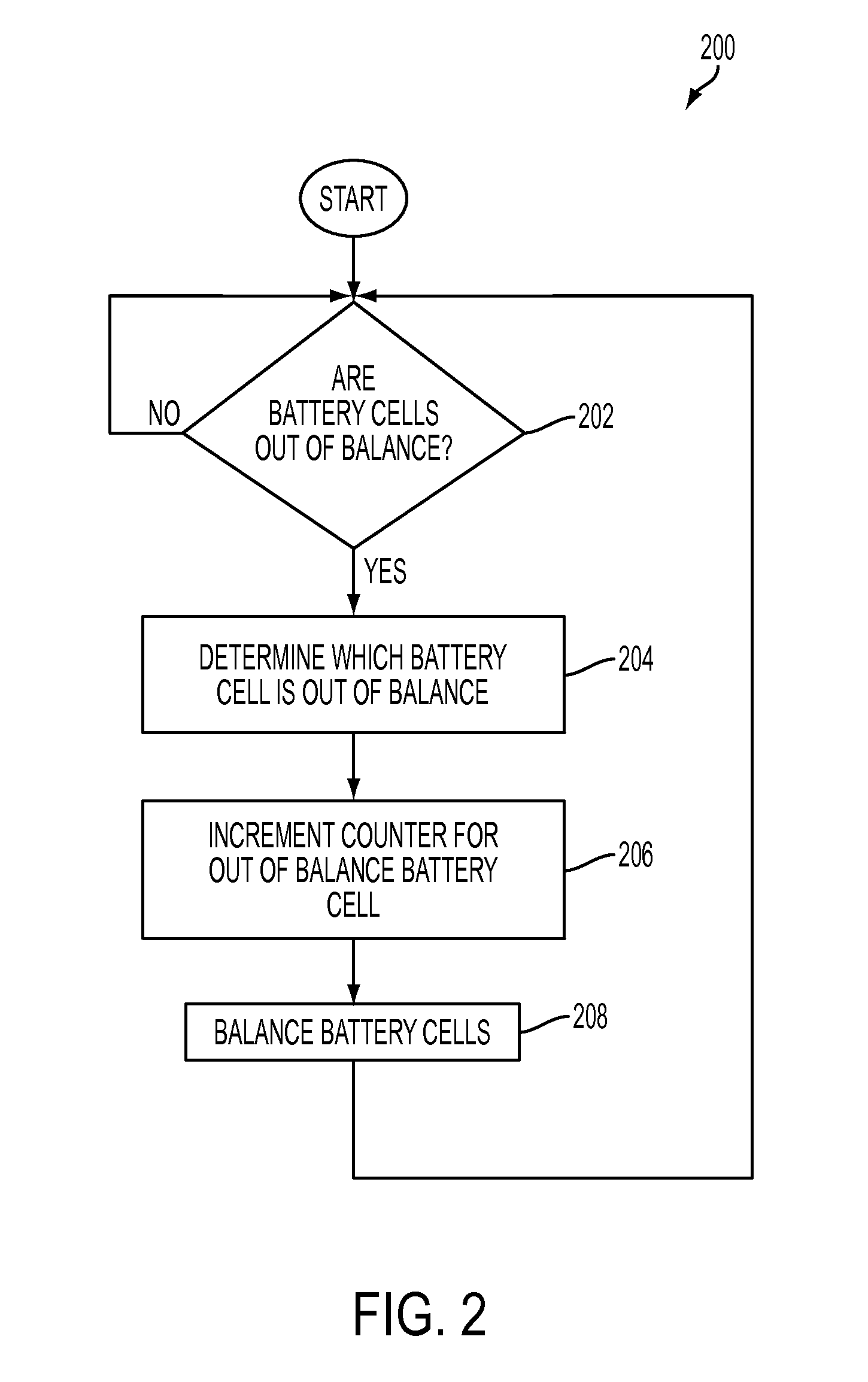
[0025]Although an external temperature monitor may be insufficient to detect a thermal run away event before it occurs, other methods may be used to detect internal shorts in battery cells or modules. A battery cell with internal shorts may be balanced more frequently or less frequently than other battery cells. For example, when an internal cell short causes a current drain the battery cell discharges faster causing the balancing circuits to direct differential current to respond to the shorted battery cell. A balancing circuit or an external monitor to the balancing circuit, may track the number of times a battery cell is balanced and determine that a battery cell has an internal short before a thermal run away event occurs. The circuit or monitor may determine the battery cell is being excessively balanced by implementing threshold detection such as when a count exceeds a threshold, implementing an algorithm to detect unusual balancing behavior over time, and / or implementing a di...

the structure of the environmentally friendly knitted fabric provided by the present invention; figure 2 Flow chart of the yarn wrapping machine for environmentally friendly knitted fabrics and storage devices; image 3 Is the parameter map of the yarn covering machine
Login to View More

PUM

PropertyMeasurementUnit
output voltageaaaaaaaaaa
voltageaaaaaaaaaa
Login to View More

Abstract

Internal shorts and other failures in lithium-ion battery cells may be detected during balancing of the battery cells. A counter may be used to detect when a battery cell is behaving differently than other battery cells by balancing more or less frequently. The counter may increment each time a battery cell is balanced to the other battery cells. A misbehaving battery cell may be flagged, when the counter exceeds a threshold value, for safety checks before an overheating event occurs. This misbehaving battery cell may be faulty due to an internal short. If the faulty battery cell is not corrected by replacement with a different battery cell or corrected by a user resetting the counter, the misbehaving battery cell may be disconnected to prevent the overheating event.

Description

TECHNICAL FIELD[0001]The present disclosure is related to rechargeable batteries. More specifically, the present disclosure is related to fault detection in rechargeable batteries.BACKGROUND[0002]A device powered by rechargeable batteries may include several battery cells to achieve voltage and / or current levels used by the device. For example, if a rechargeable battery cell has a nominal output voltage of 1 Volt, a device having a 2 Volt operational level may include two battery cells coupled in series. In another example, if a rechargeable battery cell has a nominal output current of 100 milliamps, a device having a 400 milliamp operational level may include four battery cells coupled in parallel. Battery cells coupled in parallel and series may be combined to reach the desired operational voltage and current levels of the device.[0003]The battery cells may be grouped with circuitry for balancing the charge levels in the battery cells to form a battery pack system module. Multiple...

Claims

the structure of the environmentally friendly knitted fabric provided by the present invention; figure 2 Flow chart of the yarn wrapping machine for environmentally friendly knitted fabrics and storage devices; image 3 Is the parameter map of the yarn covering machine
Login to View More

Application Information

Patent Timeline
no application Login to View More
Patent Type & Authority Patents(United States)
IPC IPC(8): G01R31/36H02J7/00H01M10/44G01R31/02
CPCG01R31/3658H01M10/441G01R31/3679H02J7/0014G01R31/025G01R31/396G01R31/52G01R31/36H02J7/04H02J7/00G01R31/392
Inventor WHITE, DAVID A.BENCKENSTEIN, JR., CLAUDE L.
Owner SOUTHWEST ELECTRONICS ENERGY CORP
Features
  • R&D
  • Intellectual Property
  • Life Sciences
  • Materials
  • Tech Scout
Why Patsnap Eureka
  • Unparalleled Data Quality
  • Higher Quality Content
  • 60% Fewer Hallucinations
Social media
Patsnap Eureka Blog
Learn More