Extending the success of
multilateration techniques used by outdoor GPS systems to urban and indoor environments faces fundamental challenges due to their unique propagation environments.
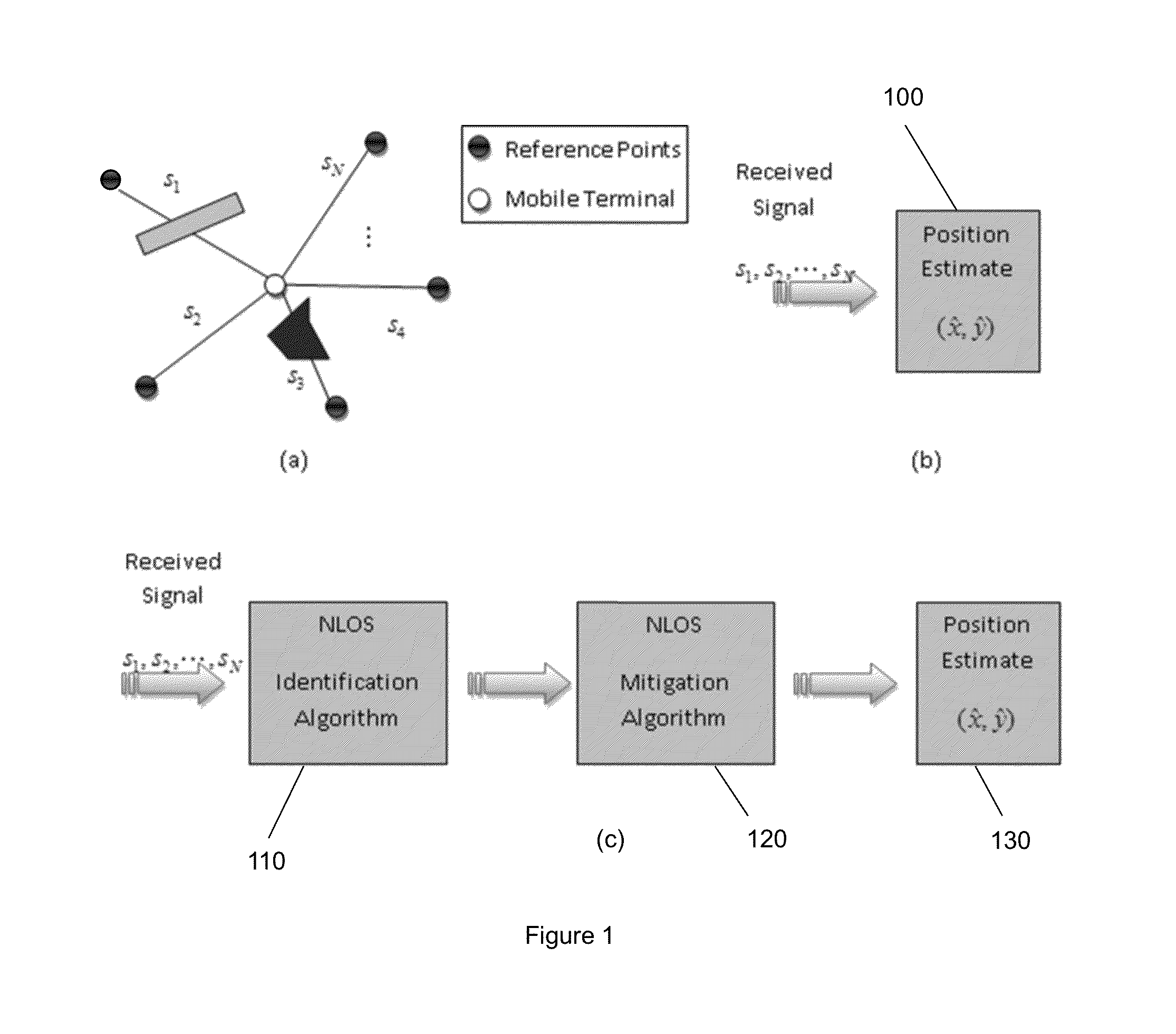
In urban and indoor environments the availability of LOS signals is not always guaranteed due to physical obstructions such as buildings, walls,
elevator shafts, etc.
Specifically, NLOS introduces a
positive bias to the distance
estimation which causes significant localization errors.
As a result
geolocation in light of the NLOS problem faces considerable challenges that affect the reliability and accuracy of the positioning systems.
Recently as the number of smart devices and mobile users increased significantly, the potential for new location-based services and challenges emerged.
The major challenge facing this new emerging industry is fundamental to the environment where the devices are to be deployed.
As the nature of the applications moved closer to the urban cities (high-rise buildings) and into indoor buildings and residences, the problem of GPS coverage has surfaced.
As a result, as the applications move close to dense urban areas and indoor environments, the major challenge facing accurate localization is the non-
line of sight (NLOS) propagation problem [2].
NLOS propagation causes significant errors / biases to distance / angle
estimation between mobile devices which affects the localization accuracy directly.
In traditional approaches all the measurements are assumed to be under the LOS and large positioning errors will occur due to the NLOS corrupted measurements.
This results in large
estimation errors when some of the links experience NLOS conditions and therefore create incompatible or skewed estimates of the position.
This approach however is not robust since it does not
exploit all the available information.
In addition there are cases where the time variation of LOS and NLOS are similar and the identification becomes difficult.
The technique assumes that both LOS and NLOS range measurements follow a
Gaussian distribution; while this might be valid for LOS, the assumption is not valid for most NLOS conditions.
One
weakness of this technique is the reliance on a priori pathloss models which vary in different areas and also lacks accuracy in their relation to distance.
This identification method's
weakness is its dependence on a priori pathloss models which can vary in different environments.
One major
weakness of these techniques is that they rely on the statistics of range error which in many occasions might not provide sufficient information to clearly distinguish between LOS and NLOS.
The NLOS biases in a fixed location are constant (unknown-deterministic), as a result in some cases when the environment is quasi-stationary the two distributions might not have sufficient separation between them [11].
The technique's major weakness is the requirement for repeated computation of the position and residual through a combinatorial process.
This approach has limited identification capabilities since it does not
exploit all the information available in the CIR.
One major weakness of the RMS
delay spread as a NLOS identification metric is that the conditional distributions of the RMS
delay spread in LOS and NLOS are “close” to each other—
weak correlation to the condition.
This means that a
hypothesis test will result in significant misdetections (LOS identified as NLOS—higher probability in making an error in the identification process) and as a result the metric is not a robust indicator of the channel condition.
This difference in estimation is due to the multipath error.
Thus, TOA-based
ranging error in LOS environments is attributed to both multipath and measurement
noise.
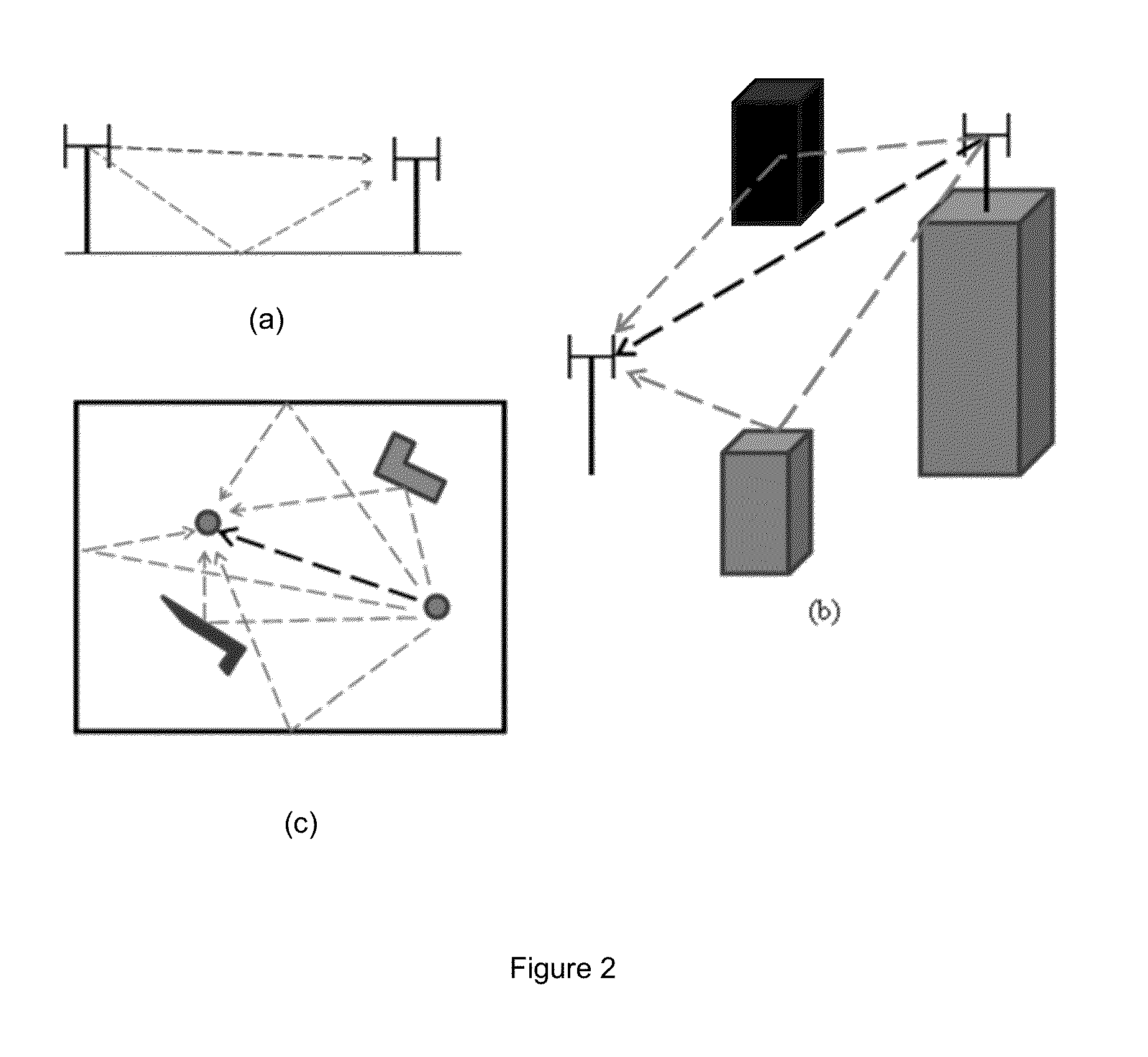
In a general LOS multipath environment the
mobile device will experience varying error behavior depending on the structure of the propagation environment and the
system bandwidth.
In NLOS conditions, however, there is an obstruction in the path of the
transmitter and
receiver.
The second NLOS case occurs when there is a “heavy” obstruction between the
transmitter and
receiver which attenuates the DP severely making it difficult for the receiver to detect it.
This results in a significant bias that corrupts the TOA estimation and ultimately the position estimate.
By adopting this traditional “black” or “white” approach, there is a
high probability of misclassifying NLOS conditions which reduces the robustness of NLOS identification and mitigation algorithms.
As the technology moves closer to dense urban environments and especially indoors, the localization performance degrades significantly.
The main challenge facing localization in harsh multipath environments (such as indoors) is the NLOS problem which introduces significant errors to the location estimation.
Although there are several state of the art NLOS identification techniques, their robustness and effectiveness are limited.



 Login to View More
  Login to View More