Part for a timepiece movement

a timepiece movement and movement technology, applied in the field of non-magnetic pivot pins, can solve the problems of affecting the working of the watch, and being magnetic, and achieve the effect of improving hardness

US9377760B2Active Publication Date: 2016-06-28OMEGA SA
25 Cites 4 Cited by

Patent Information

Authority / Receiving Office
US · United States
Patent Type
Patents(United States)
Current Assignee / Owner
Publication Date
2016-06-28

Smart Images

  • Figure 1
    Figure 1
  • Figure 2
    Figure 2
  • Figure 3
    Figure 3
Patent Text Reader

Abstract

The invention relates to a pivot pin for a timepiece movement including at least one pivot at at least one of the ends thereof, characterized in that said at least one pivot is formed of a composite material having a metallic matrix including at least one metal selected from among nickel, titanium, chromium, zirconium, silver, gold, platinum, silicon, molybdenum, aluminum or an alloy of the above metals, said matrix being charged with hard particles selected from among WC, TiC, TaC, TiN, TiCN, Al2O3, ZrO2, Cr2O3, SiC, MoSi2, Al N or a combination thereof, so as to limit the sensitivity of the pin to magnetic fields.The invention concerns the field of timepiece movements.
Need to check novelty before this filing date? Find Prior Art

Description

[0001] This application claims priority from European Patent application No. 13151671.8 filed Jan. 17, 2013, the entire disclosure of which is hereby incorporated by reference.FIELD OF THE INVENTION

[0002] The invention relates to a part for a timepiece movement and particularly to a non-magnetic pivot pin for a mechanical timepiece movement and more particularly to a non-magnetic escape pinion, balance staff and pallet staff.BACKGROUND OF THE INVENTION

[0003] The manufacture of a pivot pin for a timepiece consists in performing bar turning operations on a hardenable steel bar to define various active surfaces (shoulder, projecting portion, pivots, etc.) and then in subjecting the bar-turned pin to heat treatments including at least one hardening operation to improve the hardness of the pin and one or more tempering operations to improve the roughness. The heat treatment operations are followed by an operation of rolling the pin pivots, which consists in polishing the pivots to the requi...

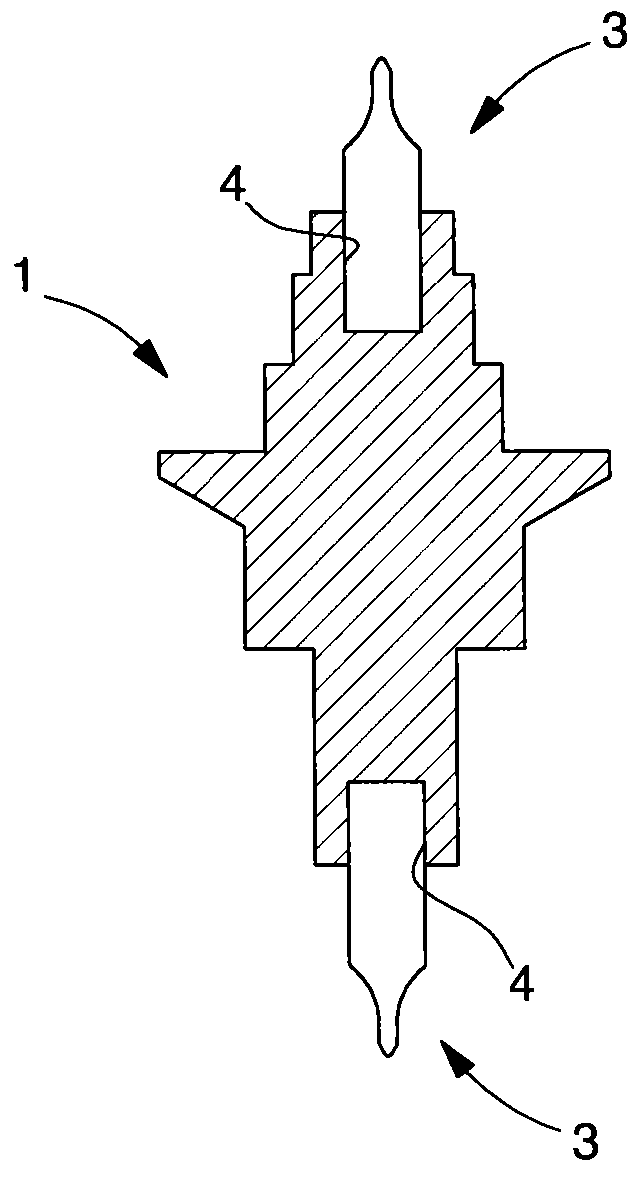
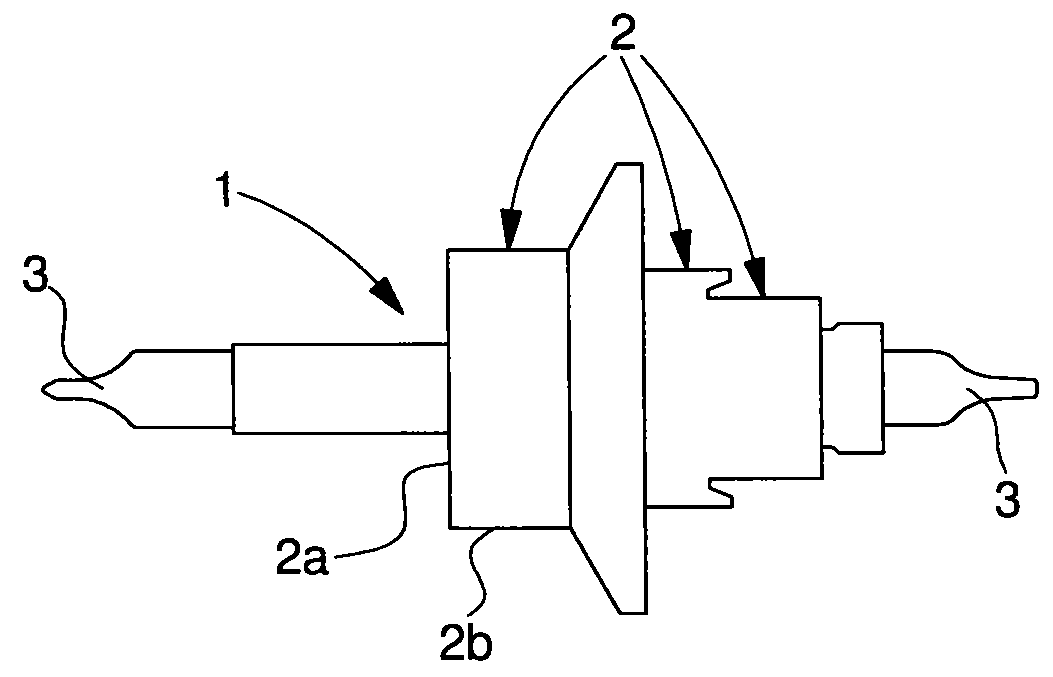
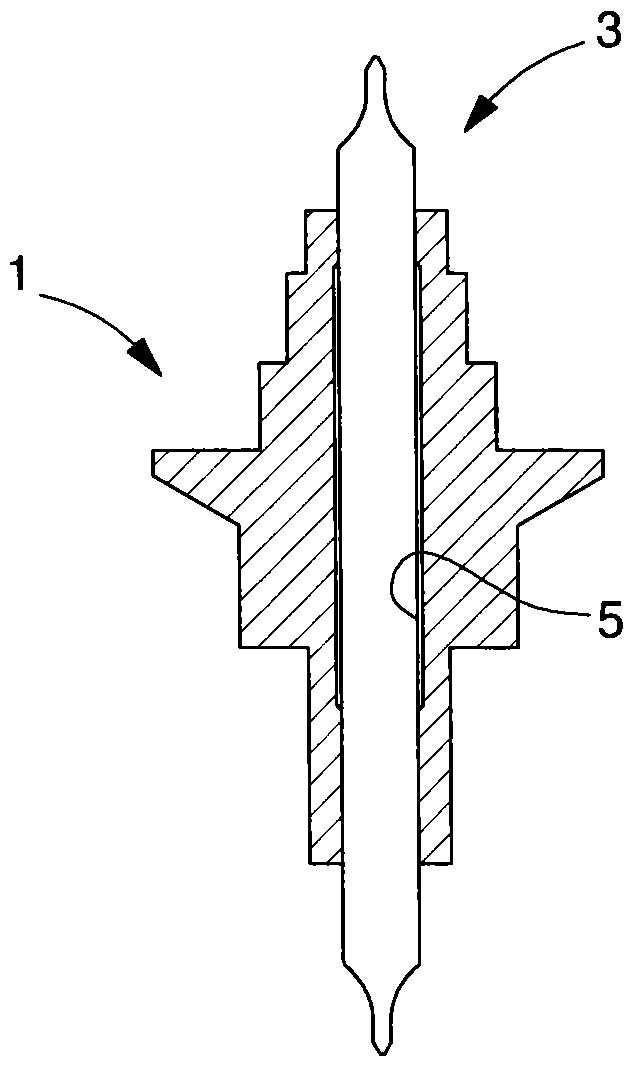
Examples

Embodiment Construction

[0025]The invention relates to a part for a timepiece movement and particularly to a non-magnetic pivot pin for a mechanical timepiece movement.

[0026]The invention will be described below with reference to an application to a non-magnetic balance staff 1. Of course, other types of timepiece pivot pins may be envisaged such as, for example, timepiece wheel set arbours, typically escape pinions or pallet staffs.

[0027]Referring to FIG. 1, there is shown a balance staff 1 according to the invention, which includes a plurality of sections 2 of different diameters conventionally defining shoulders 2a and projecting portions 2b arranged between two end portions defining pivots 3. These pivots are intended each to pivot in a bearing typically in an orifice in a jewel or ruby.

[0028]With the magnetism induced by objects that are encountered on a daily basis, it is important to limit the sensitivity of balance staff 1 to avoid affecting the working of the timepiece in which it is incorporated....