

Polymeric materials with antifouling, biocidal, antiviral and antimicrobial properties; elaboration method and its uses
a polymer material and antibacterial technology, applied in the field of polymer materials, can solve the problems of inability to achieve controlled release of ions in these samples, and evidence of the dependence of the amount of nanoparticles
- Summary
- Abstract
- Description
- Claims
- Application Information
AI Technical Summary
Benefits of technology
Problems solved by technology
Method used
Image

Examples
example 1
Preparation of a Polypropylene Resin with Metallic Copper Nanoparticles
[0076]Different polypropylene materials were prepared with metallic copper nanoparticles in different ratios.
[0077]A Brabender plasticorder mixer was used at 190° C., using stirring at 110 rpm for 10 minutes, in a controlled nitrogen atmosphere to avoid oxidative degradation during the process. During the stirring period, different amounts of copper nanoparticles, of average size 10 nanometers were added. The ratios of copper nanoparticles and thermoplastic material in the different materials were 0% (control) 1%, 5%, 10% and 20% w / w.
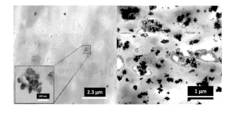
[0078]In particular, for example, the agglomerate density (D) for the resin of 5% w / w was 0.42 m since the average agglomerate number was 140 units, with an average volume of agglomerates of 268,000 cubic micrometers. The samples used for determination of these indexes were laminates of 0.1 mm thick, and a surface of 0.25 mm2 was analyzed, i.e., a volume of 0.025 mm3. At least 12 dif...
example 2
Preparation of a Polypropylene Resin with Metallic Copper Nanoparticles, which were Pre-Treated Using an Organic Solvent
[0079]Similarly to Example 1, different polypropylene materials were prepared with metallic copper nanoparticles in different ratios, using ethanol as solvent for pre-treatment of the nanoparticles. Nanoparticles, as in the previous example, had a size of 10 nanometers. The amount of nanoparticles in ethanol was determined in order to achieve the following ratios in the final thermoplastic resin: 0% (control) 1%, 5%, 10% y 20% weight / weight.
[0080]In this case, the agglomerate density (D) for the case of 5% w / w resin was 5.1. The average number of agglomerates in the sample was 90 units and the average volume of said agglomerates was 14,000 cubic micrometers.
[0081]FIG. 6A shows the comparison of the resin prepared according to Example 1 (direct addition) with the pre-treatment made with ethanol (pre-treated with solvent (ethanol)). It is clearly observed an increase...
example 3
Preparation of a Polypropylene Resin with Metallic Copper Nanoparticles, Pre-Treated by Incorporation to a Master-Batch
[0082]Similarly to example 1, different polypropylene materials were prepared with metallic copper nanoparticles in different ratios, using the incorporation of nanoparticles in a polypropylene master-batch using maleic anhydride as compatibilizer. Nanoparticles were incorporated in a ratio of 5% w / w in the masterbatch. Afterwards, the amount of nanoparticles was determined to reach the following rations in the final thermoplastic resin: 0% (control) 1%, 5%, 10% y 20% volume / volume. Nanoparticles, as well as in previous examples, had a size of 10 nm.
[0083]FIG. 6B shows the comparison of the resin prepared in Example 1 (direct addition) to the pre-treatment corresponding to preparation of a master-batch (pre-treatment master-batch (PPgAM)). It is clearly observed an increase in the release rate which is maintained during all the test period, and wherein it is clear t...
PUM
| Property | Measurement | Unit |
|---|---|---|
| sizes | aaaaa | aaaaa |
| sizes | aaaaa | aaaaa |
| sizes | aaaaa | aaaaa |
Abstract
Description
Claims
Application Information
 Login to View More