Filtrate reducer for oil field well drilling fluid
What is AI technical title?
AI technical title is built by Patsnap AI team. It summarizes the technical point description of the patent document.
A fluid loss reducer, oil field drilling technology, applied in drilling compositions, chemical instruments and methods, etc., can solve problems such as irreversible degradation, limited synergy between sulfomethyl lignite and lignosulfonate, and reduction in efficiency
Active Publication Date: 2009-08-12
CHINA PETROLEUM & CHEM CORP +1
View PDF3 Cites 0 Cited by
Summary
Abstract
Description
Claims
Application Information
AI Technical Summary
This helps you quickly interpret patents by identifying the three key elements:
Problems solved by technology
Method used
Benefits of technology
Problems solved by technology
However, field use shows that iron-chromium salts will lose their effectiveness at temperatures above 130°C, and irreversible degradation will occur when the temperature exceeds 177°C
Therefore the synergistic effect of sulfomethyl lignite and lignosulfonate is limited
Especially in the case of high temperature and high salt, the two will not be able to play a role due to their own shortcomings.
Method used
the structure of the environmentally friendly knitted fabric provided by the present invention; figure 2 Flow chart of the yarn wrapping machine for environmentally friendly knitted fabrics and storage devices; image 3 Is the parameter map of the yarn covering machine
View more
Image
Smart Image Click on the blue labels to locate them in the text.
Viewing Examples
Smart Image
Click on the blue label to locate the original text in one second.
Reading with bidirectional positioning of images and text.
Smart Image
Examples
Experimental program
Comparison scheme
Effect test
example 1
[0039] Get 100 grams of sulfomethyl lignite, dissolve in water, add 10 grams of sodium lignosulfonate, 3 grams of dimethyl diallyl ammonium chloride, 0.01 gram of ferric chloride (FeCl 3 ), and stir well.
[0040] Pour the solution into the reaction kettle (or directly mix in the reaction kettle), turn on the stirring, and react at 150°C for 2 hours, and the pressure is normal pressure. After the reaction, the product is a black liquid, and the product 1# is obtained after evaporating the water. The product is a black powder with good water solubility.
example 2
[0042] Take 100 grams of sulfomethyl lignite, dissolve it in water, add 25 grams of sodium lignosulfonate, 10 grams of dimethyl diallyl ammonium chloride, and 0.05 grams of ferric chloride, and stir evenly.
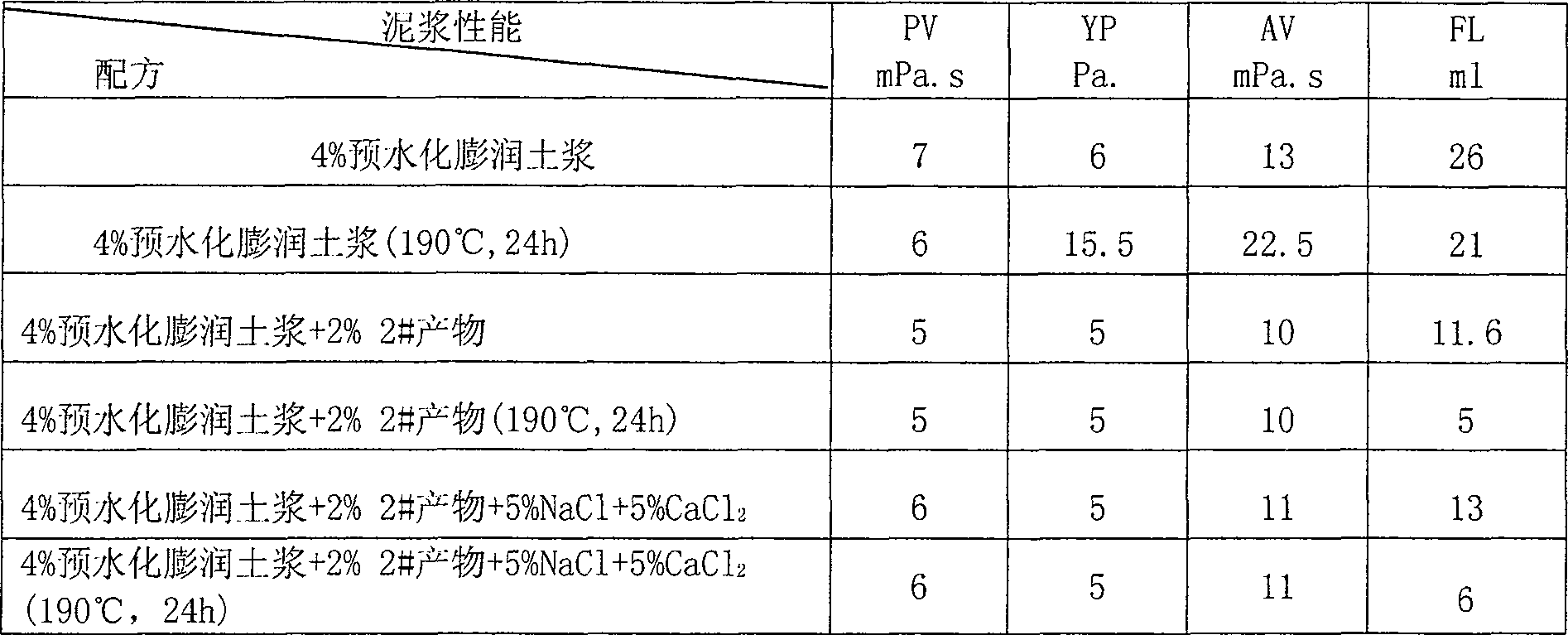
[0043] Pour the solution into the reaction kettle (or directly mix in the reaction kettle), turn on the stirring, and react at 120°C for 4 hours, and the pressure is normal pressure. After the reaction, the obtained product is a black liquid, and the product is obtained after evaporating the water. The product is black powder 2# and has good water solubility.
example 3
[0045] Take 100 grams of sulfomethyl lignite, dissolve it in water, add 50 grams of sodium lignosulfonate, 15 grams of dimethyl diallyl ammonium chloride, and 0.52 grams of ferric chloride, and stir evenly.
[0046] Pour the solution into the reaction kettle (or directly mix in the reaction kettle), turn on the stirring, and react at 85° C. for 6 hours, and the pressure is normal pressure. After the reaction, the obtained product is a black liquid, and the product is obtained after evaporating the water. The product is a black powder 3# with good water solubility.
the structure of the environmentally friendly knitted fabric provided by the present invention; figure 2 Flow chart of the yarn wrapping machine for environmentally friendly knitted fabrics and storage devices; image 3 Is the parameter map of the yarn covering machine
Login to View More
PUM
Login to View More
Abstract
The invention relates to a fluid loss reducer for oil field drilling fluid, a preparation method thereof, and an application of the treatment agent in preparing a drilling fluid system. The treatment agent uses the cationic monomer dimethyl diallyl ammonium chloride to graft sodium lignin sulfonate and sulfomethyl lignite under the trigger of FeCl3 to form a new high-temperature, salt-resistant, slump-proof and dehydration-resistant agent. The synthesized product combines the advantages of lignite and lignin, that is, it combines lignite's excellent resistance to temperature drop and water loss, and lignin's excellent resistance to salt and viscosity reduction. The introduction of cations improves the anti-slump inhibition, and Fe3+ The weak bonding effect of the product further improves the temperature resistance of the product on the basis of lignite. Therefore, this product can be widely used in drilling under various complex conditions such as high-temperature deep wells, salt-gypsum formations, serious water-sensitive formations, hard and brittle formations, etc., and has broad application prospects.
Description
technical field [0001] The invention relates to an additive for oilfield drilling fluid, more specifically, to a fluid loss reducer for oilfield drilling fluid. The treatment agent has the ability to resist high temperature and salt intrusion. technical background [0002] In oil drilling operations, when the drilling fluid flows through the permeable formation under pressure, it will infiltrate, causing the liquid phase of the drilling fluid to infiltrate into the formation. This process is collectively called "water loss". If water loss cannot be well controlled, a large amount of water loss entering the formation will not only induce wellbore instability, but also cause damage to oil and gas formations. At present, the effective way to solve this problem is to add fluid loss control agent in the drilling fluid. [0003] The fluid loss control agents used in oilfield drilling fluid mainly include the following types: [0004] (1) Special ultrafine particle materials, suc...
Claims
the structure of the environmentally friendly knitted fabric provided by the present invention; figure 2 Flow chart of the yarn wrapping machine for environmentally friendly knitted fabrics and storage devices; image 3 Is the parameter map of the yarn covering machine
Login to View More
Application Information
Patent Timeline
Application Date:The date an application was filed.
Publication Date:The date a patent or application was officially published.
First Publication Date:The earliest publication date of a patent with the same application number.
Issue Date:Publication date of the patent grant document.
PCT Entry Date:The Entry date of PCT National Phase.
Estimated Expiry Date:The statutory expiry date of a patent right according to the Patent Law, and it is the longest term of protection that the patent right can achieve without the termination of the patent right due to other reasons(Term extension factor has been taken into account ).
Invalid Date:Actual expiry date is based on effective date or publication date of legal transaction data of invalid patent.


 Login to View More
  Login to View More